
Strategic Implications of RLUSD Adoption by BlackRock and VanEck for Institutional On-Chain Infrastructure
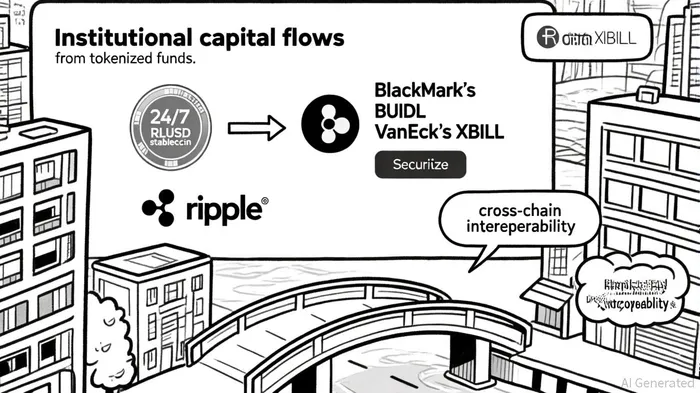
The integration of Ripple's RLUSD stablecoin into BlackRock's BUIDL and VanEck's VBILL tokenized funds marks a pivotal shift in institutional on-chain infrastructure. By enabling real-time, 24/7 liquidity through smart contracts, this collaboration redefines how traditional financial institutions interact with digital assets. For investors, it signals a maturation of the tokenized asset market and underscores the growing role of stablecoins as foundational infrastructure for hybrid financial systems.
A New Era of Institutional Liquidity
BlackRock's BUIDL fund, launched in March 2024, has already surpassed $2 billion in assets under management (AUM), while VanEck's VBILL tokenized U.S. Treasury-backed product has reached $74 million in AUM [1]. These figures reflect institutional confidence in tokenized real-world assets (RWAs). However, liquidity—traditionally constrained by market hours and settlement delays—has remained a barrier. Ripple's RLUSD, a regulated, USD-backed stablecoin, now serves as an off-ramp for these funds, allowing investors to instantly convert tokenized shares into stablecoin. This integration, facilitated by Securitize's tokenization platform, provides continuous liquidity and enhances on-chain flexibility [3].
The strategic implications are profound. For institutions, RLUSD offers a bridge between tokenized assets and DeFi strategies, enabling exposure to on-chain yield without sacrificing regulatory clarity. Ripple's SVP of Stablecoins, Jack McDonald, emphasizes that RLUSD is “built for institutional use,” with full transparency and compliance with U.S. and EU standards [2]. This is critical in an era where regulatory scrutiny of crypto assets remains high.
Regulatory Clarity as a Competitive Advantage
Regulatory developments in 2024–2025 have accelerated the adoption of tokenized assets. RLUSD's design—backed 1:1 by U.S. dollars and secured by custodial services from BNY Mellon—addresses institutional concerns about stability and compliance [3]. BNY Mellon's involvement adds a layer of trust, as it provides institutional-grade custody for RLUSD reserves, ensuring transparency and adherence to both U.S. and EU regulatory frameworks [3].
This regulatory clarity differentiates RLUSD from other stablecoins, which have faced scrutiny over reserve composition and governance. For BlackRockBLK-- and VanEck, adopting RLUSD aligns with their cautious approach to digital assets, allowing them to offer tokenized products without exposing clients to the volatility or compliance risks of unregulated stablecoins.
Technological Advancements and Market Structure
The RLUSD integration also highlights technological advancements in cross-chain interoperability. Ripple's multi-chain strategy, which includes future expansion to the XRPXRP-- Ledger (XRPL) and EVM Sidechain, aims to make RLUSD a universal liquidity tool. By leveraging platforms like AxelarAXL-- and WormholeW--, RLUSD can facilitate cross-chain transactions, further enhancing its utility for institutional investors [1].
This interoperability reshapes market structure. Traditionally, institutional investors have relied on centralized intermediaries for settlement and liquidity. With RLUSD, settlements occur on-chain in real time, reducing counterparty risk and operational costs. For example, investors in BUIDL or VBILL can now swap tokenized shares for RLUSD instantly, bypassing the need for traditional market hours or intermediaries [4].
Strategic Expansion and Future Outlook
Ripple's collaboration with Securitize, which now supports $4 billion in tokenized RWAs, underscores the scalability of this model. As more institutions tokenize assets—from real estate to corporate bonds—the demand for stable, regulated liquidity tools like RLUSD will grow. Analysts project that RLUSD's deflationary mechanics, tied to XRP's ecosystem, could further drive adoption, particularly as hybrid financial systems emerge [1].
For investors, the adoption of RLUSD by BlackRock and VanEck signals a broader trend: the convergence of traditional finance and decentralized infrastructure. This integration not only enhances liquidity but also paves the way for more sophisticated on-chain strategies, such as collateralized lending and yield farming, while maintaining regulatory compliance.
Conclusion
The adoption of RLUSD by BlackRock and VanEck represents more than a technical upgrade—it is a strategic repositioning of institutional finance in the digital age. By providing 24/7 liquidity, regulatory clarity, and cross-chain interoperability, RLUSD addresses key pain points for institutional investors. As tokenized assets become a larger portion of institutional portfolios, stablecoins like RLUSD will serve as the rails for a new financial ecosystem, blending the best of traditional and decentralized markets.





Comentarios
Aún no hay comentarios