
The Strategic Implications of Paramount's Reaffirmed $30 WBD Bid for PSKY Stock
The ongoing battle for control of Warner Bros.WBD-- Discovery (WBD) has escalated into a high-stakes clash between Paramount SkydancePSKY-- (PSKY) and NetflixNFLX--, with profound implications for merger arbitrage strategies and shareholder value creation. As of December 2025, Paramount has reaffirmed its $30-per-share all-cash offer for WBDWBD--, a bid it claims is structurally superior to WBD's existing merger agreement with Netflix, which values shares at $27.75 according to Paramount's announcement. This $2.25-per-share arbitrage spread reflects the market's assessment of the probability of either deal closing, but it also underscores a deeper strategic debate: Is Paramount's leveraged bid a bold reimagining of media consolidation, or a risky overreach that could destabilize WBD's value?
The Financing and Regulatory Landscape
Paramount's offer is fully financed, with $40.65 billion in equity commitments backed by an irrevocable personal guarantee from Larry Ellison. The company has secured debt financing from Bank of America, Citibank, and Apollo Capital Management, signaling institutional confidence in the $108.4 billion acquisition. However, WBD's board has rejected the bid as "inadequate," citing concerns over the lack of "unconditional backing" from the Ellison family and the risks of a debt-laden structure according to board statements. This skepticism is compounded by regulatory headwinds: U.S. lawmakers have urged WBD to file with the Committee on Foreign Investment in the United States (CFIUS) due to the involvement of Middle Eastern sovereign wealth funds in Paramount's financing as reported.
In contrast, WBD's Netflix deal-a $82.7 billion acquisition of WBD's streaming and studio assets-includes a mix of cash, stock, and a stake in the Discovery Global spin-off as detailed. While WBD's board argues this structure provides "greater certainty," critics highlight the Netflix deal's valuation of Discovery Global as a "black box" with potential downside risks according to Paramount's analysis.
Merger Arbitrage: A Game of Probabilities
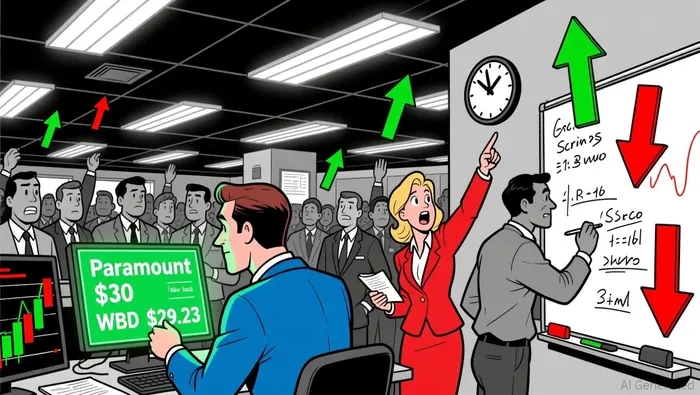
The $2.25 arbitrage spread between Paramount's $30 offer and WBD's current stock price of $29.23 has created a fertile ground for merger arbitrageurs. According to probabilistic modeling, this spread implies a market-implied probability of Paramount's deal closing at approximately 60%. Investors who take a long position in WBD shares and hedge with short positions in PSKYPSKY-- or Netflix (NFLX) are essentially betting on the likelihood of regulatory approval or a bidding war driving up the price.
However, the risks are asymmetric. If Paramount's bid fails, WBD's stock could fall to a "fallback price" of $25–$26, reflecting the perceived value of its standalone operations or a revised Netflix deal as projected. Conversely, a successful Paramount acquisition would deliver immediate liquidity to shareholders, while a Netflix victory could lock in long-term value through Netflix's stock appreciation and Discovery Global's potential.
Shareholder Value: Cash vs. Equity, Certainty vs. Ambiguity
Paramount's all-cash offer is a double-edged sword. On one hand, it provides immediate and unambiguous value to shareholders, eliminating the execution risks inherent in the Netflix deal's complex structure. On the other, the leveraged nature of the bid exposes WBD to refinancing risks and potential asset sales to service debt-a scenario that could erode long-term value. WBD's board has emphasized that the Netflix deal preserves "operational flexibility" and avoids the "catastrophic failure" risks of a leveraged buyout according to board documentation.
Yet, major WBD shareholders have questioned the board's stance, arguing that Paramount's offer represents a "superior and more certain path". This divide highlights a broader tension in corporate governance: Should boards prioritize short-term certainty or long-term strategic flexibility? For merger arbitrageurs, the answer lies in the interplay of regulatory outcomes, financing stability, and market sentiment.
Strategic Implications for PSKY
Paramount's stock (PSKY) is also a key player in this drama. A successful WBD acquisition would significantly expand Paramount's media empire, creating a $108.4 billion entertainment giant with combined streaming, film, and cable assets. However, the $30-per-share WBD bid consumes a large portion of Paramount's liquidity, leaving limited room for error in its financing structure as stated. If the deal collapses, PSKY could face a liquidity crisis, triggering a sell-off in its shares.
For investors, this creates a binary scenario: a high-reward, high-risk bet on Paramount's ability to navigate regulatory and financing hurdles, versus a more conservative approach aligned with WBD's Netflix deal. The latter path, while offering lower upside, may appeal to risk-averse investors who prioritize stability over speculative gains.
Conclusion
The WBD bidding war is a masterclass in strategic ambiguity. Paramount's $30-per-share offer represents a bold, all-in bet on media consolidation, while WBD's Netflix deal prioritizes certainty at the expense of potential upside. For merger arbitrageurs, the $2.25 spread is both an opportunity and a warning-a reflection of the market's belief in Paramount's vision, tempered by skepticism about its execution. As the battle unfolds, the key variables will be regulatory outcomes, financing stability, and the possibility of a "White Knight" entering the fray. In this high-stakes game, the winners will be those who can accurately price the probabilities-and the losers, those who misread the odds.





Comentarios
Aún no hay comentarios