
The Strategic Implications of JUP Stakers Receiving a MET Airdrop at TGE
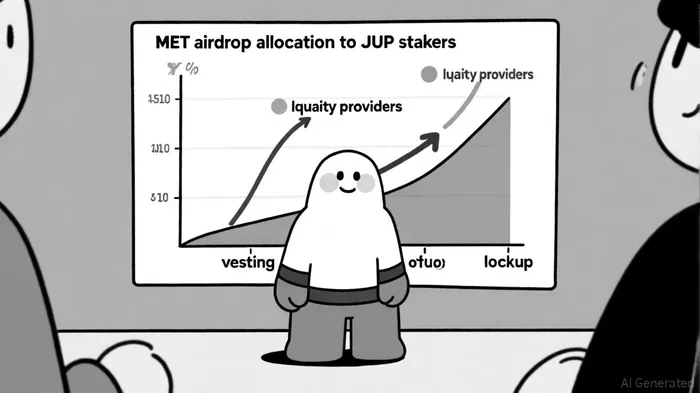
The impending Token Generation Event (TGE) for Meteora's native token, MET, in October 2025, marks a pivotal moment for Solana's DeFi ecosystem. Central to this event is the airdrop strategy targeting JUPJUP-- stakers, a move designed to decentralize token distribution while incentivizing long-term participation. This analysis explores the strategic implications of this airdrop, focusing on token distribution mechanics and its potential to drive network value accrual.
Token Distribution Dynamics: Allocation and Vesting
Meteora's airdrop allocates 15% of the total MET supply at TGE to early liquidity providers (LPs) and active participants, with an additional post-TGE points campaign to distribute remaining tokens over time [1]. For JUP stakers, the allocation appears to be embedded within this framework, though exact percentages remain ambiguous. Some proposals suggest JUP stakers could receive 10–15% of the airdrop based on staked JUP volume and duration [2], while others hint at a broader 25% allocation for liquidity incentives [3].
The vesting structure is equally critical. While Meteora has not explicitly outlined lockup terms for JUP stakers, the broader airdrop emphasizes time-weighted rewards and one-year lockups for veMET [4]. This aligns with Jupiter's own staking incentives, where JUP stakers face delayed claim options (e.g., 3–9 month vesting periods with penalties for early withdrawal) [5]. By extending these principles to MET, Meteora aims to mitigate sell pressure and reward sustained engagement.
Network Value Accrual: Incentives and Ecosystem Growth
The airdrop's design reflects a dual focus on liquidity provision and governance participation. JUP stakers are incentivized to deposit liquidity into Meteora's Dynamic Liquidity Market MakerMKR-- (DLMM) pools, earning MET points alongside Kamino and JupiterJUP-- rewards [6]. This triple-stacking mechanism not only boosts individual returns but also deepens Meteora's liquidity reserves, enhancing its appeal to traders and developers.
Moreover, the airdrop's tiered multiplier model (1.0x to 0.7x) ensures that small-to-medium LPs are fairly rewarded, curbing sybil attacks and fostering a decentralized user base [7]. By prioritizing real-world activity over speculative farming, Meteora reduces the risk of token concentration, a common pitfall in airdrop-driven ecosystems.
Strategic Risks and Opportunities
While the airdrop's structure is robust, risks persist. Ambiguity around JUP stakers' exact allocation percentage could lead to uneven participation, particularly if larger stakers dominate rewards. Additionally, the absence of explicit lockup terms for JUP stakers might result in short-term dumping post-TGE, undermining price stability.
However, the integration of Active Staking Rewards (ASR) and governance voting incentives offers a counterbalance. For instance, Jupiter's ASRASR-- program distributes tokens quarterly to stakers who engage in governance, a model Meteora could adopt to further align incentives [8]. Such measures would ensure that token distribution remains tied to active contribution, reinforcing network value over time.
Conclusion
Meteora's MET airdrop represents a calculated effort to decentralize token ownership while fostering long-term liquidity provision. By targeting JUP stakers with layered incentives and vesting schedules, the project aims to create a self-sustaining ecosystem where value accrues to active participants. However, the success of this strategy hinges on clear communication of allocation percentages and lockup terms, as well as ongoing engagement through governance and ASR programs. For investors, the airdrop's execution will be a key indicator of Meteora's ability to deliver on its vision of a robust Solana-based DeFi infrastructure.






Comentarios
Aún no hay comentarios