
The Strategic Implications of U.S. Government Bitcoin Holdings and Sales
The U.S. government's foray into BitcoinBTC-- as a strategic asset has reshaped the digital asset landscape in 2025, with profound implications for market dynamics and institutional trust. President Donald J. Trump's March 2025 executive order establishing the Strategic Bitcoin Reserve (SBR) and U.S. Digital Asset Stockpile marked a pivotal shift, positioning Bitcoin as a sovereign reserve asset and signaling a long-term commitment to digital finance leadership. This analysis examines the market impact of these developments, the evolving institutional credibility of U.S. digital asset strategy, and the broader implications for investors.
The Strategic Bitcoin Reserve: A New Era of Sovereign Holdings
The SBR, formalized under H.R.2032-the BITCOIN Act of 2025-aims to acquire 200,000 BTC annually for five years, totaling 1,000,000 BTC, with a minimum 20-year holding period to ensure stability according to the bill. This initiative builds on the government's existing holdings, which surged to $36 billion (325,000 BTC) in 2025, largely from the seizure of 127,271 BTC in a historic Department of Justice forfeiture. By treating Bitcoin as a reserve asset akin to gold, the U.S. has legitimized its role in global finance, reducing perceived volatility and encouraging institutional adoption.
The SBR's emphasis on cold storage and long-term stewardship contrasts sharply with past practices, where premature sales reportedly cost taxpayers $17 billion. This shift reflects a strategic pivot toward treating Bitcoin as a store of value rather than a short-term asset, aligning with broader efforts to position the U.S. as a global leader in digital finance.
Market Impact: Volatility, Institutional Adoption, and the "Sovereign Air Cover" Effect
The establishment of the SBR has had a transformative effect on market perception. By 2025, over 30% of Bitcoin's circulating supply was held by centralized entities, including governments, exchanges, and institutional investors according to BitGo. The U.S. government's adoption of a "Sovereign Air Cover" strategy-backed by the repeal of SAB 121 and the GENIUS Act-has further reinforced Bitcoin's legitimacy, enabling corporations to allocate Bitcoin to treasuries as a hedge against inflation. 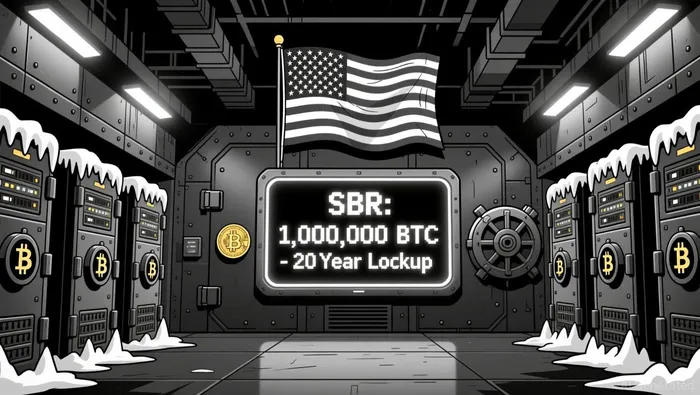
However, the market has not been immune to volatility. Bitcoin reached an all-time high of $126,000 in October 2025 but subsequently lost 30% of its value, driven by leveraged positions and external shocks like Trump's tariff threats. This correction underscores the tension between Bitcoin's newfound institutional credibility and its inherent price sensitivity to macroeconomic and geopolitical factors.
The SBR's long-term holding mandate, however, may mitigate supply-side pressures. By locking away 1,000,000 BTC for two decades, the U.S. could reduce market liquidity, potentially driving long-term price appreciation. This dynamic mirrors central bank gold reserves, where scarcity and strategic allocation reinforce value over time.
Institutional Trust: Regulatory Clarity and the Path to Mainstream Adoption
The Trump administration's digital asset strategy has prioritized regulatory clarity, a cornerstone of institutional trust. The January 2025 executive order, "Strengthening American Leadership in Digital Financial Technology," replaced the Biden-era framework and emphasized technology-neutral regulations, supporting innovation while protecting consumers. Key outcomes include:
- Jurisdictional Clarity: The Working Group on Digital Asset Markets' July 2025 report outlined 100 recommendations to define SEC-CFTC boundaries, enabling digital assets to transition from securities to commodities as networks decentralize.
- Stablecoin Framework: The GENIUS Act, signed into law, established a 1:1 reserve requirement for stablecoins, monthly audits, and anti-money laundering compliance, addressing systemic risks.
- Pro-Innovation Appointments: Figures like SEC Chair Paul Atkins and Special Advisor David Sacks have signaled a shift toward fostering innovation, with the SEC's Crypto Task Force and CFTC's supportive stance further bolstering confidence according to BitGo.
These measures have catalyzed institutional adoption. Over 80% of reviewed jurisdictions saw financial institutions announce digital asset initiatives in 2025, including custody solutions and tokenization services according to Certik. The Basel Committee's reassessment of prudential rules for crypto exposures also reflects a global softening of regulatory attitudes, further legitimizing the U.S. approach.
Challenges and Unanswered Questions
Despite progress, challenges persist. The management of seized Bitcoin-such as the $15 billion forfeiture from the Prince Group-raises questions about valuation, custody, and transparency. Additionally, while the SBR's long-term holding strategy reduces short-term market volatility, it does not eliminate risks from macroeconomic shifts, such as the Federal Reserve's rate cuts in late 2024 and early 2025, which influenced both traditional and crypto markets.
Institutional trust metrics remain mixed. While regulatory clarity has spurred adoption, the October 2025 crash highlighted vulnerabilities in leveraged positions and market sentiment. Analysts like Mike McGlone of Bloomberg Intelligence caution that Bitcoin could face a sharp reversal toward $50,000 in 2026 as risk assets normalize.
Conclusion: A Strategic Asset in a New Financial Order
The U.S. government's Bitcoin strategy represents a bold reimagining of digital assets as sovereign reserves. By combining long-term holdings, regulatory clarity, and institutional adoption, the SBR has positioned Bitcoin as a cornerstone of U.S. financial leadership. For investors, this signals a maturing market where Bitcoin's role evolves from speculative asset to strategic reserve. However, the path forward remains contingent on navigating macroeconomic uncertainties, regulatory nuances, and the delicate balance between innovation and stability.
As the Trump administration's policies continue to shape the landscape, the coming years will test whether the U.S. can sustain its leadership in digital finance-or if the global market will pivot toward alternative models. For now, the SBR stands as a testament to the transformative power of strategic vision in an era of digital disruption.






Comentarios
Aún no hay comentarios