
Strategic Implications of EU Local Content Requirements on European Auto and EV Supply Chains
The European Union's evolving industrial strategy, centered on local content requirements for automotive and electric vehicle (EV) supply chains, is reshaping the competitive landscape for European manufacturers and suppliers. As the bloc seeks to counter global challenges-particularly the rise of Chinese EV production and trade uncertainties-policymakers are prioritizing domestic industrial sovereignty. This shift presents both risks and opportunities for investors, particularly in resilient European automotive suppliers adapting to the 2025 policy framework.
The Rationale Behind Local Content Requirements
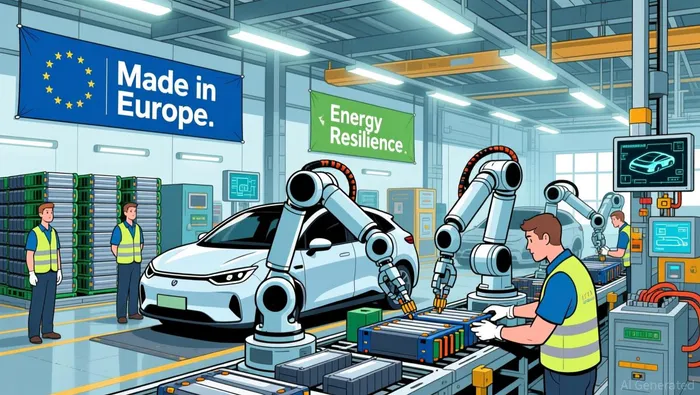
The EU's push for local content rules is driven by a dual mandate: safeguarding competitiveness and ensuring energy and supply chain resilience. The Industrial Accelerator Act, proposed on December 10, 2025, mandates that a significant portion of vehicle components be produced within the EU, with some industry leaders advocating for a minimum 80% local content threshold. Valeo's CEO, for instance, has explicitly supported this target, arguing it would preserve Europe's industrial leadership in adjacent technologies like battery manufacturing and autonomous driving.
 However, the policy faces scrutiny. Critics, including German stakeholders, warn that rigid local content rules could stifle innovation and create regulatory burdens. Legal challenges under WTO rules also loom, particularly under the Agreement on Subsidies and Countervailing Measures (ASCM) according to industry analysis. Despite these concerns, the EU remains committed to a phased, technology-open approach, as emphasized by the European Automobile Manufacturers' Association, to balance competitiveness with supply chain adaptability.
Corporate Fleets as a Catalyst for Demand
A critical component of the EU's strategy is the Clean Corporate Vehicles legislation, which imposes binding zero-emission vehicle targets on large corporate fleets. By 2026, all new corporate vehicles must be zero-emission, with member states like Germany, France, and the Netherlands required to procure 37.4% to 38.5% of clean light-duty vehicles annually until 2030. Corporate fleets, which account for nearly 60% of new car registrations in the EU, are seen as a linchpin for decarbonization due to their high turnover rates according to industry analysis.
Eurelectric has further recommended extending binding ZEV targets to all corporate purchases by 2030, ensuring a sustained demand for EU-produced EVs. This policy lever not only accelerates EV adoption but also aligns with the EU's broader goal of boosting demand for "Made-in-EU" vehicles, which are currently preferred in corporate procurement.
Resilience Strategies Among European Suppliers
European automotive suppliers are recalibrating their strategies to meet the 2025 local content requirements. A McKinsey report underscores the need for €200–300 billion in targeted investments by 2035 to secure the industry's future, emphasizing resilience through localized value chains and reduced reliance on external regions. Battery suppliers, in particular, are advocating for local content rules to strengthen domestic production of critical components.
However, high energy and labor costs, coupled with fragmented regulatory frameworks, pose significant challenges. A Roland Berger study commissioned by CLEPA highlights a 15–35% cost disadvantage for European suppliers compared to global competitors. To mitigate this, Renault Group has proposed a flexible approach: an averaged local content threshold of 60% across a manufacturer's sales portfolio, rather than rigid per-model rules according to industry reports. This model aims to balance industrial sovereignty with cost competitiveness, addressing concerns raised by German automakers as reported by Reuters.
Investment Opportunities in Resilient Suppliers
The transition to localized supply chains creates compelling investment opportunities in suppliers that are proactively retooling their operations. Key areas of focus include:
1. Battery and Component Manufacturing: European battery suppliers are positioning themselves to meet the EU's demand for locally produced cells, with the Commission allocating €1 billion through the Horizon Europe Programme to support this shift.
2. Digitalization and R&D: Suppliers investing in software development and autonomous driving technologies-such as Valeo-are well-positioned to capitalize on the EU's emphasis on innovation according to industry analysis.
3. Infrastructure and Energy Solutions: As the EU seeks to reduce energy costs-a major pain point for manufacturers-suppliers offering grid optimization or renewable energy integration could see heightened demand according to policy analysis.
Risks and the Need for Policy Balance
While local content requirements aim to protect jobs and domestic production, they risk fragmenting supply chains and inflating costs. The EU's battery supply chain, for instance, remains underdeveloped compared to China's, with European battery prices 20% higher. Policymakers must also navigate the tension between protectionism and global trade norms, ensuring that local content rules do not trigger WTO disputes.
A balanced approach, as advocated by ACEA, involves combining phased-in local content thresholds with demand-side incentives, such as buy-European clauses in subsidies. This dual strategy could stimulate domestic production while avoiding the pitfalls of overregulation.
Conclusion
The EU's 2025 local content requirements represent a pivotal moment for European automotive and EV suppliers. While challenges such as high costs and regulatory complexity persist, the policy framework creates a clear pathway for resilient suppliers to thrive. Investors should prioritize companies that align with the EU's industrial strategy-those investing in localization, innovation, and energy efficiency-while remaining mindful of the need for policy flexibility. As the automotive sector evolves, the ability to adapt to these strategic shifts will define the next era of European industrial competitiveness.







Comentarios
Aún no hay comentarios