
The Strategic Implications of U.S. Crypto Market Structure Reform for Institutional Investors
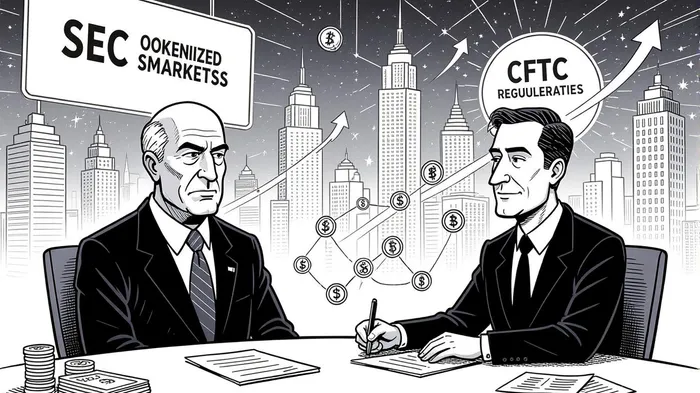
The U.S. crypto market is undergoing a seismic shift as regulatory clarity emerges from the collaborative efforts of the Securities and Exchange Commission (SEC) and Commodity Futures Trading Commission (CFTC). For institutional investors, this evolving landscape—marked by tokenization advancements and a clearer division of regulatory responsibilities—represents a golden opportunity to unlock capital, reduce risk, and pioneer new financial products.
Regulatory Clarity: A Foundation for Institutional Confidence
The 2025 reforms, including the Responsible Financial Innovation Act and the Digital Asset Market Clarity Act (CLARITY Act), have begun to resolve the long-standing ambiguity over whether crypto assets are securities or commodities. The Senate’s proposed joint advisory committee between the SEC and CFTC aims to harmonize oversight, ensuring that digital assets are regulated proportionally to their risks while fostering innovation [1]. For example, tokenized equities are now explicitly classified as securities under the SEC’s jurisdiction, aligning them with traditional stocks and enabling seamless integration into existing financial infrastructure [2]. This clarity eliminates the regulatory “no man’s land” that previously deterred institutional participation.
The SEC’s Project Crypto and the CFTC’s Crypto Sprint further reinforce this shift. By modernizing custody rules, clarifying token classification, and enabling spot trading on regulated exchanges, these initiatives create a predictable environment for institutions to deploy capital. As stated by SEC Commissioner Hester Peirce, tokenization does not alter the fundamental nature of an asset but enhances its utility—facilitating faster settlement, improved collateral efficiency, and broader access to markets [3].
Tokenization: A Catalyst for Market Innovation
Tokenization is no longer a theoretical concept—it’s a reality. Post-2025, major financial institutionsFISI-- like Goldman SachsGS--, JPMorganJPM--, and BlackRockBLK-- have launched tokenized products, including U.S. Treasuries, private equity funds, and even real-world assets (RWAs) such as real estate and infrastructure [4]. JPMorgan’s Project Guardian pilot, for instance, simulates DeFi-style trading of tokenized bonds and foreign exchange using public blockchains, demonstrating how traditional finance can harness blockchain’s efficiency [5].
The economic potential is staggering. Tokenized assets are projected to grow from $300 billion in 2025 to $18.9 trillion by 2033, driven by institutional demand for liquidity and 24/7 trading [6]. This growth is further accelerated by the SEC’s proposed Micro-Innovation Sandbox, which allows firms to test tokenization products under limited exemptions, reducing the cost of compliance for early-stage projects [7].
Institutional Adoption: From Hesitation to Hyper-Scaling
Institutional capital flows have already begun to reflect this new paradigm. U.S. public companies now hold over 3.7 million ETH and 1 million BTC, treating crypto as a corporate treasury asset [8]. Meanwhile, ETH ETFs have attracted $3.8 billion in inflows, outpacing BTC ETFs—a sign that investors are prioritizing utility-driven assets like EthereumETH-- [9].
The U.S. Treasury’s commitment to acquiring BTC in budget-neutral ways and the FDIC’s rescission of prior crypto restrictions further signal a regulatory environment conducive to institutional participation [10]. For example, the FDIC now allows supervised banks to engage in crypto activities without prior approval, a move that could democratize access to tokenized assets for retail investors through traditional banking channels [11].
Strategic Implications for Institutional Investors
For institutions, the post-2025 landscape offers three key advantages:
1. Capital Efficiency: Portfolio margining frameworks under consideration by the SEC and CFTC could allow institutions to net exposures across regulated platforms, improving liquidity and reducing capital requirements [12].
2. Product Diversification: The CFTC’s exploration of spot crypto trading on exchanges and the SEC’s focus on tokenized RWAs open new avenues for structured products, such as tokenized bonds and synthetic assets [13].
3. Global Leadership: By aligning with the White House’s Strengthening American Leadership in Digital Financial Technology executive order, U.S. institutions position themselves to dominate a sector projected to reshape global finance [14].
Conclusion
The U.S. crypto market is no longer a Wild West of speculation. Regulatory clarity, tokenization, and institutional adoption are converging to create a robust ecosystem where innovation thrives. For investors, this means opportunities to capitalize on a $18.9 trillion tokenized asset market, while for the U.S., it represents a chance to lead the next financial revolution. As the lines between traditional and digital finance blur, the institutions that act now will define the future of capital markets.
Source:
[1] Senate market structure bill draft proposes SEC–CFTC joint committee to end crypto turf wars [https://www.theblock.co/post/369716/senate-market-structure-bill-draft-proposes-sec-cftc-joint-committee-to-end-crypto-turf-wars]
[2] Senate Crypto Bill Clarifies Tokenized Stocks Will Remain Securities [https://bravenewcoin.com/insights/senate-crypto-bill-clarifies-tokenized-stocks-will-remain-securities]
[3] Launching Tokenized Stocks & U.S. Securities Regulators Openness to Discussing Tokenized Securities [https://faruqilaw.com/blog/1053/token-talks-launching-tokenized-stocks-u-s-securities-regulators-openness-to-discussing-tokenized-securities/]
[4] Real-World Assets in Onchain Finance Report - RedStone blog [https://blog.redstone.finance/2025/06/26/real-world-assets-in-onchain-finance-report/]
[5] Traditional institutions embrace the crypto industry timeline [https://www.panewslab.com/en/articles/lxpvl6pd]
[6] Here's how tokenization is igniting innovation in financial... [https://rsmus.com/insights/industries/financial-services/heres-how-tokenization-is-igniting-innovation-in-financial-marke.html]
[7] White House, SEC provide roadmaps for advancing crypto, Carta [https://carta.com/blog/policy-weekly-08-01-25/]
[8] Market Update (August 2025) [https://crypto.com/en/research/market-update-aug-2025]
[9] BitcoinBTC-- 2025-2026 Macro Analysis: Policy, Institutional Flows, and Strategic Positioning [https://papers.ssrn.com/sol3/Delivery.cfm/5232018.pdf?abstractid=5232018&mirid=1]
[10] The Coming of Age of Digital Assets: Key Policy [https://businesslawtoday.org/2025/08/the-coming-of-age-of-digital-assets-key-policy-regulatory-and-legal-considerations/]
[11] Joint Statement from the Chairman of the SEC and Acting Chairman of the CFTC [https://www.cftc.gov/PressRoom/SpeechesTestimony/phamatkinsstatement090525]
[12] SEC and CFTC Staff Issue Joint Statement on Digital AssetDAAQ-- Commodity Transactions [https://www.troutmanfinancialservices.com/2025/09/sec-and-cftc-staff-issue-joint-statement-on-digital-asset-commodity-transactions/]
[13] Crypto Policy Under Trump: H1 2025 Report, Galaxy DigitalGLXY-- [https://www.galaxy.com/insights/research/crypto-policy-under-trump-administration]
[14] 2025 regulatory preview: Understanding the new US [https://www.statestreet.com/us/en/insights/digital-digest-march-2025-digital-assets-ai-regulation]







Comentarios
Aún no hay comentarios