
The Strategic Implications of U.S. Control Over Venezuelan Oil for Energy and Bitcoin Mining Sectors
The U.S. military intervention in Venezuela and its subsequent control over the country's oil infrastructure mark a pivotal shift in global energy dynamics, with cascading implications for energy-intensive industries like BitcoinBTC-- mining. By examining the interplay between geopolitical strategy, energy pricing, and technological innovation, this analysis explores how U.S. actions in Venezuela could create cost advantages for sectors reliant on affordable energy.
Geopolitical Reconfiguration and Energy Pricing
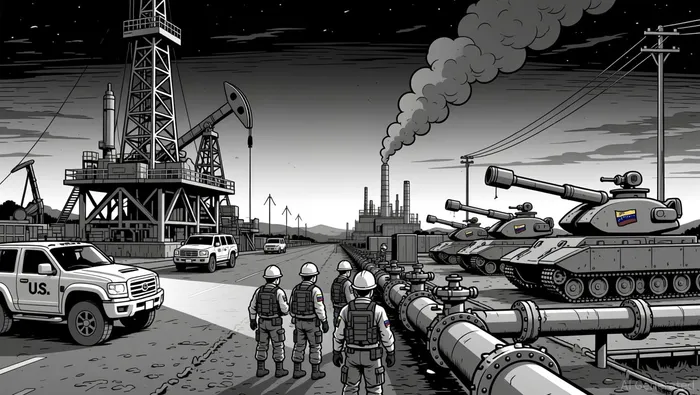
The U.S. has long sought to reshape Venezuela's political and economic landscape through sanctions targeting its oil sector. These measures, which evolved from financial restrictions to physical enforcement mechanisms like maritime interdictions of oil tankers, have reduced Venezuela's oil production to approximately 1 million barrels per day-far below its peak of 3.5 million barrels per day. The U.S. now aims to revitalize Venezuela's oil infrastructure, with President Donald Trump pledging billions in investments to restore production and secure access to the country's 303 billion-barrel reserves. Analysts at JP Morgan suggest this could position the U.S. to control roughly 30% of the world's total oil reserves, reshaping global energy markets.
The immediate impact of U.S. intervention has been volatility in oil prices. Following the capture of President Nicolás Maduro in late 2025, Brent crude surged by 5%, reflecting uncertainty over Venezuela's future production capacity and infrastructure stability. However, long-term projections indicate that increased U.S. investment could stabilize supply and lower energy costs. For instance, revitalizing Venezuela's heavy crude production-critical for diesel-could reduce global dependence on Russian oil and ease supply constraints in refining markets. This shift could indirectly benefit energy-intensive industries by stabilizing energy prices and reducing exposure to geopolitical risks.
Bitcoin Mining and Energy Cost Dynamics
Bitcoin mining, a sector acutely sensitive to energy costs, stands to gain from these developments. Venezuela's energy sector has historically offered a unique advantage: cheap, subsidized electricity. Despite infrastructure decay and political instability, the country's low energy costs have made it a hub for Bitcoin mining, particularly after China's 2021 ban on the activity. Reports suggest Venezuela accumulated over 600,000 BTC between 2023 and 2025 through oil sales settled in USDT and gold conversions. However, the government banned mining in 2024 due to energy shortages and corruption scandals.
U.S. control over Venezuela's oil infrastructure could indirectly lower Bitcoin mining costs by modernizing energy infrastructure. For example, investments in Venezuela's power grid and oil refineries could increase access to affordable electricity, a critical input for mining operations. Additionally, the U.S. has signaled its intent to leverage Venezuela's oil reserves to reduce global oil prices, which could lower energy costs for industries reliant on oil-derived power. While direct links between U.S. infrastructure projects and Bitcoin mining cost reductions remain speculative, the broader trend of energy price stabilization aligns with the sector's needs.
Strategic Risks and Market Uncertainties
Despite these potential benefits, significant challenges persist. Venezuela's oil infrastructure is in dire need of modernization, with production capacity unlikely to return to historical levels for a decade without sustained investment. Political instability and legal uncertainties further complicate U.S. companies' ability to commit to long-term projects. Moreover, global oil markets are currently oversupplied, reducing the urgency for new investments.
For Bitcoin mining, the indirect benefits of U.S. intervention are tempered by regulatory risks. Venezuela's 2024 mining ban underscores the government's prioritization of energy security over crypto adoption. While U.S. involvement may eventually create a more stable environment for mining, the sector must navigate short-term volatility and policy shifts.
Conclusion: A Geopolitical Energy Play
The U.S. takeover of Venezuela's oil sector represents a strategic gambit with far-reaching implications. By revitalizing Venezuela's energy infrastructure, the U.S. could reduce global oil prices and stabilize energy markets, indirectly benefiting energy-intensive industries like Bitcoin mining. However, the success of this strategy hinges on overcoming infrastructure decay, political instability, and global market dynamics. For investors, the interplay between geopolitical action and energy pricing offers both opportunities and risks, underscoring the need for a nuanced understanding of the evolving landscape.







Comentarios
Aún no hay comentarios