
The Strategic Implications of Circle's Massive USDC Minting on Solana
Circle's Aggressive Liquidity Play: Fueling Solana's Ecosystem
Circle's recent actions on Solana have been nothing short of seismic. In Q3 2025 alone, the firm minted $250 million in USDC on the chain in multiple instances, including a jaw-dropping $7.5 billion surge in a single hour on October 27, according to a LookOnChain feed. By November 7, cumulative mints from October 11 had reached $52.5 billion, as reported in a LookOnChain feed. These figures underscore a deliberate strategy to flood Solana with liquidity, leveraging its low fees and high throughput to enable high-velocity stablecoin operations.
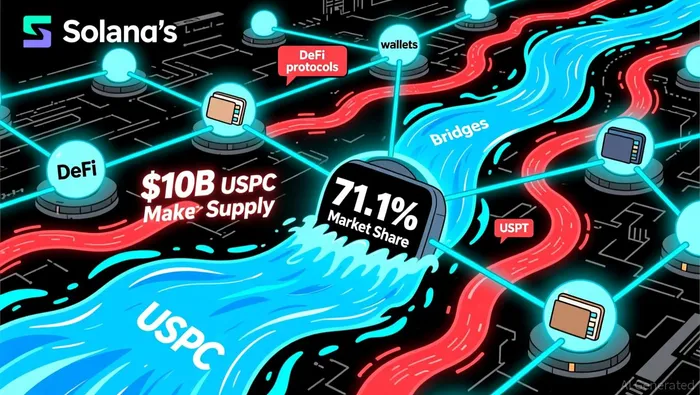
The rationale is clear: USDC's growth on Solana has skyrocketed from $2.5 billion to $10 billion in a short span, according to a Coinotag article, with the stablecoin now accounting for 71.1% of Solana's stablecoin market cap, as noted in the Messari Q3 2025 report. This dominance is further amplified by partnerships with cross-chain bridges like WormholeW-- and LayerZeroZRO--, which facilitate seamless asset transfers between ecosystems, according to the Coinotag article. For investors, this signals a network effect where increased USDC liquidity attracts more DeFi protocols, traders, and developers, creating a self-reinforcing cycle.
Solana vs. Tether: The Stablecoin Arms Race
While USDC's ascent is undeniable, Tether's USDTUSDT-- remains a formidable competitor. USDT's market share on Solana stands at 16.9%, according to the Messari Q3 2025 report, and it recently overtook USDC in decentralized exchange (DEX) volume, as reported in the Cex.io Q3 2025 stablecoin report. However, USDC's on-chain transaction dominance-63% of Solana's stablecoin activity, according to the Cex.io Q3 2025 stablecoin report-reveals a critical edge. This is partly due to bot-driven trading and arbitrage, but also reflects USDC's integration into key protocols like KaminoKMNO-- and OrcaORCA--, which prioritize its use for lending and automated market-making.
The competition extends beyond market share. Tether's regulatory challenges and opaque reserves have created an opening for USDC, whose transparency and compliance with U.S. regulations make it a safer bet for institutional adoption. As PayPal's PYUSD (now 112.3% higher in market cap, according to the Messari Q3 2025 report) and other stablecoins enter the fray, Solana's role as a neutral, high-speed settlement layer becomes increasingly valuable.
Solana's Network Metrics: A Maturing Ecosystem
Solana's Q3 2025 performance paints a picture of a maturing blockchain. DeFi total value locked (TVL) surged 32.7% to $11.5 billion, according to the Messari Q3 2025 report, with Kamino leading at $2.8 billion. The Application Revenue Capture Ratio (App RCR) climbed to 262.8%, indicating that protocols are effectively monetizing on-chain activity, as noted in the Messari Q3 2025 report. Meanwhile, retail adoption has exploded, with under-$250 stablecoin transfers hitting an all-time high in September, according to the Cex.io Q3 2025 stablecoin report, signaling mass-market traction.
Analysts project Solana's price to rally 67% from its June 2025 correction low, driven by innovations like the Firedancer validator client and a thriving developer ecosystem, according to the Cex.io Q3 2025 stablecoin report. However, risks persist: technical complexity and regulatory scrutiny could disrupt momentum. For now, though, Solana's unique value proposition-speed, low cost, and a stablecoin-centric infrastructure-positions it as a critical player in the DeFi stack.
Investment Implications: A High-Velocity Bet
For investors, the strategic implications are twofold. First, Solana's dominance in the stablecoin ecosystem is no longer theoretical-it's a reality backed by $14.1 billion in stablecoin market cap, according to the Messari Q3 2025 report. Second, the network's ability to process high-frequency transactions at scale makes it a natural fit for emerging use cases like microtransactions, gaming, and cross-border payments.
Yet, this is not without caveats. The reliance on bot activity to drive on-chain volume, as noted in the Cex.io Q3 2025 stablecoin report, raises questions about the sustainability of growth. Additionally, regulatory shifts could impact stablecoin issuance and Solana's role as a settlement layer. Investors must weigh these risks against the potential rewards of a network poised to redefine liquidity in DeFi.
Conclusion
Circle's USDC minting spree on Solana is more than a liquidity play-it's a strategic move to cement the chain's role as the backbone of global stablecoin infrastructure. With USDC's market share surging and Solana's ecosystem maturing, the blockchain is well-positioned to outpace competitors in the short term. For investors, the key lies in balancing optimism with caution, recognizing that Solana's success hinges on its ability to maintain technical excellence while navigating an increasingly regulated landscape.





Comentarios
Aún no hay comentarios