
Strategic Implications of U.S.-China Trade Dynamics for Aerospace Stocks: Assessing Boeing's Resilience and Risks
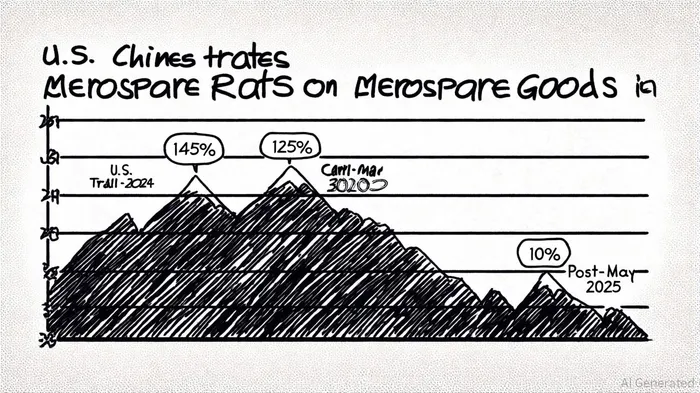
The U.S.-China trade war has long cast a shadow over global aerospace markets, but recent developments in 2025 suggest a fragile truce that could reshape Boeing's strategic outlook. After months of escalating tariffs—peaking at 145% on Chinese imports and 125% on U.S. goods—the two nations agreed to a 90-day tariff reduction in May 2025, followed by an extension through November 2025[1]. This temporary ceasefire has allowed BoeingBA-- to resume aircraft deliveries to China, a critical market for its long-term recovery. However, the company's path forward remains fraught with challenges, from financial strain to intensifying competition from Airbus and COMAC's C919.
Trade Truce: A Lifeline for Boeing's China Strategy
The May 2025 agreement marked a pivotal shift. China lifted a month-long ban on Boeing deliveries[2], enabling airlines like China Southern and Air China to accept 10 737 Max aircraft in 2025[3]. This move followed a mutual reduction in tariffs: U.S. rates on Chinese goods dropped to 30%, while China's tariffs on Boeing jets fell to 10%[4]. The truce, extended in August 2025[5], provided Boeing with a critical reprieve. Prior to this, the company had faced inventory bottlenecks and operational disruptions due to China's import ban on U.S.-made parts[6].
Yet, the truce is not a permanent solution. Analysts caution that unresolved issues—such as China's industrial overcapacity and U.S. technology export controls—could reignite tensions[7]. For Boeing, the resumption of deliveries is a short-term win but does not address deeper structural risks.
Boeing's Financial Struggles and Operational Hurdles
Despite the trade thaw, Boeing's Q3 2025 financials remain under pressure. The company reported a negative profit margin of 16.58%, a diluted earnings per share of -$17.95, and free cash flow of -$7.94 billion[8]. These figures underscore the challenges of recovering from the 737 Max crisis and supply chain bottlenecks. While the 777X program received FAA approval for expanded testing[9], the aircraft's 2026 delivery to Lufthansa is still months away.
The Chinese market, which accounts for 30% of Boeing's single-aisle market share[10], remains a key growth lever. However, Boeing's ability to capitalize on this market is constrained by its financial health and the rising threat of COMAC's C919.
The C919 Challenge: A Game Changer in China's Skies
COMAC's C919 has emerged as a formidable competitor. By mid-2025, the aircraft had secured over 1,000 orders and delivered 16 units, with production targets of 75 aircraft annually by 2025 and 200 by 2029[11]. Government-backed subsidies and a focus on domestic demand have accelerated its adoption. Projections suggest the C919 could capture 25% of China's single-aisle market[12], directly challenging Boeing's and Airbus's dominance.
Airbus, too, is vying for market share. Reports indicate China is considering an order for 200–500 Airbus jets[13], a move that could further fragment the market. For Boeing, the dual threat of COMAC and Airbus highlights the urgency of cost-cutting and innovation.
Strategic Risks and Opportunities
The U.S.-China trade dynamic remains a double-edged sword. While the tariff truce has stabilized Boeing's China operations, the company must navigate ongoing geopolitical risks. For instance, China's deepening economic ties with Southeast Asia—via partnerships with Malaysia, Cambodia, and Vietnam—could diversify its aerospace supply chains and reduce reliance on U.S. suppliers[14]. This shift could weaken Boeing's long-term position in the region.
Conversely, the truce offers an opportunity for Boeing to rebuild trust with Chinese partners. If the U.S. and China can resolve broader trade disputes by November 2025[15], Boeing may secure long-term contracts and access to critical components. However, this hinges on the success of upcoming negotiations and the Trump–Xi summit.
Investment Considerations
For investors, Boeing's stock (current price: $213.43, up 20.58% year-to-date[16]) reflects a mix of optimism and caution. The company's technical progress—such as the 777X program—signals potential for future growth. However, its financial metrics and competitive pressures suggest a high-risk profile.
Key watchpoints include:
1. Tariff negotiations: A failure to extend the truce could trigger renewed trade tensions and disrupt Boeing's China operations.
2. C919 adoption: If COMAC meets its production targets, Boeing's market share could erode further.
3. Airbus's China strategy: A large Airbus order could shift the balance of power in the global aerospace sector.
Conclusion
Boeing's growth potential in the post-truce era depends on its ability to navigate geopolitical uncertainties and outmaneuver rivals. While the U.S.-China trade truce provides a temporary lifeline, the company must address its financial weaknesses and accelerate innovation to compete with COMAC and Airbus. For investors, Boeing remains a high-stakes bet—a symbol of both the fragility and resilience of global aerospace markets.





Comentarios
Aún no hay comentarios