
The Strategic Implications of Blue Origin's New Glenn Rocket Launch for Aerospace and SpaceTech Equity Investors
Technological Credibility: A Step Toward Reusability and Cost Efficiency
The New Glenn's successful first-stage landing is a significant technical achievement. Reusability is a cornerstone of cost-effective space access, . According to a report, the rocket's first stage, dubbed "Never Tell Me the Odds," separated cleanly and executed a controlled descent, underscoring the company's progress in mastering complex landing maneuvers.
The rocket's payload capacity further strengthens its technological appeal. , the New Glenn offers greater flexibility for large satellite deployments and interplanetary missions compared to traditional five-meter fairings according to Blue Origin. This capability is particularly relevant for NASA's ESCAPADE mission, which required precise delivery of twin satellites to study Martian space weather.
However, cost remains a hurdle. , this pales in comparison to SpaceX's Falcon 9, according to Wikipedia. For investors, the New Glenn's price point must be balanced against its reusability potential and specialized capabilities.
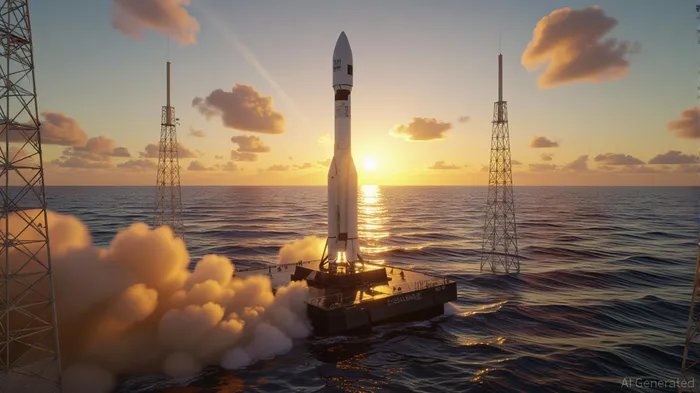
Market Positioning: Competing with SpaceX in a Crowded Landscape
Blue Origin's market credibility hinges on its ability to secure high-profile contracts and demonstrate operational efficiency. The ESCAPADE mission, its first NASA science mission, is a strategic win, but the company still lags behind SpaceX in commercial launch frequency. As of 2025, of the global commercial launch market, supported by its Starlink satellite constellation and a cadence of over 90 Falcon 9 launches in 2023 alone. Blue Origin, by contrast, has yet to match this scale, according to market analysis.
The New Glenn's competitive advantages-payload capacity, reusability, , particularly for heavy-lift and interplanetary missions. However, . Analysts note that Blue Origin's focus on , , could mitigate these risks by securing long-term revenue streams.
Investor Sentiment: Optimism Amid Caution
. , . A Reuters report highlights that the .
However, financial analysts remain divided. , according to market analysis. . For SpaceTech equity investors, .
Strategic Implications for Investors
For aerospace and SpaceTech investors, . , . Investors should prioritize metrics such as launch frequency, reusability rates, and contract diversification when evaluating Blue Origin's long-term viability.
In the broader market, . However, , .







Comentarios
Aún no hay comentarios