
The Strategic Implications of Blue Origin's New Glenn Launch for the Space Investment Sector
A New Era in Mars Exploration and Commercial Viability
The ESCAPADE mission, a twin-satellite endeavor to study Mars' magnetosphere, exemplifies how commercial partnerships are reshaping planetary science. Launched aboard Blue Origin's New Glenn rocket, this mission leverages a novel "launch-and-loiter" trajectory to reach Mars, reducing costs while maintaining scientific rigor, as reported by a NASA report. According to a Bloomberg report, this mission marks Blue Origin's first for NASA and underscores the rocket's capability to deliver high-value payloads to deep-space destinations. The satellites, nicknamed Blue and Gold, will arrive at Mars in 2027, providing critical data on atmospheric loss and space weather-key challenges for future human exploration, as noted in the NASA report.
The mission's strategic significance lies in its alignment with NASA's SIMPLEx program, which prioritizes low-cost, high-impact science. By demonstrating that commercial launch providers can meet rigorous scientific demands, ESCAPADE paves the way for future missions with constrained budgets. This shift reduces reliance on traditional government-led infrastructure, accelerating the pace of discovery while opening new revenue streams for private companies.
Blue Origin's Operational Progress and Market Positioning
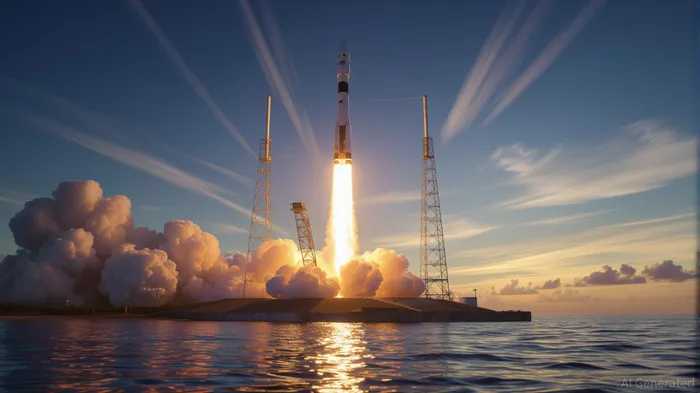
Blue Origin's New Glenn rocket has faced its share of challenges, including launch delays and regulatory hurdles. However, the November 2025 launch represents a turning point. The company's attempt to land the rocket's reusable booster-a critical step in reducing launch costs-mirrors strategies pioneered by SpaceX. According to a SpaceNews report, Blue Origin is actively seeking an FAA exemption to conduct nighttime launches, a move that would expand its operational flexibility and align with Florida's record-breaking 91 launches in 2025.
Financially, Blue Origin is positioning itself as a formidable competitor. The New Glenn's methane-fueled first stage and hydrogen-powered second stage offer a unique value proposition: higher payload capacity and reusability at a lower cost per launch, according to a Space Intelligence report. This technological edge is attracting attention from both NASA and commercial clients. For instance, the rocket's second flight carried a Viasat technology demonstration for NASA's Communications Services Project, highlighting its versatility beyond planetary missions, as noted in a WESH report.
NASA's Commercial Partnerships and the Future of Space Infrastructure
NASA's growing reliance on commercial partners is reshaping the space infrastructure landscape. The ESCAPADE mission is part of a broader trend where agencies like NASA are outsourcing launch services, satellite manufacturing, and even mission design to private firms. According to a SpaceNews report, global investments in core space infrastructure surged to $4.4 billion in Q3 2025, driven by U.S. satellite production and Chinese launch innovations. This growth is fueled by initiatives like the Pentagon's Golden Dome, which requires scalable satellite networks for national security and commercial applications, as described in the SpaceNews report.
Blue Origin's potential role in NASA's Artemis III mission further underscores this shift. While SpaceX has dominated lunar ambitions, Blue Origin's New Glenn rocket is now being considered as a viable alternative, particularly for high-energy trajectories, as reported in a WESH report. This diversification of launch providers reduces systemic risk and fosters competition, driving down costs and accelerating innovation-a win for both public and private stakeholders.
Investor Implications and Sector Trends
For investors, the New Glenn launch and ESCAPADE mission highlight three key trends:
1. Reusable Technology as a Cost Multiplier: The ability to land and reuse rocket boosters is no longer a niche innovation but a standard expectation. Blue Origin's progress in this area positions it to capture a significant share of the launch market, particularly for deep-space missions.
2. Satellite Manufacturing and Logistics: As demand for Earth-observation, communications, and scientific satellites grows, companies like Apex and Rocket Lab are securing substantial funding. The latter's involvement in ESCAPADE demonstrates how small-satellite manufacturers are becoming integral to large-scale missions, as noted in the Bloomberg report.
3. Regulatory and Market Flexibility: The FAA's nighttime launch restrictions and Blue Origin's exemption request illustrate the importance of regulatory agility in the space sector. Investors must monitor policy shifts that could impact launch windows and operational costs.
Conclusion: A Turning Point for Space Commercialization
The New Glenn launch and ESCAPADE mission represent more than a technical success-they signal a paradigm shift in how humanity approaches space exploration. By proving that commercial providers can deliver complex, science-driven missions at lower costs, Blue Origin and its partners are dismantling the barriers between government-led and private-sector initiatives. For investors, this means a sector that is no longer speculative but increasingly predictable, with clear pathways for growth in launch services, satellite infrastructure, and deep-space logistics.
As the space economy matures, the focus will shift from "can we do this?" to "how can we scale this?" The answer lies in companies like Blue Origin, whose innovations are not just launching satellites but launching an era of commercial viability in space.







Comentarios
Aún no hay comentarios