
The Strategic Implications of Blockchain Network Upgrades on Altcoin Volatility and Exchange Dynamics
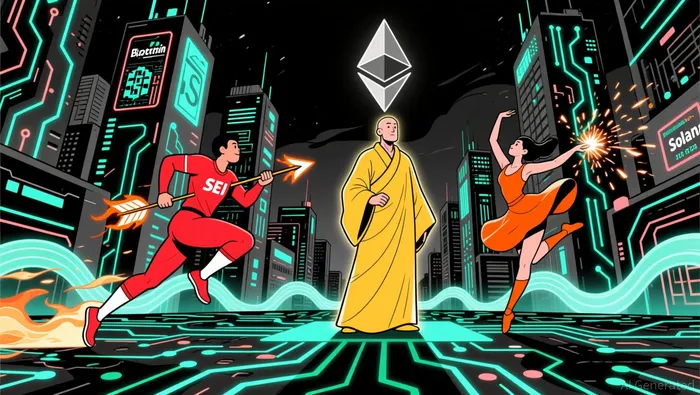
Blockchain network upgrades have long been catalysts for both innovation and volatility in the cryptocurrency market. For tokens like SEISEI--, EthereumETH--, and SolanaSOL--, these upgrades are not merely technical milestones but pivotal events that reshape liquidity, investor sentiment, and competitive positioning. As the 2025–2026 upgrade cycle unfolds, the interplay between technical advancements and market dynamics offers critical insights for investors navigating the altcoin landscape.
Technical Upgrades: A Double-Edged Sword
The Sei Network's Giga upgrade, scheduled for Q1 2026, exemplifies the dual nature of blockchain advancements. By targeting 200,000 TPS and sub-400ms finality through asynchronous execution and Autobahn consensus, Sei aims to position itself as a high-performance EVM-compatible chain according to CoinMarketCap. These optimizations, coupled with the October 2025 storage overhaul (replacing RocksDB with PebbleDB), have already improved block sync times by 2x and reduced node hardware costs. However, such upgrades often coincide with market turbulence. For instance, the October 2025 Giga upgrade saw SEI's price plummet to $0.0868 amid broader risk-off sentiment, despite institutional adoption and ecosystem growth.
Ethereum's 2026 roadmap-Glamsterdam and Hegota-also highlights the tension between technical progress and market stability. While parallel processing and ZKZK-- proof verification could push Ethereum's TPS to 10,000 according to KuCoin, the network's reliance on gradual, consensus-driven upgrades means volatility is often dampened by institutional confidence and TVL dominance as The Block reports. Solana, by contrast, has leveraged its Alpenglow upgrade to reduce transaction times to near 1 second, but its history of memecoin-driven volatility (e.g., 80% 90-day realized volatility vs. Ethereum's 60%) underscores the risks of prioritizing speed over stability according to DropStab research.
Market Volatility: Upgrades as Catalysts
Network upgrades often act as psychological triggers for price swings. SEI's January 2026 fee removal, intended to boost high-frequency trading and gaming adoption, initially caused a 4.72% price drop and 31.31% trading volume decline as MEXC reported. Yet, the subsequent rebound-pushing the price above $0.12 support-suggests that long-term fundamentals (e.g., 1 million new users in Q1 2026 according to Intellectia) can outweigh short-term jitters. Similarly, Ethereum's spot ETF launches in 2025 mitigated some volatility, with ETHETH-- declining only -25% in H1 2025 compared to Solana's -19.1% as CoinGecko analysis shows, reflecting its role as a "blue-chip" crypto asset.
For SEI, the SIP-3 upgrade's transition to an EVM-only chain in late March 2026 introduces additional risks. Holders of Cosmos-native USDCUSDC--.n must swap to native USDC to avoid liquidity loss, a process that could exacerbate short-term selling pressure. Meanwhile, the January 15, 2026 token unlock of 55.56M SEI tokens-0.86% of market cap-poses a classic supply shock, with historical patterns indicating post-unlock sell-offs.
Exchange Dynamics: Liquidity Shifts and Institutional Responses
Exchange liquidity dynamics during upgrades reveal deeper structural shifts. Solana's DEX volume surged to $117.1 billion in Q3 2025, outpacing Ethereum's $105.3 billion according to Antier Solutions, driven by its low fees and high throughput. SEI, meanwhile, saw decentralized exchange volume exceed $500 million in November 2025 as Brave New Coin reported, with 30-day volumes hitting $411.7 million-a sign of growing institutional participation. However, liquidity providers face challenges: SEI's derivatives volume spiked to $32 million in 24 hours post-fee removal, signaling heightened liquidation risks.
Binance's support for the October 2025 SEI upgrade (scheduled at block height 174,967,675) illustrates how exchanges adapt to network changes. By aligning with Sei's timeline, Binance likely aimed to capture early liquidity from the Giga upgrade's 50x throughput improvements according to Binance. Such coordination between chains and exchanges is critical for maintaining stable trading environments during upgrades.
Comparative Analysis: SEI vs. Ethereum and Solana
While Solana's volatility makes it a high-risk, high-reward asset, SEI's strategic focus on EVM compatibility and institutional-grade infrastructure positions it as a hybrid between Ethereum's stability and Solana's speed. Ethereum's 2026 upgrades (e.g., Verkle Trees in Hegota) aim to balance scalability with decentralization, but its TVL dominance $99 billion in 2025 ensures slower, more predictable price movements. SEI's 23% price surge in early 2026 according to Phemex, driven by daily active addresses surpassing 1.3 million, suggests it is carving a niche in on-chain finance and gaming-sectors where Ethereum's gas costs and Solana's occasional outages are liabilities.
Risk and Opportunity Assessment
For investors, the key lies in balancing technical potential with market realities. SEI's Giga and SIP-3 upgrades offer a compelling value proposition: 200K TPS, EVM compatibility, and institutional partnerships (e.g., BlackRock, Circle according to Followin). However, risks such as token unlocks, legacy token migration challenges, and macroeconomic headwinds (e.g., U.S. Federal Reserve rate cuts as AmberData notes) cannot be ignored.
Ethereum's 2026 roadmap, while less disruptive, provides a safer bet for long-term holders. Its institutional adoption (e.g., spot ETFs according to Yahoo Finance) and TVL dominance mitigate volatility, though it may lag in capturing high-frequency trading niches. Solana, meanwhile, remains a speculative play-its Alpenglow upgrade could drive adoption in DeFi and Web3 gaming, but its volatility profile (80% realized volatility according to DropStab research) demands caution.
Conclusion
Blockchain network upgrades are not just technical events-they are strategic inflection points that redefine market dynamics. For SEI, the 2026 Giga and SIP-3 upgrades represent a bold bid to capture the EVM ecosystem while addressing scalability and liquidity challenges. Investors must weigh these innovations against risks like token unlocks and migration complexities. In a landscape where Ethereum and Solana set the benchmarks, SEI's ability to deliver on its performance promises will determine whether it becomes a cornerstone of on-chain finance or a cautionary tale of overambitious upgrades.





Comentarios
Aún no hay comentarios