
The Strategic Implications of Bithumb's Repeated Network Upgrade Suspendances in 2025
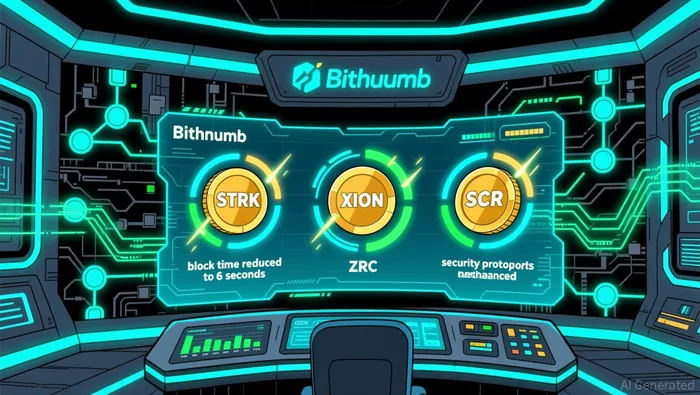
In the fast-evolving world of blockchain, network upgrades are a necessary evil. For exchanges like Bithumb, these upgrades often require temporary suspensions of deposits and withdrawals to ensure seamless integration of protocol changes. In 2025, Bithumb executed multiple such suspensions for tokens like ScrollSCR-- (SCR), ZRC, XION, and StarknetSTRK-- (STRK), sparking debates about their short-term inconveniences versus long-term strategic value. This analysis explores how these upgrades impact the stability and growth of blockchain projects, using Bithumb's 2025 actions as a case study.
The Necessity of Network Upgrades
Network upgrades are critical for blockchain projects to remain competitive. Bithumb's suspensions-such as the December 2025 pause for STRKSTRK-- deposits and withdrawals-were implemented to facilitate Starknet's v0.14.0 upgrade, which reduced block times to 6 seconds and introduced a decentralized sequencer network using Tendermint consensus. These technical improvements enhance scalability and user experience, aligning with broader industry trends toward efficiency and security according to market analysis.
While suspensions disrupt liquidity temporarily, they are standard practice. For example, Bithumb suspended ZRC transactions on December 8, 2025 to support a network upgrade aimed at improving performance and security. Such measures prevent transaction errors and chain splits, reinforcing user trust in the exchange's operational rigor as reported in industry analysis.
Case Studies: Technical Gains vs. Market Volatility
Starknet (STRK):
Starknet's v0.14.0 upgrade, coupled with the deployment of USDCUSDC-- and BitcoinBTC-- staking via Anchorage Digital, positioned the network to attract institutional liquidity. However, the project faced a 56% price drop over 30 days, coinciding with a 5.07% token supply unlock in December 2025. This highlights a tension between technical progress and market sentiment: while upgrades lay the groundwork for long-term stability, short-term volatility can erode investor confidence.
XION:
XION's partnership with Fireblocks, granting access to 2,400 financial institutions, underscores its focus on institutional adoption. Despite a 267% post-listing rally followed by a 45% retrace, the token's roadmap emphasizes APAC expansion and ecosystem innovation through initiatives like the Believathon competition as detailed in market reports. These efforts suggest a strategic pivot toward sustained growth, even amid price fluctuations.
ZRC and Scroll (SCR):
For ZRC and SCRSCR--, Bithumb's suspensions were part of routine protocol improvements. While specific post-upgrade metrics are scarce, the general trend in blockchain suggests that enhanced security and scalability-such as faster transaction times and reduced fees-typically drive user adoption and developer activity according to industry trends.
Long-Term Stability and Growth: Bithumb's Role
Bithumb's own financials reflect the broader market's resilience. In Q3 2025, the exchange reported KRW 196 billion (~$135.2 million) in revenue, a 771.1% year-on-year increase. This growth, driven by regulatory compliance and institutional interest, positions Bithumb as a key player in South Korea's digital-asset market. By prioritizing network upgrades, Bithumb reinforces its reputation as a secure and reliable exchange, which is critical in a highly regulated environment.
However, challenges remain. Korea's exchanges, including Bithumb, are constrained by regulatory limitations that prevent diversification into institutional services, unlike global peers like CoinbaseCOIN-- as noted in policy analysis. This highlights a strategic gap: while upgrades enhance technical stability, broader market access and product diversification are needed for sustained growth.
Strategic Implications for Investors
For investors, the key takeaway is that network upgrades are a double-edged sword. They are essential for long-term project viability but can introduce short-term volatility. Projects like Starknet and XION demonstrate that technical innovation must be paired with robust market strategies-such as institutional partnerships and tokenomics adjustments-to mitigate risks.
Bithumb's role as a gatekeeper further complicates the landscape. Its delisting of tokens like Cortex (CTXC) in early 2026 signals a tightening of listing standards, emphasizing transparency and sustainability. While this may reduce liquidity for affected tokens, it reinforces Bithumb's commitment to quality, potentially attracting risk-averse investors.
Conclusion
Bithumb's 2025 network upgrade suspensions underscore the delicate balance between technical progress and market dynamics. While these upgrades are necessary for blockchain projects to thrive, their success hinges on complementary strategies-such as institutional adoption, tokenomics design, and regulatory alignment. For investors, the lesson is clear: prioritize projects that not only deliver technical upgrades but also address market volatility and long-term sustainability. In a space where innovation is constant, strategic foresight remains the ultimate differentiator.





Comentarios
Aún no hay comentarios