
The Strategic Implications of Binance's USDe Listing and the Activation of Ethena's Fee Switch
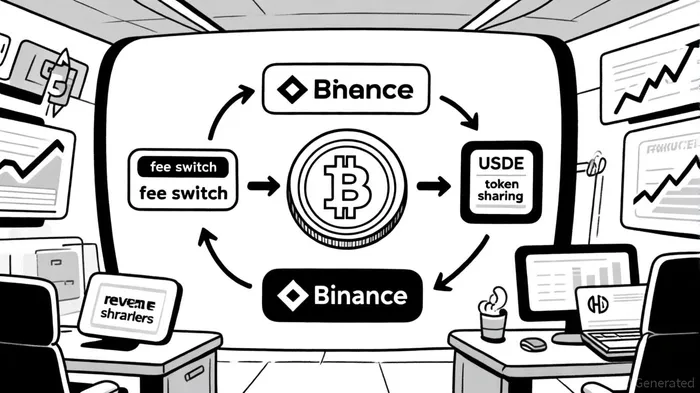
In Q3 2025, the DeFi landscape is witnessing a paradigm shift toward protocols with sustainable revenue models that prioritize real-world utility, institutional adoption, and tokenholder alignment. Ethena's recent listing of its synthetic dollar stablecoin, USDe, on Binance and the impending activation of its fee switch mechanism exemplify this trend. These developments not only validate Ethena's innovative approach but also highlight a broader opportunity for investors to capitalize on DeFi protocols that are redefining value capture in decentralized finance.
Ethena's USDe: A Catalyst for Ecosystem Growth
Binance's decision to list Ethena's USDe stablecoin with a $12 billion supply[1] marked a pivotal milestone for the protocol. This listing fulfilled critical thresholds—$6 billion in supply and $250 million in revenue—required to trigger the fee switch[3]. The move immediately boosted ENA's price to a 7-month high of $0.83[1], signaling strong market confidence in Ethena's ability to scale. USDe's rapid adoption, now exceeding $13 billion in total supply[5], underscores its role as a high-yield, delta-neutral stablecoin backed by crypto assets like ETH and BTC. Unlike traditional stablecoins, USDe generates revenue through perpetual funding rates, ETH staking rewards, and T-bill returns[5], creating a self-sustaining revenue engine.
The activation of the fee switch—a governance mechanism allowing sENA holders to share in protocol revenue—represents a structural innovation in DeFi. Once live, this feature will transform ENAENTA-- from a governance token into a yield-bearing asset, distributing a portion of Ethena's $32.48 million monthly revenue[3] to tokenholders. Analysts estimate this could unlock up to $500 million in buybacks[3], driven by institutional backing from a $360 million funding round led by Pantera and Dragonfly[1].
Ethena's Revenue Model vs. DeFi Peers
Ethena's strategy contrasts sharply with traditional DeFi protocols. While platforms like Aave and Morpho rely on transaction fees from lending and borrowing[4], or Banana Gun (BANANA) shares 40% of its 1% trading fees[3], Ethena's model is built on a delta-neutral carry trade. This approach leverages perpetual funding rates (19% for BitcoinBTC--, 12% for Ethereum) and ETH staking yields to generate consistent returns[5]. In the past 30 days, Ethena's revenue surged 243%, outpacing even high-growth protocols like Pump.fun (79% increase) and Hyperliquid (25.9% increase)[3].
The protocol's ecosystem further strengthens its competitive edge. Products like Ethereal (a perpetuals exchange with $712M TVL), Terminal (a liquidity hub with $129M TVL), and Strata (structured products with $13M TVL)[1] diversify revenue streams while attracting institutional capital. Meanwhile, the launch of USDtb, a GENIUS Act-compliant stablecoin, and expansion into Arbitrum-based Converge Chain[5] demonstrate Ethena's commitment to regulatory alignment—a critical factor for long-term scalability.
Strategic Implications for Investors
For investors, Ethena's fee switch and Binance listing represent a flight to quality in DeFi. The activation of revenue-sharing mechanisms aligns tokenholder incentives with protocol success, a model increasingly favored over inflationary “Ponzinomics.” This is evident in the success of protocols like goodcryptoX ($GOOD), which allocates 50% of its DEX fees to tokenholders[3], and Morpho, which generates $100 million in annualized fees through institutional-grade lending[4].
Ethena's potential to distribute $500 million in buybacks[3] also addresses a key criticism of DeFi tokens: low utility. By converting ENA into a yield-bearing asset, Ethena creates a flywheel effect—rising token value attracts more liquidity, which in turn boosts revenue and buybacks. This dynamic is further amplified by Binance's listing, which provides USDe with global liquidity and credibility[1].
However, risks remain. Ethena's high emission-to-revenue ratio and potential token unlocks in 2026[5] could pressure the price if not managed carefully. Investors must also monitor macroeconomic factors, such as the Federal Reserve's rate-cut timeline[1], which could impact funding rates and, by extension, Ethena's revenue.
The Broader DeFi Opportunity
Ethena's success reflects a broader trend: DeFi protocols are maturing by prioritizing sustainability over speculative hype. Protocols like Morpho (with $4B TVL and $100M in annual fees[4]) and Avalanche (post-Etna upgrade[4]) demonstrate that institutional adoption and clear value capture are now table stakes. For investors, this means shifting focus from TVL metrics to revenue per token and tokenholder ROI.
Conclusion
Ethena's strategic moves—listing USDe on Binance and activating the fee switch—position it as a leader in the next phase of DeFi. By combining a unique revenue model with institutional-grade infrastructure, the protocol is redefining how value is created and distributed in decentralized finance. For investors, this represents a rare opportunity to back a project that is not only capital-efficient but also aligned with the long-term interests of its community. As the DeFi space consolidates, protocols like Ethena will likely dominate, offering a blueprint for sustainable growth in an increasingly competitive ecosystem.






Comentarios
Aún no hay comentarios