
The Strategic Implications of BHP's Exit from Anglo American for Copper Market Consolidation
The Collapse of a Megamerger: A New Era of Strategic Prudence
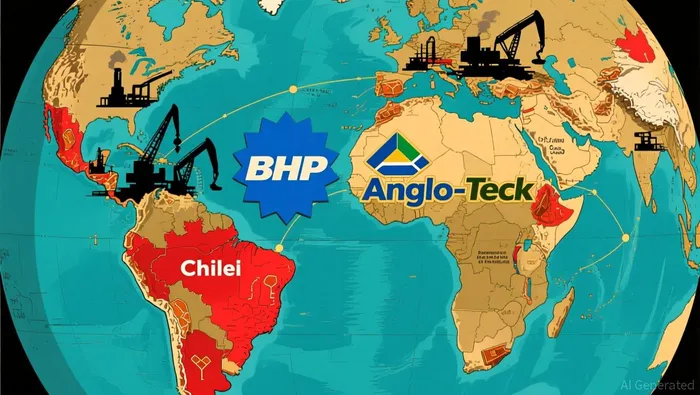
BHP's formal withdrawal from its Anglo American pursuit under Rule 2.8 of the UK City Code on Takeovers and Mergers underscores a strategic recalibration. The company's pivot to organic growth, particularly in copper, reflects a recognition of the structural barriers to cross-border consolidation. Anglo American's prior commitment to merging with TeckTECK-- Resources-a deal featuring financial penalties for competing bids-created an insurmountable hurdle for BHP. This arrangement not only shielded Anglo American but also positioned the Anglo-Teck combination as a top-5 global copper producer with 900,000 tonnes of annual output, effectively creating a duopoly with BHPBHP--, which controls roughly 16-18% of global production.
The failure of the BHP-Anglo American merger highlights a broader industry trend: the decline of mega-deals in favor of targeted, resource-specific strategies. Regulatory scrutiny, particularly in South Africa, and the rising influence of activist shareholders have made large-scale acquisitions increasingly untenable. For BHP, this means prioritizing internal growth in copper-a commodity where supply constraints are expected to drive long-term value creation.
Copper Market Dynamics: Volatility, Disruptions, and Structural Deficits
The Q3 2025 copper market has been a case study in volatility. Prices surged to $5.81 per pound on the COMEX in July amid fears of a 50% U.S. import tariff, only to plummet to $4.37 per pound by mid-August as policy clarity emerged. This turbulence was compounded by supply-side disruptions: Ivanhoe Mines' Kamoa-Kakula operation in the DRC was temporarily halted due to seismic activity, while Freeport-McMoRan's Grasberg mine in Indonesia faced a tragic incident that halted production. These events pushed 2025 mine disruptions to 6% of global supply, exacerbating an already tightening market.
Looking ahead, analysts project a structural supply deficit of 6-8 million tonnes by 2030, driven by declining ore grades, permitting delays, and the energy transition's insatiable demand for copper in electrification and AI infrastructure. Low global inventories and the concentration of production in a handful of players-BHP and Anglo-Teck now dominate 16-18% of output-further amplify pricing power and supply security risks.
Investment Implications: Navigating a Consolidated Landscape
For investors, the post-BHP-Anglo-Teck landscape demands a reevaluation of traditional mining sector strategies. The Anglo-Teck merger, valued at over $60 billion, has created a formidable competitor to BHP, reshaping competitive dynamics and reducing the likelihood of further consolidation. This bifurcated market structure favors companies with robust project pipelines and low-cost production, as well as those positioned to benefit from the energy transition's copper demand surge.
However, risks persist. The U.S.-China trade standoff and potential regulatory headwinds could disrupt supply chains, while project development timelines remain long and capital-intensive. Investors must also weigh the geopolitical exposure of key producers, particularly in regions like the DRC and Indonesia, where operational risks are elevated.
That said, the long-term bull case for copper remains intact. With global demand projected to outstrip supply for years, companies with strong reserves, advanced exploration projects, and strategic partnerships in high-growth regions are likely to outperform. BHP's focus on organic growth and Anglo-Teck's scale provide compelling case studies, but smaller, agile players with innovative technologies or access to underexplored jurisdictions could also capture significant value.
Conclusion: A Structural Shift in Mining's Future
The collapse of the BHP-Anglo American merger and the rise of the Anglo-Teck duopoly signal a fundamental realignment in the mining sector. While megamergers may no longer be the path to dominance, the industry's shift toward disciplined capital allocation and resource-specific strategies aligns with the energy transition's demands. For investors, the key lies in identifying companies that can navigate near-term volatility while capitalizing on the long-term structural supply deficits in copper. As the market evolves, those who adapt to this new paradigm-prioritizing resilience, innovation, and strategic positioning-will be best positioned to thrive.





Comentarios
Aún no hay comentarios