
The Strategic Imperative of Space-Based Data Centers: A Hedge in the AI-Centric Future
The global AI revolution is accelerating at an unprecedented pace, driven by insatiable demand for compute power and the need for infrastructure that can scale beyond terrestrial constraints. As artificial intelligence becomes the cornerstone of economic and technological dominance, the limitations of Earth-based data centers-energy inefficiency, cooling costs, and physical space-are becoming increasingly untenable. Enter space-based data centers: a next-generation infrastructure solution that promises to redefine the economics of AI. This article examines why space-based data centers represent a strategic hedge in AI-driven markets, drawing on insights from Gavin Baker of Atreides Management, AI capital efficiency trends, and a critical comparison to historical market bubbles.
The Bottlenecks of Earth-Based Infrastructure
Traditional data centers are energy-intensive, with cooling alone accounting for up to 40% of operational costs. As AI models grow in complexity, the demand for high-performance computing (HPC) and graphics processing units (GPUs) has surged, straining existing infrastructure. According to a report by Atreides Management, leading AI spenders have seen a 10-point increase in return on invested capital (ROIC) since ramping up capital expenditures, underscoring the necessity of robust infrastructure to sustain returns. However, Earth's finite resources and regulatory hurdles-such as land use and energy grid limitations-pose significant barriers to scaling.
Space-Based Data Centers: A Paradigm Shift
Gavin Baker, managing partner and CIO of Atreides Management, has positioned space-based data centers as a transformative solution. He argues that the economics of AI are fundamentally tied to compute efficiency, and space offers two unparalleled advantages: unlimited solar power and free, near-absolute-zero cooling according to Baker's analysis. These factors eliminate the energy and cooling bottlenecks that plague terrestrial facilities, enabling AI models to train and operate at optimal performance per watt. 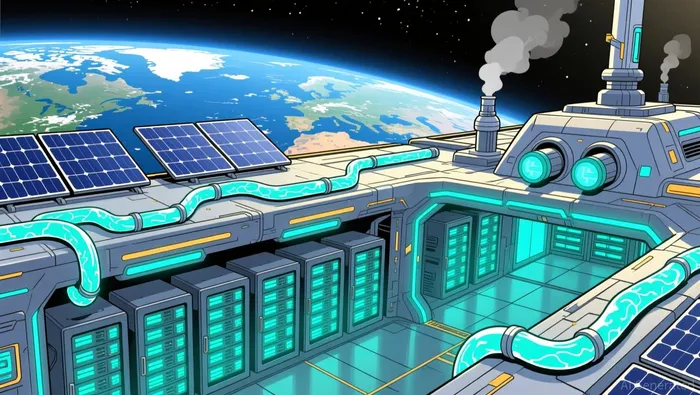 Baker's rationale is rooted in the growing global push to expand data center capacity for AI applications. Companies are investing heavily to meet this demand, with space-based infrastructure emerging as a logical extension of this trend. For instance, the competition between tech giants like NvidiaNVDA-- and GoogleGOOGL-- has intensified, as AI capabilities directly translate to competitive advantage. Google's TPU chips and Gemini product, for example, are challenging Nvidia's dominance, illustrating how infrastructure innovation is a key battleground in the AI arms race.
AI Capital Efficiency and the "No Bubble" Argument
Critics have likened the current AI investment boom to the 2000 dot-com crash, citing high valuations and speculative enthusiasm. However, Baker dismisses this analogy, emphasizing critical differences. During the dot-com era, 97% of laid fiber was unused ("dark fiber"), leading to a collapse in value. Today, GPUs are in such high demand that they are "melting from overuse," indicating strong utilization and positive ROI according to Baker's analysis.
This distinction is vital. According to Atreides Management's 2025 Q3 13F filing, the firm has significantly increased holdings in AI-related assets like QQQ and MU, reflecting confidence in the sector's capital efficiency. The firm's strategic shifts-such as initiating positions in INTU and INTC-further highlight the institutional conviction in AI's long-term viability.
Baker also notes that post-training scaling laws, such as reinforcement learning with verified rewards and test-time compute, have sustained AI progress during hardware bottlenecks. For example, delays in Nvidia's Blackwell chips were mitigated by these techniques, ensuring continuous innovation. This adaptability contrasts sharply with the speculative excesses of the dot-com era, where returns were often disconnected from tangible value creation.
Strategic Hedging in a Fragmented Market
Space-based data centers offer a unique hedge against the volatility of AI-driven markets. By leveraging solar power and zero-gravity cooling, they reduce dependency on terrestrial energy grids and geopolitical supply chains. This resilience is critical in an era where AI infrastructure is both a commercial asset and a strategic national interest.
Moreover, the competitive dynamics between firms like Nvidia and Google underscore the urgency of infrastructure innovation. As Baker observes, the economics of AI are not just about hardware but about positioning-who controls the most efficient compute infrastructure will dominate the next decade according to Baker's analysis. Space-based data centers, with their inherent advantages, could become the "dark fiber of the future," a foundational layer for AI's global expansion.
Conclusion: A Calculated Bet on the Future
The convergence of AI's exponential growth and the limitations of Earth-based infrastructure creates a compelling case for space-based data centers. Gavin Baker's bullish rationale-rooted in compute efficiency, capital returns, and a rejection of bubble narratives-aligns with broader industry trends. While risks remain, the strategic advantages of space-based infrastructure position it as a hedge against both technological stagnation and market overcorrection. For investors, this represents not just a speculative play but a calculated bet on the next frontier of AI.





Comentarios
Aún no hay comentarios