
Strategic Government Backing as a Catalyst for Intel's Turnaround
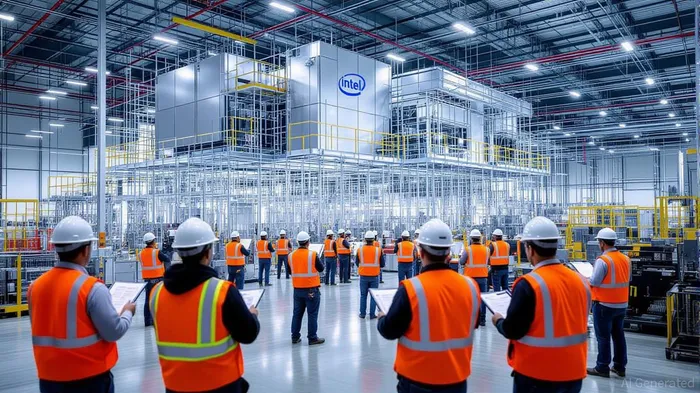
The U.S. government's potential equity stake in Intel CorporationINTC-- represents a pivotal moment in the semiconductor industry's evolution. As geopolitical tensions intensify and global supply chains face unprecedented scrutiny, the Trump administration's reported plans to leverage the CHIPS and Science Act of 2022 to inject capital into IntelINTC-- signal a bold reimagining of industrial policy. This intervention, if realized, could not only stabilize Intel's financial trajectory but also redefine its role in the U.S. tech ecosystem. For investors, the implications are profound: a struggling tech giant may be on the cusp of a strategic rebirth, backed by the full weight of national security imperatives.
A New Era of Government-Backed Industrial Policy
The U.S. government's interest in Intel is part of a broader trend of state-led interventions in strategic industries. From the Pentagon's $400 million stake in rare-earth producer MP MaterialsMP-- to the CHIPS Act's $53 billion funding package, the administration is prioritizing domestic control over critical technologies. Intel, a once-dominant semiconductor leader now grappling with operational delays and market share losses to TSMCTSM-- and Samsung, has become a focal point of this strategy. The proposed equity stake—whether through converting existing grants into shares or allocating new funds—would provide Intel with the liquidity needed to accelerate its Ohio campus project, a $20 billion initiative delayed to the 2030s.
Historical precedents, such as the 2008 financial crisis bailouts, demonstrate that government-backed equity stakes can stabilize firms during crises while aligning corporate goals with national priorities. A 2018 study in the Journal of Corporate Finance found that government ownership often enhances firm valuations by reducing financial distress risks and signaling stability. However, the study also noted that excessive control (over 50% ownership) can erode efficiency. The Trump administration's approach appears calibrated to avoid this pitfall, with performance-linked incentives tied to production timelines and technology milestones.
Financial Implications: Stabilizing a Struggling Giant
Intel's recent financial struggles are well-documented. Its stock price fell below book value in 2024, and the company has implemented cost-cutting measures, including 15,000 job cuts and a suspended dividend. The government's stake would inject much-needed capital, potentially stabilizing its balance sheet and enabling long-term investments in advanced manufacturing. The CHIPS Act's $11 billion in loans and $8.5 billion in grants have already provided a lifeline, but the proposed equity stake would add a layer of credibility and financial flexibility.
For shareholders, the government's involvement introduces a dual revenue stream: commercial sales and government-backed contracts. This model, akin to the Pentagon's stake in MP Materials, could insulate Intel from market volatility while ensuring a steady flow of revenue for critical projects. However, critics argue that such interventions distort market dynamics, creating an uneven playing field. The administration's emphasis on accountability—tying funding to measurable outcomes—aims to mitigate these concerns.
Competitive Positioning: Regaining Leadership in Advanced Manufacturing
Intel's ability to compete with TSMC and Samsung hinges on its capacity to produce cutting-edge semiconductors at the 2 nm node and below. The company's access to ASML's High-NA EUV lithography machines and its rebranded foundry business position it to capture high-margin contracts, particularly in AI and defense. The government's stake would accelerate these efforts, ensuring that Intel's Ohio campus becomes a hub for next-generation chip production.
Geopolitical dynamics further amplify the stakes. With China's aggressive push to dominate semiconductor manufacturing and the U.S. seeking to counter this through alliances with Japan and South Korea, Intel's role as a domestic champion is critical. The administration's focus on securing supply chains for defense applications—such as the $3 billion Secure Enclave program—aligns with broader national security goals, ensuring that Intel's technology remains exclusive to U.S. allies.
Investment Timing and Strategic Considerations
For investors, the current juncture presents a unique opportunity. Intel's undervaluation, coupled with the potential for government-backed growth, creates an asymmetric risk-reward profile. The stock's recent performance () reflects market skepticism, but the administration's support could catalyze a turnaround. Key metrics to monitor include the Ohio campus's progress, the company's ability to secure external foundry customers, and its R&D efficiency in advancing 2 nm technology.
However, timing is crucial. The proposed stake is still in early discussions, and execution risks—such as project delays or misaligned incentives—remain. Investors should also consider the broader semiconductor landscape, including rival companies like AMDAMD-- and TSMC, which are also benefiting from CHIPS Act incentives. Diversification across the sector may mitigate risks while capitalizing on the industry's long-term growth.
Conclusion: A Strategic Bet on National Resilience
The U.S. government's potential equity stake in Intel is more than a financial transaction—it is a strategic investment in technological sovereignty. By aligning corporate goals with national security imperatives, the administration is reshaping the semiconductor industry's competitive landscape. For Intel, this backing could be the catalyst needed to regain its leadership in advanced manufacturing. For investors, the challenge lies in balancing the risks of execution with the potential for long-term gains in a sector defined by geopolitical and technological upheaval. As the global semiconductor race intensifies, Intel's revival may hinge on its ability to leverage government support while delivering on its strategic vision.





Comentarios
Aún no hay comentarios