
Strategic Geopolitical Alignment and the Next-Generation Energy and Technology Infrastructure
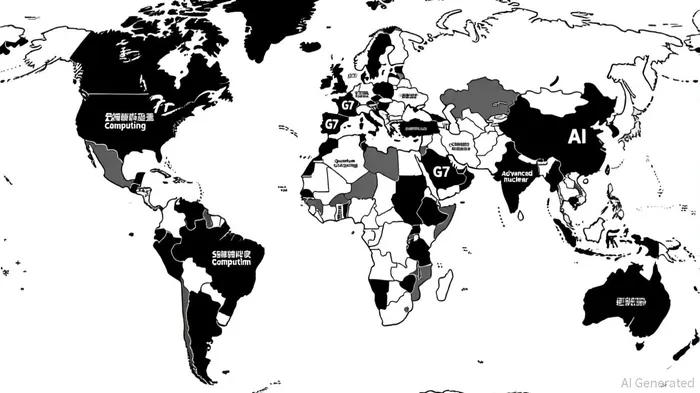
The next-generation energy and technology infrastructure is no longer a question of if but how it will be shaped by the geopolitical forces accelerating breakthroughs in artificial intelligence (AI), quantum computing, and advanced nuclear energy. From 2023 to 2025, a clear pattern has emerged: nations and alliances are strategically aligning resources, policies, and private-sector capabilities to dominate these fields, creating both competitive advantages and investment opportunities.
AI: The G7's Blueprint for Public Good and Economic Competitiveness
The G7's June 2025 commitments to AI and quantum technologies underscore a shift from speculative hype to actionable frameworks. According to a report by Nextgov, the G7 GovAI Grand Challenge and the G7 AI Network (GAIN) are designed to prioritize AI solutions that enhance public services while addressing ethical concerns[1]. For instance, the G7 AI Adoption Roadmap emphasizes workforce training and SME support, recognizing that small- and medium-sized enterprises are critical to scaling practical applications[5]. This approach not only mitigates risks like algorithmic bias but also creates a fertile ground for startups and regional tech ecosystems to thrive. Investors should note that governments are increasingly acting as both regulators and enablers, funding infrastructure (e.g., cloud computing access) to lower barriers for innovation[1].
Quantum Computing: A Geopolitical Arms Race with Dual-Use Implications
Quantum computing remains a high-stakes arena where national security and economic competitiveness collide. The U.S. National Quantum Initiative Act of 2018, which allocated $1.2 billion for R&D, exemplifies a private-sector-driven model[1]. Meanwhile, China's recent breakthrough with a room-temperature photonic chip highlights its focus on secure, energy-efficient quantum communication[2]. The G7's shared "common vision" document, however, signals a pivot toward collaboration, with a new Joint Working Group on Quantum Technologies aiming to harmonize policy and commercialization strategies[3]. This duality—competition and cooperation—creates a unique investment landscape. Quantum startups with dual-use applications (e.g., cryptography, materials science) are likely to attract both public and private capital, particularly in regions with strong government-industry linkages.
Advanced Nuclear Energy: SMRs as the New Energy Geopolitics
Small modular reactors (SMRs) are emerging as a linchpin in the global energy transition, driven by alliances like the European Industrial Alliance on SMRs and the UK-US Atlantic Partnership for Advanced Nuclear Energy. The EU's Strategic Action Plan for SMRs, unveiled in February 2024, aims to streamline deployment by the early 2030s, emphasizing energy autonomy and carbon neutrality[4]. Similarly, the UK-US collaboration has fast-tracked projects like X-energy's Xe-100 reactors and Holtec's SMR-300 for data centers[2]. However, the geopolitical stakes extend beyond Western partnerships. As noted by the New Nuclear Watch Institute, Russia and China are leveraging SMRs like the RITM-200 and ACP100 to expand their influence through "turn-key" solutions, positioning nuclear energy as a tool of soft power[3]. For investors, this means opportunities in both developed markets (e.g., EU regulatory frameworks) and emerging markets (e.g., Africa's energy access projects).
Strategic Implications for Investors
The convergence of geopolitical strategy and technological innovation demands a nuanced investment approach. First, prioritize regions and sectors where government policy directly aligns with private-sector capabilities—such as the G7's AI and quantum initiatives or the EU's SMR action plan. Second, monitor how emerging markets leverage SMRs and AI for energy access and economic leapfrogging, as these regions may become key battlegrounds for influence. Finally, consider the dual-use nature of quantum and AI technologies, which will likely attract both venture capital and state-backed funding.
The next decade will be defined by the winners and losers of this strategic alignment. For investors, the key is to identify not just the technologies of the future but the geopolitical frameworks that will accelerate their adoption.







Comentarios
Aún no hay comentarios