
Strategic Expansion in Global Brokerage: Sumitomo Mitsui's Deepening Stake in Jefferies
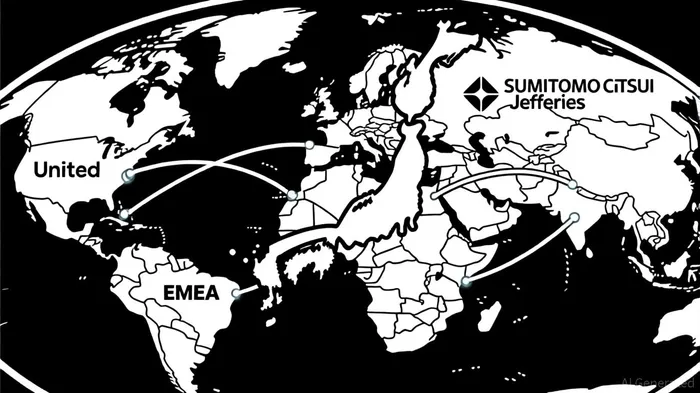
The recent strategic deepening of Sumitomo Mitsui Financial Group's (SMFG) partnership with JefferiesJEF-- represents a pivotal shift in global investment banking dynamics. By increasing its equity stake in the U.S. firm from 15% to 20% through open market purchases, SMBCSMBC-- Group has signaled a long-term commitment to leveraging cross-border synergies[1]. This move, coupled with a $2.5 billion credit facility and a planned joint venture in Japan, underscores a broader trend of institutional alliances aimed at navigating the complexities of global capital markets[2]. For investors, the partnership raises critical questions about the strategic and financial implications for cross-border investment opportunities, particularly in an era of fragmented markets and evolving regulatory landscapes.
Strategic Implications: A Dual-Pronged Global Push
The partnership's strategic architecture is built on two pillars: geographic expansion and operational integration. SMBC's increased ownership in Jefferies provides the U.S. firm with access to Japan's $5 trillion capital markets, while Jefferies' global execution capabilities—particularly in M&A and leveraged finance—offer SMBC a foothold in the U.S. investment banking sector, where Japanese institutions have historically struggled[3]. According to a report by Reuters, this alignment allows SMBC to bypass the high costs of organic expansion in the U.S., instead co-opting Jefferies' established infrastructure in key sectors like pre-IPO lending and asset-backed securitization[1].
The joint venture in Japan, set to launch in January 2027, further exemplifies this strategy. By combining SMBC Nikko's domestic expertise with Jefferies' global reach, the new entity aims to dominate Japanese equity capital markets (ECM) and sales trading[2]. This is particularly significant given Japan's aging population and the growing demand for cross-border financing solutions among domestic firms seeking international listings. As stated by SMFG's CEO, Toru Nakashima, the venture will “offer integrated support for the financing needs of Japanese companies, both domestically and internationally”[3].
Financial Implications: Capital Infusion and Risk Mitigation
Financially, the partnership is a win-win. SMBC's $2.5 billion credit facility to Jefferies not only bolsters the latter's liquidity but also aligns with SMBC's risk-mitigation goals. By tying its capital to joint initiatives in EMEA leveraged lending and U.S. pre-IPO markets, SMBC diversifies its exposure beyond Japan's relatively stagnant economy[2]. For Jefferies, the influx of capital provides a buffer against sector-specific volatility, particularly in leveraged finance, where interest rate fluctuations and regulatory scrutiny have constrained growth in recent years[3].
Data from Investing.com highlights that Jefferies' cross-border activities have already seen a “notable shift” post-investment, with expanded collaboration in EMEA syndicated lending and asset-backed securitization[3]. This suggests that the partnership is not merely symbolic but operational, with tangible benefits for both firms' balance sheets.
Cross-Border Investment Opportunities: A New Paradigm
The SMBC-Jefferies allianceAENT-- reflects a broader industry shift toward strategic partnerships as a means of accessing cross-border opportunities. For investors, this model offers several advantages:
1. Market Access: Japanese firms seeking U.S. listings can now leverage a dual-brand solution, reducing the friction often associated with cross-border transactions[3].
2. Cost Efficiency: By pooling resources, the partnership reduces the overhead costs of maintaining separate global operations, a critical factor in an industry where margins are increasingly compressed[2].
3. Regulatory Navigation: The collaboration allows both firms to navigate complex regulatory environments more effectively, particularly in EMEA, where divergent compliance requirements have historically hindered expansion[3].
However, challenges remain. The joint venture's success hinges on cultural integration between SMBC's risk-averse Japanese ethos and Jefferies' more aggressive U.S. approach to deal-making. Additionally, geopolitical tensions, such as U.S.-China trade dynamics, could impact the flow of capital between regions[3].
Conclusion
Sumitomo Mitsui's deepening stake in Jefferies is more than a financial transaction—it is a strategic recalibration of global investment banking. By combining SMBC's regional expertise with Jefferies' global execution, the partnership creates a hybrid model that addresses the limitations of both firms operating independently. For cross-border investors, this alliance signals a new paradigm: one where institutional partnerships, rather than solo expansion, will define the next era of global capital markets. As the joint venture in Japan moves closer to launch, all eyes will be on whether this collaboration can replicate the success of earlier SMBC-Jefferies initiatives in EMEA and the U.S.





Comentarios
Aún no hay comentarios