
Strategic Entry Points in Web3 Infrastructure: Unlocking 2025's Institutional Surge
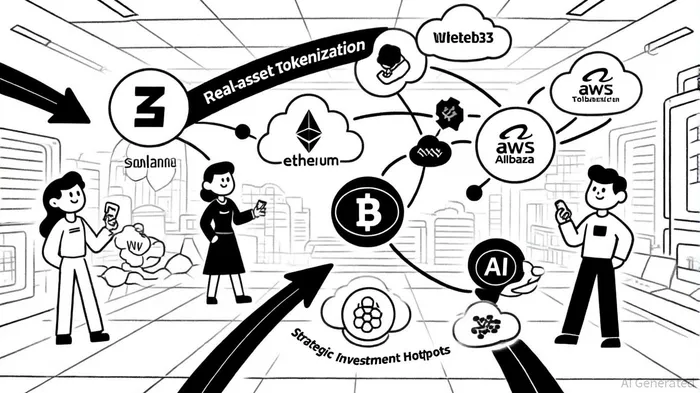
The Web3 infrastructure landscape in 2025 is no longer a speculative frontier but a maturing ecosystem defined by institutional gravity, technological breakthroughs, and regulatory clarity. For investors seeking high-impact entry points, the convergence of these factors creates a unique window to capitalize on scalable, interoperable solutions that underpin the next phase of decentralized innovation.
Institutional Surge and Market Consolidation
According to a report by On the Node, venture capital inflows into Web3 infrastructure startups reached $9.6 billion in Q2 2025, signaling a 68% year-over-year increase[1]. This surge reflects institutional confidence in infrastructure-first strategies, as evidenced by high-profile mergers like Helio's $175 million and Alterya's $150 million acquisitions[1]. These deals underscore a shift toward consolidating fragmented markets, enabling platforms to offer end-to-end solutions for decentralized finance (DeFi), NFT marketplaces, and DAOs.
Technological Advancements: Scalability as a Catalyst
Technological parity with traditional systems is accelerating adoption. Solana's Alpenglow upgrade, for instance, achieved 107,540 transactions per second (TPS)—a 12x leap over Ethereum's current capacity[1]. Such advancements address critical scalability bottlenecks, making Web3 infrastructure viable for enterprise-grade applications. Investors should prioritize protocols and tools that bridge the gap between blockchain performance and real-world use cases, such as cross-chain interoperability platforms and modular smart contract frameworks.
Regulatory Clarity and Global Workforce Expansion
Regulatory uncertainty, once a barrier to institutional participation, is receding. The GENIUS and CLARITY Acts have provided legal frameworks for tokenized assets and decentralized governance, reducing compliance risks[1]. Concurrently, the Web3 industry now employs 460,000 professionals globally, with the US, India, and China accounting for 50% of the workforce despite representing only 37% of the global tech labor pool[2]. This talent concentration creates a competitive edge for regions with supportive policies, offering investors geographic diversification opportunities.
Cost Reductions via Strategic Cloud Partnerships
Operational costs, a historical pain point for Web3 startups, are being slashed through cloud collaborations. Strategic alliances with AWS and Alibaba Cloud have reduced infrastructure deployment costs by up to 50%, enabling rapid scaling[1]. This cost efficiency is particularly attractive for AI-driven analytics tools and real-world asset (RWA) tokenization platforms, which require robust backend systems to process vast datasets and ensure compliance.
Strategic Entry Points for 2025
For investors, the most compelling opportunities lie in:
1. Scalable Layer-1 Protocols: Projects like SolanaSOL-- and CosmosATOM-- that prioritize throughput and interoperability.
2. RWA Tokenization Platforms: Firms bridging physical and digital assets, such as real estate or supply chain solutions.
3. Cloud-Optimized Infrastructure: Startups leveraging AWS/Alibaba partnerships to reduce operational overhead.
4. Regulatory Compliance Tools: Software suites addressing legal uncertainties in DeFi and DAO governance.
Conclusion
The Web3 infrastructure market's 28.54% annual growth rate[2] is notNOT-- merely a function of hype but a response to structural demand for decentralized systems. As institutional capital, regulatory clarity, and technological maturity align, strategic entry points are emerging in scalable protocols, RWA integration, and cloud-optimized solutions. Investors who act decisively in 2025 will position themselves at the forefront of an ecosystem poised to redefine digital ownership and value exchange.






Comentarios
Aún no hay comentarios