
Strategic Entry Points in Undervalued European Equities: A Post-DAX Correction Analysis
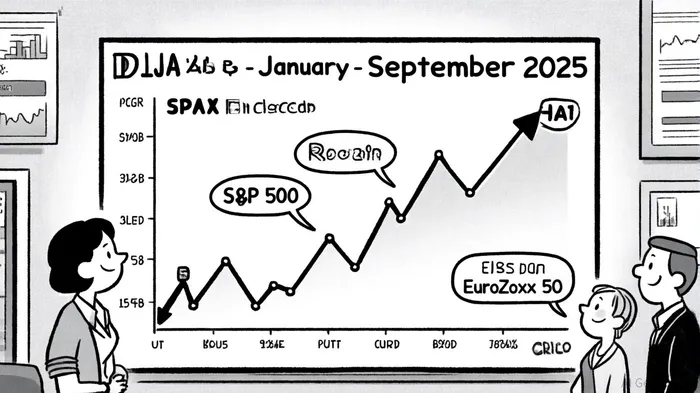
The German DAX index, a bellwether for European equities, has recently retreated from its July 2025 peak of 24,641.50 points, closing at 23,744 points by mid-September 2025[4]. This correction, though modest compared to the index's 34.60% year-to-date gain, has sparked renewed interest in undervalued European equities. With the DAX trading at a price-to-earnings (P/E) ratio of 12.3—well below its historical average and the S&P 500's 21—investors now face a compelling opportunity to reassess risk-rebalance portfolios[1].
The Drivers of DAX's Pre-Correction Rally
The DAX's meteoric rise in 2025 was fueled by a confluence of macroeconomic tailwinds. The European Central Bank's (ECB) aggressive rate-cutting cycle, which brought the official cash rate to 2%, and Germany's €500 billion infrastructure fund injected liquidity into the market[1]. Additionally, global trade dynamics, including the US-EU tariff deal, bolstered export-driven sectors like automotive and industrial manufacturing[2]. Key constituents such as Rheinmetall (up 112%) and Siemens Energy (up 68%) capitalized on defense spending and the energy transition, respectively[3].
However, this growth was uneven. While the DAX's top 10 companies accounted for over 60% of the index's gains, smaller and mid-cap firms lagged, creating a structural imbalance[5]. This concentration, coupled with rising German 10-year bond yields (now 2.78%), has left the index vulnerable to profit-taking and macroeconomic headwinds[3].
The September Correction: A Buying Opportunity?
The DAX's recent volatility—swinging between 23,700 and 23,860 points in a single week—reflects investor caution ahead of the ECB's policy decision and political uncertainty in France[4]. Yet, this correction may be a temporary setback rather than a bearish signal. Historical data shows the DAX has outperformed the Euro Stoxx 50 by an average of 5.7 percentage points annually since 2010[5], suggesting its long-term fundamentals remain intact.
For value-oriented investors, the current P/E discount offers a rare window. German equities trade at a 35% discount to their US counterparts, with sectors like industrial automation, green hydrogen, and e-mobility particularly undervalued[1]. Siemens, for instance, is pioneering smart grid technology and industrial IoT solutions at a P/E of 10.5, while Volkswagen's EV transition is supported by a €20 billion government subsidy[1]. In energy, RWE and E.ON are expanding renewable capacity at a time when Europe's carbon pricing mechanism has surged to €100 per ton[3].
Strategic Entry: Sectors and Instruments
- Industrial Automation & Digital Infrastructure: Siemens and Bosch's software division are beneficiaries of Germany's €10 billion industrial AI fund[1].
- Defense & Security: Rheinmetall's 112% gain in 2025 reflects its dominance in armored vehicles and missile systems, with €30 billion in unfulfilled defense contracts[2].
- Renewables & Hydrogen: RWE's Neurath coal plant conversion to hydrogen production and Linde's electrolyzer projects position them to capture Europe's €180 billion green hydrogen market[1].
For diversified exposure, ETFs like the iShares Core DAX UCITS ETF (P/E 12.1) and thematic funds focused on hydrogen energy or industrial IoT offer lower risk[1]. Additionally, Germany's Mittelstand—family-owned firms like Sartorius (biopharma) and Wacker Neuson (construction tech)—are now accessible via public markets, offering niche expertise and global competitiveness[1].
Conclusion: Balancing Caution and Opportunity
While the DAX's correction reflects short-term macroeconomic jitters, its underlying drivers—ECB easing, fiscal stimulus, and structural shifts in energy and defense—remain intact. For investors with a 3–5 year horizon, the current valuation gap between European and US equities presents a strategic entry point. As one analyst notes, “The DAX's volatility is a feature, not a bug—it's a reflection of Europe's complex but dynamic economic rebalancing”[5].







Comentarios
Aún no hay comentarios