
Strategic Entry Points in the Stablecoin Revolution: Navigating Institutional Adoption and Global Payments Disruption
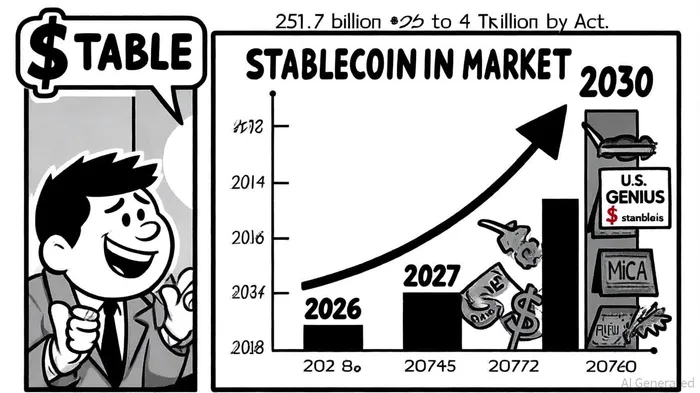
The stablecoin market is no longer a niche corner of crypto—it's a $251.7 billion juggernaut reshaping global finance[5]. By 2028, it could hit $2 trillion, and under a bullish scenario, $4 trillion by 2030[2]. This isn't just speculative hype; it's a structural shift driven by institutional adoption, regulatory clarity, and the urgent need for faster, cheaper cross-border payments. For investors, the question isn't whether to participate—it's how to position for the next phase of this revolution.
The New Infrastructure: Stablecoins as Global Payment Rail
Stablecoins are becoming the backbone of modern financial infrastructure. Institutions are deploying $47.3 billion into yield-generating strategies, with 58.4% allocated to lending protocols like AaveAAVE-- (41.2% market share) and 26.8% to real-yield products[1]. These aren't just crypto-native players; traditional finance giants like BlackRockBLK-- and PayPalPYPL-- are now issuing compliant stablecoins (e.g., USDCUSDC--, PYUSD) to tap into this liquidity.
The dominance of USDC (56.7% institutional share) and USDTUSDT-- (27.9%) underscores the demand for stable, programmable cash equivalents[1]. But the real story is in the use cases: stablecoins are enabling real-time settlements, tokenized treasuries, and even programmable smart contracts for corporate treasuries[3]. For example, USD Coin's integration with BlackRock's infrastructure allows institutions to tokenize cash reserves and generate yields without sacrificing liquidity[1].
Strategic Entry Points for Investors
- Yield-Generating Stablecoins
- Lending Protocols: Aave and CompoundCOMP-- dominate, offering 5.7%–5.3% borrowing rates for USDC and USDT[1]. Conservative investors can lock in 4.1–4.7% via overcollateralized lending, while aggressive allocators chase 8.3–11.2% through yield farming[1].
- Real-Yield Products: Platforms like Maple FinanceSYRUP-- (6.8%) and Goldfinch (9.1%) tokenize short-term Treasuries and commercial paper, blending TradFi safety with DeFi efficiency[1].
Liquid Staking Derivatives (LSDs): Pairing USDC with ETH or SOL LSDs allows dual yield capture, a favorite among balanced-risk portfolios[1].
Regulatory-Compliant Stablecoins
The U.S. GENIUS Act and EU's MiCA have created a “safe harbor” for compliant stablecoins, mandating full reserve backing and monthly transparency reports[4]. USDC and PYUSD are the clear winners here, with PYUSD seeing 140% QoQ growth in institutional adoption[1]. For risk-averse investors, these tokens offer the lowest regulatory friction.Blockchain Ecosystem Diversification
While EthereumETH-- (42.3% institutional deployments) remains the gold standard for security and compliance[1], Layer 2s like Base (11.7%) and ArbitrumARB-- (9.3%) are gaining traction for lower fees and faster transactions[1]. BNBBNB-- Chain and SolanaSOL--, with their 14.1% and 8.7% shares, appeal to investors seeking high throughput and emerging DeFi ecosystems[1].Hedging Against Liquidity Risks
Despite the $27 trillion in 2025 transaction volume[2], liquidity remains a bottleneck for large-scale institutional use. Firms are focusing on high-need corridors like USD-to-emerging markets and euro-to-African remittances[3]. For investors, this means opportunities in stablecoin bridges (e.g., Stargate Finance) and compliance-focused platforms like Yearn Finance and Pendle[1].
The Road Ahead: From Yield Tools to Systemic Infrastructure
By 2025, stablecoins have evolved from speculative assets to foundational infrastructure. They're not just facilitating crypto-native transactions—they're embedded in payment rails (PayPal, Visa), treasury management systems, and even tokenized asset settlements[3]. The next phase will see them competing directly with traditional SWIFT and ACH systems, offering 24/7, near-zero-cost, and programmable alternatives.
For investors, the key is to balance innovation with caution. While USDe's 11% staking yield is tempting[1], it's critical to prioritize stablecoins with audited reserves and regulatory alignment. The market is still evolving, but one thing is clear: stablecoins are no longer a side show—they're the main event.





Comentarios
Aún no hay comentarios