
Strategic Entry Points for Long-Term Investors in Silver Amid 2025 Correction
Strategic Entry Points for Long-Term Investors in Silver Amid 2025 Correction
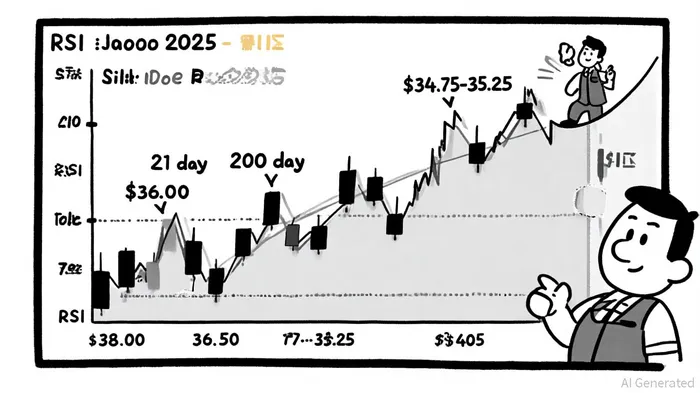
Silver's recent price correction in late 2025 has sparked renewed interest among long-term investors, offering potential opportunities to capitalize on a market still underpinned by robust fundamentals. After surging to 14-year highs near $41.00 per ounce in late 2025, the metal has retreated to the mid-$40s amid profit-taking and a strengthening U.S. dollar, according to a DiscoveryAlert analysis. While short-term volatility remains a concern, the broader bullish narrative-driven by structural supply deficits and surging industrial demand-suggests that this correction may represent a strategic entry point for patient investors.
Technical Analysis: Navigating the Correction
Technical indicators highlight key levels to monitor as the market digests its recent gains. Silver's price action has tested critical support zones, including $38.00, $36.50 (aligned with the rising 21-day moving average), and the Ichimoku cloud range of $34.75–35.25, as noted in the DiscoveryAlert analysis. The $40.00 level, a psychological resistance point, has repeatedly capped advances, while the 25 USD level is seen as a critical long-term support zone, according to the World Silver Survey.
The Relative Strength Index (RSI) currently reflects overbought conditions, with readings above 70 and a 14-day RSI of 73.52, as discussed in Silver Outlook 2025. However, bearish divergence on shorter timeframes-where price highs outpace momentum-suggests weakening short-term strength. Historically, bull markets in silver have experienced corrections of 15–20% within broader uptrends, indicating that the current 5–10% pullback may be a precursor to deeper consolidation, per the DiscoveryAlert analysis. Investors should watch for price compression near key moving averages and a resumption of bullish momentum before committing capital.
Fundamental Drivers: Structural Deficits and Industrial Demand
The case for silver's long-term strength lies in its structural supply-demand imbalance. The World Silver Survey 2025 estimates a cumulative deficit of 796 million ounces from 2021 through the end of 2025, driven by record industrial consumption in solar photovoltaics, electric vehicles (EVs), and next-generation electronics (World Silver Survey 2025). Solar energy alone accounts for 17% of silver usage, with demand projected to grow as global energy transitions accelerate, according to Silver Outlook 2025.
Meanwhile, constrained mine production-largely a byproduct of base-metal mining-limits the ability to scale output quickly. Recycling, while a partial offset, remains inelastic due to logistical delays. ETF inflows have further tightened the market, with global holdings surpassing 1.13 billion ounces in mid-2025, as highlighted in the DiscoveryAlert analysis. These fundamentals, combined with macroeconomic tailwinds like Fed rate cuts and a weakening dollar, create a compelling backdrop for sustained price resilience.
Strategic Entry Points: Timing the Correction
For long-term investors, the current correction offers a disciplined opportunity to accumulate at favorable levels. Historical patterns suggest that corrections of 15–20% often precede resumption of uptrends, making the $38–$36.50 range a high-probability target for strategic entries, per the DiscoveryAlert analysis. A break below $34.75–35.25 would test deeper support but could also trigger renewed buying interest from institutional players and ETFs.
Investors should also consider the broader context: a 25 USD level break would likely trigger a reevaluation of the bullish thesis, potentially extending the correction to 18–20 USD, according to the World Silver Survey. However, given the structural deficits and industrial demand growth, such a scenario appears unlikely unless macroeconomic conditions deteriorate sharply.
Long-Term Outlook and Risks
The base case for 2025 projects silver trading within a $42–$52 range, with aggressive industrial demand and Fed easing potentially pushing prices toward $50–$70 by 2030, as suggested in the DiscoveryAlert analysis. However, risks include sudden shifts in investor sentiment, a surge in recycling, or policy-driven currency stability. That said, the dual role of silver-as both a monetary asset and an industrial commodity-provides a unique buffer against volatility, ensuring its relevance in both inflationary and deflationary environments, as outlined in Silver Outlook 2025.
Conclusion
Silver's recent correction, while unsettling for short-term traders, aligns with historical bull market dynamics and offers a disciplined entry point for long-term investors. By combining technical analysis of key support levels with the structural strength of industrial demand and ETF flows, investors can position themselves to benefit from the metal's long-term trajectory. As the market consolidates, patience and a focus on fundamentals will be critical to navigating this pivotal phase in silver's 2025 rally.







Comentarios
Aún no hay comentarios