
Strategic Entry Points for Investors in Asia-Pacific's Industrial AI and Smart Manufacturing Revolution
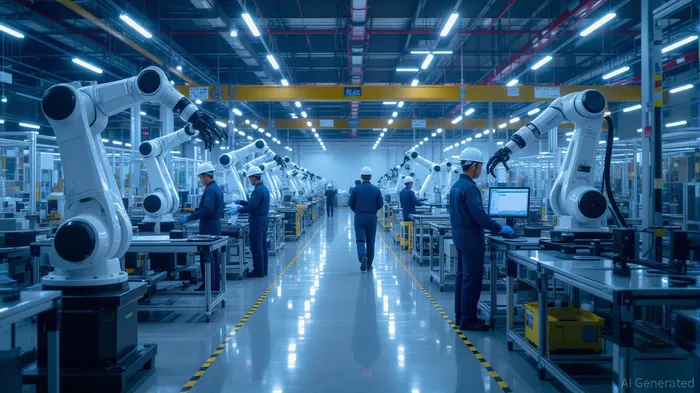
The Asia-Pacific industrial AI and smart manufacturing market is undergoing a seismic shift in 2025, driven by a confluence of technological innovation, policy tailwinds, and sector-specific demand. With the market projected to grow from $58.47 billion in 2025 to $87.03 billion by 2030 at a 8.28% CAGR, investors are faced with a critical question: Where should capital be allocated to capitalize on this transformation? The answer lies in identifying strategic entry points that align with both macroeconomic trends and granular sector dynamics.
Key Trends Reshaping the Landscape
The region's industrial AI and smart manufacturing boom is underpinned by three pillars: AI integration, automation scalability, and government-led digitalization.
AI-Driven Operational Efficiency: Predictive maintenance, computer vision, and natural language processing are no longer niche experiments. For instance, the oil and gas sector in APAC has adopted AI-based systems to monitor equipment in real time, reducing downtime by up to 30%. Similarly, the automotive industry—accounting for 21% of the market—relies on AI to optimize production lines, with China's 50% surge in industrial robot production in 2021 underscoring the shift.
Government Policy as a Catalyst: China's "Made in China 2025" and India's "Make in India" initiatives are accelerating smart manufacturing adoption. Notably, China's 2024 policy to fully open its manufacturing sector to foreign investment has removed barriers for global players, while Singapore's $13.8 billion investment in advanced manufacturing infrastructure positions it as a regional innovation hub.
Sector-Specific Breakouts: Beyond automotive, the pharmaceutical industry is emerging as a high-growth segment, with AI-driven automation addressing post-pandemic quality control challenges. The sector is projected to grow at 10% annually, driven by demand for precision manufacturing and AI-enabled R&D.
Strategic Entry Points for Investors
To navigate this complex landscape, investors must focus on three strategic levers:
Partnership-Driven Innovation: Over 50% of APAC enterprises plan to collaborate with AI partners in 2025, signaling a shift from in-house R&D to ecosystem-based solutions. For example, Singapore's Ignition AI Accelerator, backed by NVIDIANVDA-- and the government, is scaling startups with AI-ready data centers and global market access. Investors should prioritize companies with strong local partnerships, such as Siemens and ABB, which are expanding their APAC footprints through joint ventures.
ROI-Focused AI Deployment: The "Rightsizing AI" trend—favoring smaller, purpose-built models over large language models—is gaining traction. These models, optimized for local languages and computational efficiency, are particularly attractive in cost-sensitive markets like India and Southeast Asia. Investors should target firms offering modular AI solutions, such as those enabling predictive maintenance in the oil and gas sector or agentic AI workflows in logistics.
Human-Centric AI Frameworks: The next frontier is AI that augments human capabilities rather than replaces them. This is evident in healthcare and education, where AI is automating routine tasks to free up workers for creative problem-solving. Companies like Robert Bosch, which integrates AI into employee training programs, are setting benchmarks for sustainable adoption.
Sector-Specific Opportunities
- Automotive: With 21% of the market, this sector is ripe for AI-driven automation. China's push for EVs and smart factories, coupled with Japan's robotics expertise, creates a dual opportunity for investors.
- Pharmaceuticals: AI's role in accelerating drug discovery and ensuring compliance with stringent quality standards is unlocking new value.
- Cybersecurity: As industrial systems become interconnected, the cybersecurity segment is growing at 12% CAGR. This is a defensive play within the broader smart manufacturing ecosystem.
Government Incentives and Policy Reforms
Policy tailwinds are a critical enabler. China's removal of foreign ownership restrictions in manufacturing, India's focus on AI-powered fintech (projected to raise $65.5 billion by 2025), and Singapore's AIDA grant (offering up to S$500,000 for AI projects) are reshaping the investment calculus. Investors should monitor regulatory updates in these markets, as policy shifts can unlock or constrain opportunities.
Investment Advice and Conclusion
For investors, the APAC industrial AI and smart manufacturing market offers a dual opportunity: long-term growth and short-term scalability. Prioritize sectors with clear ROI metrics (e.g., automotive, pharmaceuticals) and companies with strong local partnerships. Additionally, consider thematic ETFs or private equity funds focused on AI-driven manufacturing in the region.
The key is to act now, as the window for early-stage entry is narrowing. By 2030, the market will be dominated by a few industry leaders, leaving latecomers with limited upside. For those who position themselves strategically in 2025, the rewards could be transformative.







Comentarios
Aún no hay comentarios