
Strategic Entry Points for Institutional Investors in Grayscale's Digital Large Cap Fund
Institutional investors navigating the evolving crypto asset class in 2025 face a unique confluence of opportunities and challenges. The Grayscale Digital Large Cap Fund (GDLC) has emerged as a pivotal vehicle for accessing diversified exposure to digital assets, but its strategic value hinges on understanding market dynamics, regulatory shifts, and structural inefficiencies.
GDLC: Structure, Fees, and Performance
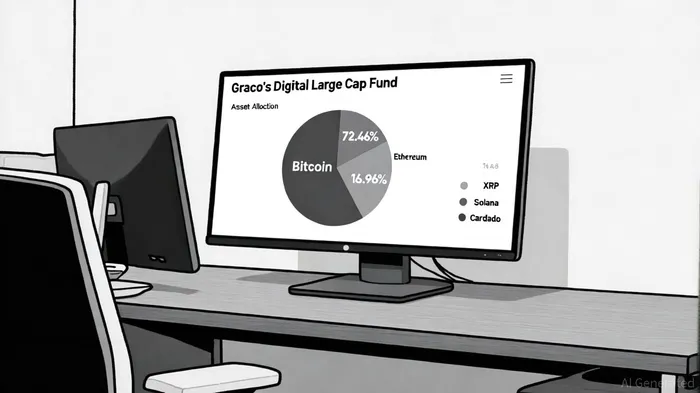
The Grayscale Digital Large Cap Fund, structured as a Cayman Islands limited liability company, offers institutional investors a basket of large-cap digital assets weighted by market capitalization. As of September 9, 2025, BitcoinBTC-- constitutes 72.46% of the fund, followed by EthereumETH-- at 16.96%, with smaller allocations to XRPXRP--, SolanaSOL--, and CardanoADA-- [1]. The fund's total expense ratio of 2.50% positions it as a premium product compared to traditional ETFs, which often charge less than 0.75% [4]. Despite this, GDLC's assets under management (AUM) have surged to $878.49 million, reflecting strong institutional demand for crypto exposure [1].
Performance metrics underscore GDLC's appeal: its net asset value (NAV) per share has increased by 81.11% since inception, while the market price has surged 165.87%, driven by speculative trading and liquidity imbalances [1]. However, the fund's shares, listed on the OTC Markets Group, have historically traded at significant premiums or discounts to NAV—a structural inefficiency that complicates valuation for institutional investors [2].
Regulatory Tailwinds and Strategic Entry Points
The U.S. Securities and Exchange Commission's (SEC) recent approval of generic listing standards for commodity-based ETFs has reshaped the crypto landscape [3]. This regulatory shift streamlines the approval process for new crypto ETFs, reducing uncertainty for issuers and investors alike. For institutional investors, the SEC's openness to products like GDLC—paired with the approval of options tied to the Cboe Bitcoin U.S. ETF Index—signals a maturing market infrastructure [3].
Strategic entry points for institutions have emerged amid Q3 2025 volatility. Bitcoin's price, trading around $108,000, and Ethereum's dip into the $2,100–$2,200 range have drawn institutional interest, particularly as firms like BlackRockBLK-- accumulate large ETH positions [4]. Dollar-cost averaging and diversified allocations are increasingly favored to mitigate risks associated with crypto's inherent volatility [4].
Comparative Advantages and Challenges
While GDLC offers a diversified approach to crypto investing, its 2.50% expense ratio lags behind competitors like BlackRock and Fidelity, which offer crypto ETFs with fees as low as 0.25% [4]. This pricing pressure highlights the need for Grayscale to innovate or adjust fees to retain institutional clients. Additionally, the fund's OTC structure—where shares trade at premiums or discounts—introduces liquidity risks not present in traditional ETFs, which trade at real-time NAV [1].
In contrast, traditional mutual funds and private equity vehicles remain less liquid and more costly, with expense ratios typically exceeding 1.5% [4]. Crypto ETFs, including GDLC, bridge this gap by offering intraday trading and tax efficiency through in-kind creation/redemption mechanisms [4]. For institutions seeking exposure to digital assets without the complexities of custody, GDLC's basket approach provides a compelling alternative to direct holdings.
Conclusion
Grayscale's Digital Large Cap Fund represents a strategic entry point for institutional investors seeking diversified crypto exposure in a regulatory-evolving environment. While its premium fees and OTC inefficiencies pose challenges, the fund's alignment with the CoinDesk 5 Index and regulatory tailwinds make it a viable option for long-term portfolios. As the SEC continues to normalize crypto ETFs, institutions must balance cost considerations with the need for liquidity and diversification. For those adopting disciplined strategies—such as dollar-cost averaging—GDLC's current valuation and market dynamics present a unique opportunity to capitalize on the crypto asset class's growth trajectory.





Comentarios
Aún no hay comentarios