
Strategic Entry Points in Asian ADRs: Navigating 2025's High-Growth Opportunities for U.S. Investors
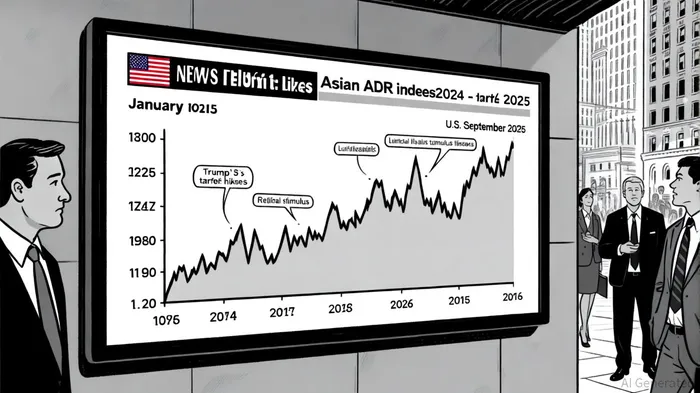
The surge in Asian American Depositary Receipts (ADRs) in 2025 reflects a complex interplay of resilience, policy-driven tailwinds, and geopolitical headwinds. For U.S. investors seeking high-growth emerging markets exposure, the current landscape offers both caution and opportunity. While U.S. tariffs under the Trump administration have disrupted supply chains and created uncertainty, certain Asian markets are adapting through fiscal stimulus, regional cooperation, and structural reforms. This analysis identifies strategic entry points for investors willing to navigate the volatility and capitalize on long-term growth drivers.
1. Regional Resilience: China, Japan, and India as Anchors
China's equity markets have demonstrated remarkable resilience despite external pressures. Stimulus measures such as interest rate cuts and reduced reserve requirements have bolstered domestic demand, stabilizing investor confidence[3]. The MSCI China ADR Index, though volatile, has shown a 12% rebound since May 2025, driven by state-backed infrastructure projects and green energy investments[3]. U.S. investors with a medium-term horizon may find value in Chinese ADRs tied to sectors like renewable energy and consumer discretionary, where domestic demand buffers offset export slowdowns[2].
Japan's Nikkei 225, now at record highs, underscores the appeal of corporate earnings growth and yen weakness. With Japan's trade deal with the U.S. reducing tariffs to 15% (from 25%), the country's export-oriented sectors—particularly automotive and electronics—are regaining competitiveness[1]. The Nikkei ADR index has outperformed its peers by 8% year-to-date, making it a compelling entry point for investors seeking exposure to a mature market with strong fundamentals[3].
India's rise as a global economic powerhouse is another key trend. The MSCI India ADR index has surged 18% in 2025, fueled by robust liquidity, favorable demographics, and aggressive corporate share sales[3]. As India surpasses China in the MSCI All-Country World Index, U.S. investors can consider ADRs in sectors like IT services, pharmaceuticals, and consumer goods, where India's structural advantages are most pronounced[3].
2. Southeast Asia: Navigating Tariff Risks and Regional Synergies
Southeast Asian ADRs face headwinds from U.S. tariffs, which have slashed ASEAN's 2025 growth forecast to 4.5%[2]. However, countries like Malaysia and the Philippines are outperforming due to strong domestic demand and diversification into U.S. supply chains[2]. For instance, Malaysian ADRs in the electronics and palm oil sectors have shown resilience, with earnings growth outpacing regional averages[2].
The Philippines, meanwhile, is leveraging its labor force and low-cost manufacturing base to attract U.S. investment. ADRs in Philippine banking and real estate are particularly attractive, given the country's 6.5% GDP growth projection for 2025[2]. Investors should monitor ASEAN's efforts to strengthen regional trade pacts, which could mitigate U.S. tariff impacts and create new export corridors[1].
3. Strategic Sectors: Semiconductors, Green Energy, and Consumer Demand
The semiconductor sector, a critical component of global supply chains, is experiencing a moderation in growth. While global shipments are expected to slow to 9.3% in 2025, U.S. investors can target ADRs in companies with strong R&D pipelines or partnerships with U.S. firms[2]. Taiwan's TSMC, despite facing 100% U.S. tariffs, is expanding its U.S. footprint, offering a paradoxical opportunity for investors willing to hedge against geopolitical risks[1].
Green energy and infrastructure ADRs also present long-term potential. China's stimulus packages and Japan's trade deal include significant investments in renewable energy, creating tailwinds for ADRs in solar, wind, and battery technologies[3]. Additionally, India's push for electric vehicles and smart cities could drive demand for ADRs in related sectors[3].
4. Tactical Entry Points: Timing the Market Amid Policy Uncertainty
The recent 90-day tariff pause between the U.S. and China, coupled with Japan's trade deal, offers a window for strategic entry. U.S. investors should prioritize ADRs in markets with strong balance sheets and low debt-to-GDP ratios, such as Singapore and South Korea[2]. These economies are better positioned to weather policy shifts and maintain growth trajectories.
For high-risk tolerance investors, ADRs in Vietnam and Thailand—despite facing 40% U.S. tariffs—could offer asymmetric upside if regional trade agreements offset export losses[2]. The key is to diversify across sectors and geographies to mitigate exposure to any single policy shock.
Conclusion: Balancing Caution and Opportunity
The surge in Asian ADRs in 2025 is a testament to the region's adaptability in the face of global headwinds. While U.S. tariffs and policy uncertainty persist, structural trends in domestic demand, regional cooperation, and sectoral innovation create compelling entry points for U.S. investors. By focusing on resilient markets like India and Japan, diversifying into Southeast Asia's high-growth economies, and targeting sectors with long-term tailwinds, investors can position themselves to capitalize on Asia's evolving economic landscape.







Comentarios
Aún no hay comentarios