
Strategic Entry into Junior Mining Equities: Navigating Cohort-Driven Cycles and Volatility in 2025
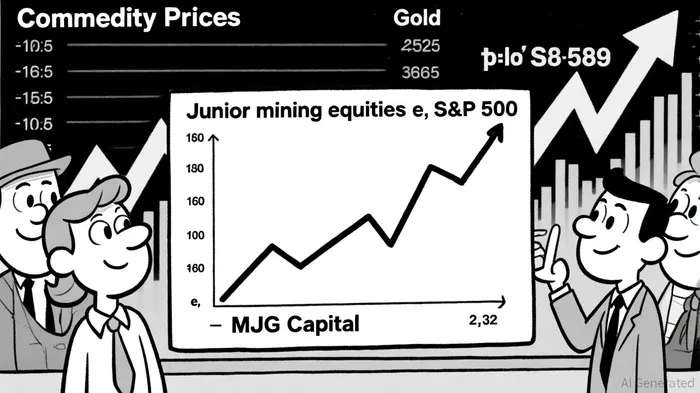
Junior mining equities have long been a double-edged sword for investors: offering outsized returns during bull markets but collapsing disproportionately during downturns. This cohort-driven performance pattern is rooted in the sector's structural vulnerabilities—smaller market caps, speculative project pipelines, and reliance on capital flows. Yet, 2025 presents a unique inflection pointIPCX--. Historical cycles, macroeconomic tailwinds, and undervaluation metrics suggest that junior miners could transition from laggards to leaders, provided investors adopt a disciplined, high-conviction approach.
Historical Underperformance: A Structural Disconnect
Junior mining equities have consistently underperformed the commodities they represent during bull markets. In 2024, for instance, gold prices surged 27% while junior gold equities, as tracked by MJG Capital, delivered a meager 6.7% return [1]. Copper prices rose 8%, yet junior copper developers failed to reflect this growth [1]. This disconnect is not new. Over the past decade, junior miners have averaged a 1.5x beta to commodities, amplifying losses during bear markets but failing to fully capitalize on bull runs [3].
The root causes are twofold. First, prolonged underinvestment in exploration has created a supply bottleneck for critical metalsCRML-- like lithium and copper, delaying production timelines and eroding investor confidence [2]. Second, junior miners often lack the financial resilience of senior peers, making them vulnerable to liquidity crunches during market stress [3]. For example, during the 2019–2020 correction, over 70% of junior mining projects failed to reach production, exacerbating sector-wide underperformance [1].
Undervaluation Metrics Signal a Reversal
The S&P GSCI Total Return Index/S&P 500 ratio, a key indicator of commodity equity valuations, is at multi-decade lows [2]. This suggests that commodities—and by extension, junior miners—are historically undervalued relative to equities. Historically, such divergences have preceded capital inflows into resource sectors. For example, during the 2008–2009 crisis, the ratio bottomed at similar levels before junior miners outperformed the S&P 500 by 300% over the next three years [3].
Current macroeconomic conditions further amplify this case. Central banks are signaling rate cuts, and global demand for critical metals is surging due to the energy transition. Copper, for instance, is projected to see a 12-month lag in outperforming gold, following gold's breakout in March 2024 [1]. This creates a “trickle-down” effect: as capital rotates into mid-tier and senior miners, junior developers with high-grade projects could see valuation multiples expand.
Volatility as a Double-Edged Sword
Junior mining equities are inherently volatile, often swinging 30–40% on speculative news or macroeconomic shifts [4]. While this volatility deters risk-averse investors, it also creates asymmetric opportunities. Top-performing juniors—such as Amaroq Minerals and ECR Minerals—have demonstrated 10x–100x returns by capitalizing on exploration milestones and commodity price surges [2]. However, success requires rigorous due diligence. Investors must prioritize companies with:
1. Defined catalysts (e.g., drill results, partnerships, or permitting progress).
2. Economically viable projects in politically stable jurisdictions.
3. Strong balance sheets to weather market volatility.
Strategic Entry in 2025: A Case for High-Conviction Plays
The current environment favors strategic entry into junior mining equities. With gold and copper prices already trending upward and the S&P GSCI/S&P 500 ratio near historical troughs, the sector is primed for a capital reallocation. However, investors must avoid broad-based bets and instead focus on high-conviction exploration plays. For example, companies with advanced-stage lithium or rare earth element projects in regions like Greenland or Australia are well-positioned to benefit from the energy transition [2].
Technical indicators also support a bullish case. The inverse head-and-shoulders pattern on the TSXV, a major junior mining exchange, suggests a potential breakout is imminent [3]. This aligns with historical patterns where junior miners outperformed during bull cycles, particularly when macroeconomic conditions (e.g., falling interest rates) improved risk appetite.
Conclusion
Junior mining equities remain a high-risk, high-reward asset class. Yet, 2025 offers a rare confluence of undervaluation, macroeconomic tailwinds, and structural supply constraints that could catalyze a sector-wide rebound. For investors willing to navigate the volatility, the key lies in identifying projects with clear catalysts and strong commodity leverage. As history shows, the most successful junior miners are not those that follow the crowd but those that capitalize on the inevitable capital rotation when the tide turns.







Comentarios
Aún no hay comentarios