
Strategic Entry of Asian and European Branded Drugs into the U.S. Market: Untapped Growth and Competitive Edge in a Shifting Regulatory Landscape
The U.S. pharmaceutical market remains a global gold standard, driven by its size, innovation incentives, and regulatory influence. However, the landscape is evolving rapidly. Recent U.S. regulatory reforms and trade policies have created both hurdles and opportunities for international players. Asian and European pharmaceutical companies are now leveraging expedited pathways, strategic partnerships, and localized manufacturing to navigate these changes—unlocking untapped growth in a market where 52% of 2024 FDA approvals targeted orphan diseases and oncology therapies [1].
Regulatory Reforms: Accelerated Pathways and the CNPV Program
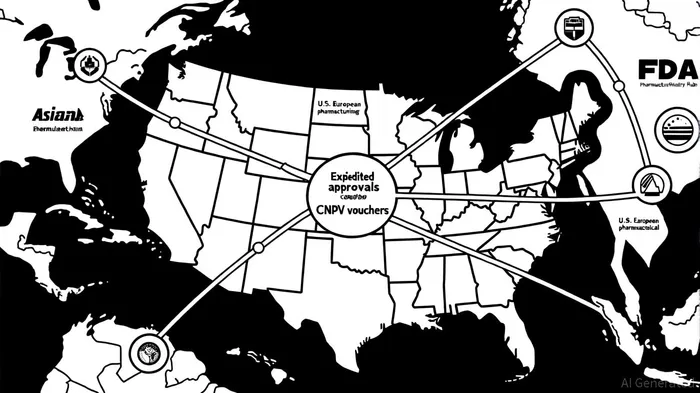
The FDA's 2024–2025 reforms have redefined the approval landscape. The Commissioner's National Priority Voucher (CNPV) program, launched in June 2025, offers a 1–2 month review window for therapies addressing public health crises, unmet medical needs, or domestic manufacturing gaps [2]. This initiative, coupled with the Breakthrough Therapy and Real-Time Oncology Review (RTOR) programs, has become a critical tool for international firms. For instance, Junshi Biosciences of China secured FDA approval for its nasopharyngeal cancer therapy, toripalimab, in 2023 by aligning with U.S. regulatory priorities [3]. Similarly, BeOne Biotech (Singapore) leveraged expedited pathways to gain approval for an esophageal cancer treatment in 2024 [3].
The CNPV program's emphasis on domestic supply chain resilience has also incentivized Asian biotechs to onshore manufacturing. Companies with capabilities in antibody-drug conjugates (ADCs) and AI-driven drug discovery are particularly well-positioned to benefit [4].
Trade Barriers and Strategic Adaptation
U.S. trade policies have introduced significant friction. Tariffs on Chinese APIs (up to 245%) and medical devices from Canada/Mexico (25%) have strained global supply chains [5]. European firms face 15% tariffs on branded drugs under the U.S.–EU trade deal, with annual losses projected at USD 13–19 billion [6].
To mitigate these risks, European companies are investing heavily in U.S. manufacturing. AstraZeneca, GSK, and Novartis have announced USD 10–20 billion in U.S. facility expansions by 2030, aiming to localize production and bypass tariffs [6]. Meanwhile, Asian firms are adopting hybrid strategies: partnering with U.S. commercialization experts while maintaining R&D in Asia. For example, BeOne Biotech partnered with U.S. firms to distribute its FDA-approved therapies, avoiding the need for full-scale U.S. manufacturing [3].
Untapped Opportunities in Rare Diseases and Oncology
The U.S. remains a critical market for rare disease and oncology therapies, where 50% of 2023 FDA approvals targeted orphan indications [7]. Asian and European biotechs are capitalizing on this trend. Junshi Biosciences and BeOne Biotech have focused on oncology, while European firms are leveraging the ORIGINS Initiative (a collaboration with the FDA) to streamline approvals for rare disease treatments [6].
The Inflation Reduction Act and Most Favored Nation (MFN) pricing policies further tilt the playing field. While these measures aim to lower drug costs, they create pricing pressures for international firms. However, companies with therapies under the CNPV program or those targeting unmet needs (e.g., rare cancers) can command premium pricing, as these designations often exempt them from MFN constraints [2].
Investment Implications and Risks
For investors, the key opportunities lie in:
1. CNPV-Eligible Therapies: Firms with pipelines aligned with U.S. public health priorities (e.g., pandemic preparedness, oncology).
2. U.S.-Onshored Manufacturing: European companies expanding domestic facilities to avoid tariffs.
3. Partnership-Driven Models: Asian biotechs leveraging U.S. commercialization expertise without full capital outlay.
Risks include regulatory uncertainty post-FDA workforce reductions and geopolitical tensions. The 20% reduction in FDA staff in 2025 has already caused delays in approvals, raising concerns about consistency [8]. Additionally, U.S. tariffs on Asian APIs could force companies to diversify supply chains, increasing costs.
Conclusion
The U.S. market's regulatory and trade dynamics are reshaping the competitive landscape. Asian and European firms that adapt swiftly—by embracing expedited pathways, onshoring manufacturing, and targeting high-value niches like rare diseases—stand to gain a significant edge. For investors, these companies represent a compelling opportunity to capitalize on a market where innovation and agility are rewarded.







Comentarios
Aún no hay comentarios