
The Strategic Edge of Whitelisting in Emerging Crypto Projects like Apeing and the Role of Established Chains in the Next Bull Run
Whitelisting: The Gateway to Community-Driven Growth
Whitelisting is no longer just a technical hurdle-it's a strategic lever for fostering early adoption. Apeing's approach exemplifies this. By offering priority allocation and early access to its presale, the project has created a sense of exclusivity that drives demand according to its official site. This strategy aligns with broader research showing that structured access mechanisms significantly boost long-term token adoption as studies indicate. Apeing's whitelist also emphasizes transparency, requiring third-party audits before allowing participation, which builds trust in a space often plagued by speculative hype according to project documentation.
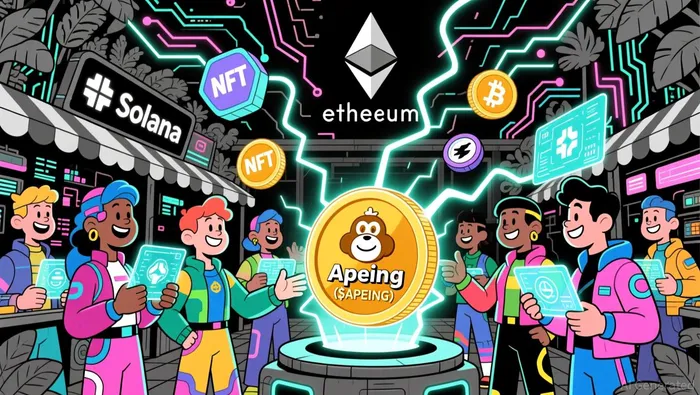 The results speak for themselves. Post-whitelist, Apeing's community has grown rapidly, fueled by a blend of humor, cultural relevance, and technical rigor. This mirrors historical patterns where projects with strong community foundations outperform during bull runs. For instance, Solana-based memeMEME-- coins like DogwifhatWIF-- (WIF) and BonkBONK-- (BONK) surged during the 2024-2025 cycle, partly due to their ability to tap into viral communities according to Solana analysis. Apeing's EthereumETH-- deployment further amplifies this effect, leveraging the network's robust infrastructure to ensure scalability and security as reported by MEXC.
The Infrastructure Edge: Ethereum vs. Solana
While whitelisting drives community engagement, the choice of blockchain determines how quickly a project can scale. Ethereum and SolanaSOL--, two of the most dominant Layer-1 networks, offer distinct advantages that amplify momentum during bull runs.
Ethereum remains the bedrock of decentralized finance (DeFi) and smart contracts, with a total value locked (TVL) of $362.7 billion as of late 2025 according to MEXC. Its ecosystem has seen over 16,000 new developers in 2025 alone, reinforcing its position as the most actively developed blockchain as reported by Yahoo Finance. Projects like Apeing benefit from Ethereum's institutional credibility and mature tooling, which attract both retail and institutional investors. However, Ethereum's slower transaction speeds and higher gas fees can be a bottleneck for projects requiring rapid execution.
Solana, by contrast, has surged in popularity due to its 198% TVL growth over the past year, reaching $38.5 billion as reported by MEXC. Its ability to process 65,000 transactions per second at a cost of $0.00025 per transaction makes it ideal for high-volume use cases like tokenized assets and meme coins according to Solana analysis. Solana's 35% monthly growth in tokenized assets-compared to Ethereum's 2%-highlights its edge in real-world adoption as reported by MEXC. For projects like Apeing, Solana's efficiency could have accelerated liquidity and reduced friction during the presale phase, though Apeing's Ethereum deployment underscores the network's enduring appeal for projects prioritizing security and brand recognition.
Timing and Momentum: The Bull Run's Double-Edged Sword
The interplay between whitelisting and blockchain infrastructure is most evident in timing. Projects that launch during quiet market periods-when competition is lower and retail FOMO is high-often see explosive growth. Apeing's whitelist strategy, for example, allows participants to join during "quieter market hours," avoiding the volatility of peak hype cycles according to market analysis. This aligns with historical trends where early access to projects like BitcoinBTC-- Munari (BTCM) and Dogwifhat (WIF) led to outsized returns for presale participants as noted in reports and according to Solana analysis.
However, timing alone isn't enough. The momentum generated by a project depends on its ability to leverage the strengths of its chosen blockchain. Ethereum's institutional backing and DeFi integration make it a safe bet for projects aiming for long-term stability, while Solana's speed and cost efficiency cater to projects needing rapid scalability. For instance, Solana's tokenized stock market grew $69.2 million in three months, dwarfing Ethereum's $274.8 million in the same category as reported by MEXC. This suggests that projects prioritizing speed and affordability may outperform during bull runs, even if they lack Ethereum's brand equity.
Strategic Implications for Investors
For investors, the key takeaway is clear: whitelisting and blockchain infrastructure are not just technical details-they're strategic assets. Projects that combine early access incentives with the right blockchain can capture both retail and institutional demand. Apeing's Ethereum deployment, for example, balances trust and scalability, while Solana's infrastructure offers a blueprint for rapid growth.
Moreover, the 2024-2025 bull run has shown that regulatory clarity and central bank adoption (e.g., Bitcoin ETFs and CBDCs) are amplifying the impact of these strategies according to IPR research. As policymakers adapt to the rise of digital assets, projects with strong community foundations and efficient infrastructure will be best positioned to capitalize on the next wave of momentum.
In the end, the next bull run will reward those who understand that timing is everything-but only if you're on the right blockchain.






Comentarios
Aún no hay comentarios