
Strategic Crossover: How Linde's CFO Appointment to Stoke Space Signals Convergence of Industrial Infrastructure and Space Commercialization
The global space economy, now valued at $613 billion in 2024, is undergoing a seismic shift as industrial giants and space startups forge strategic alliances to unlock commercial potential according to the Space Foundation. Linde's recent appointment of CFO Matt White to Stoke Space's board exemplifies this trend, signaling a broader convergence of industrial infrastructure and space commercialization. This move, coupled with cross-industry leadership patterns, underscores the sector's maturation and its implications for investors navigating this high-growth frontier.
Linde's Strategic Move: Bridging Industrial Expertise and Aerospace Ambition
Linde, a century-old industrial gas giant, has long supported the U.S. space industry, but its 2025 decision to place CFO Matt White on Stoke Space's board marks a pivotal step. White, who oversees global financial operations for LindeLIN--, brings two decades of experience in managing large-scale capital programs and complex supply chains. His appointment aligns with Stoke Space's mission to develop reusable rocket systems, a venture requiring not only technological innovation but also robust financial planning and risk management.
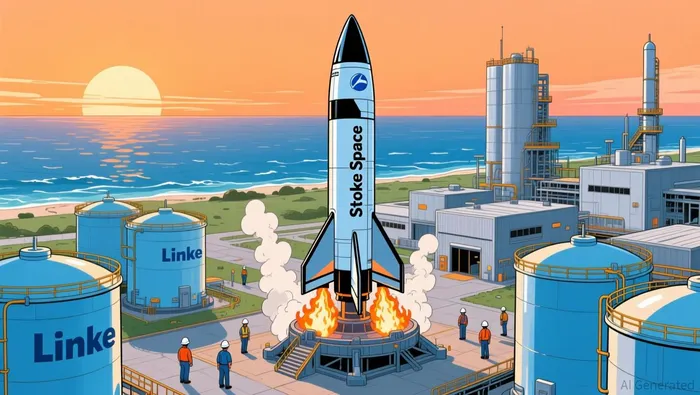 Linde's rationale is clear: by leveraging White's expertise, the company aims to strengthen governance and strategic direction for Stoke Space, ensuring alignment with industrial-grade standards. This partnership is further reinforced by Linde's 2025 investments to expand liquid oxygen, nitrogen, and argon production near Cape Canaveral and Brownsville, Texas-critical infrastructure for rocket launches and spacecraft manufacturing according to industry analysis. Such moves highlight how industrial firms are not merely supplying components but embedding themselves in the value chains of space startups, creating symbiotic ecosystems.
Cross-Industry Leadership: A Catalyst for Sector Growth
Linde's crossover is part of a larger pattern. Over the past five years, industrial sector leaders have increasingly joined space firms, driven by the sector's projected $1.8 trillion valuation by 2035. For instance, private equity firm AE Industrial Partners invested in Redwire Space, a company specializing in space infrastructure and robotics, enabling it to scale operations and develop deployable satellite structures. Similarly, Voyager Space Holdings has acquired multiple smaller firms to streamline deep-space exploration technologies according to industry reports. These cases illustrate how cross-industry leadership mitigates the high capital intensity and technical complexity of space ventures, attracting investment by validating business models through proven industrial expertise.
The strategic value of such appointments lies in their ability to bridge operational gaps. Industrial executives bring experience in managing global supply chains, optimizing capital allocation, and navigating regulatory frameworks-skills critical for scaling space startups. For example, SpaceX's success in reducing launch costs through reusable rocket technology has been mirrored by cross-industry collaborations, such as partnerships with semiconductor firms to develop advanced propulsion systems.
Investment Implications: From Infrastructure to Innovation
The convergence of industrial and space sectors is reshaping investment dynamics. Venture capital funding for space ventures exceeded $1 billion annually in 2023 and 2024, with projections for similar growth in 2025 according to Deloitte analysis. This surge is fueled by public-private partnerships, such as the U.S. government's $77 billion 2024 investment in national security and civil space programs according to Space Foundation data, and policy reforms like President Trump's 2025 executive order streamlining commercial space regulations according to legal experts. These developments lower entry barriers for startups while enhancing the scalability of industrial players like Linde.
However, challenges persist. Space debris management, regulatory uncertainty and the need for sustainable orbital practices remain critical risks. Investors must also weigh the capital intensity of space ventures against their long-term commercial viability. For instance, while in-space manufacturing and satellite broadband offer transformative potential, their returns depend on infrastructure development and market adoption rates.
Conclusion: A New Frontier for Strategic Investors
Linde's appointment of Matt White to Stoke Space's board is more than a corporate maneuver-it is a harbinger of a broader trend: the integration of industrial infrastructure into the space economy. As cross-industry leadership accelerates innovation and de-risks high-stakes ventures, investors are presented with opportunities across satellite services, propulsion technologies, and orbital logistics. Yet, success will require a nuanced understanding of both technical and financial ecosystems. For those who recognize the strategic crossover between Earth and orbit, the space economy's $1.6 trillion potential by 2040 is not just a forecast-it is an invitation to redefine the boundaries of industrial and commercial ambition.







Comentarios
Aún no hay comentarios