
Strategic Corporate Partnerships in the EV Supply Chain: Catalyzing Investor Confidence and Share Price Momentum
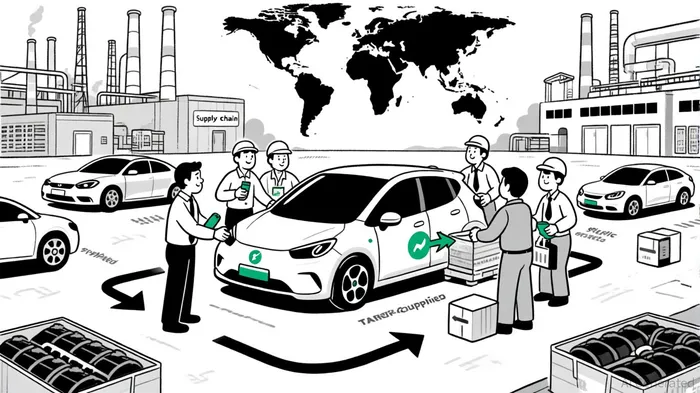
The electric vehicle (EV) industry is undergoing a seismic shift as companies navigate volatile markets, geopolitical tensions, and technological disruptions. Central to this transformation is the strategic reconfiguration of supply chain partnerships, which are increasingly shaping investor sentiment and stock price trajectories. Recent case studies from General MotorsGM-- (GM), TeslaTSLA--, and Contemporary Amperex Technology (CATL) underscore how revised financial and supply agreements can serve as catalysts for market confidence, even amid broader industry headwinds.
GM's Supply Chain Reinvention: A Blueprint for Resilience
General Motors has emerged as a case study in proactive supply chain management. The automaker's $625 million investment in Lithium Americas' Thacker Pass lithium project and a multi-billion-dollar partnership with Vianode to secure anode materials exemplify a dual strategy of vertical integration and localized sourcing, according to a Nasdaq analysis. These moves, aimed at insulating the company from global supply chain shocks, have directly correlated with a 50% surge in GM's stock price over the past year. Investors appear to value the company's commitment to securing raw materials at scale, particularly as the Inflation Reduction Act (IRA) incentivizes domestic production. By anchoring its supply chain to U.S.-based resources, GMGM-- has mitigated risks associated with geopolitical bottlenecks and positioned itself as a beneficiary of long-term electrification goals.
Tesla's Geopolitical Hedging: Diversification Amid Tariff Pressures
Tesla's $4.3 billion agreement with LG Energy Solution (LGES) to produce lithium iron phosphate (LFP) batteries in Michigan underscores the urgency of supply chain diversification. This partnership, spanning 2027–2030 with extension options, is a direct response to U.S. tariffs on Chinese battery imports, which could reach 82.4% by 2026. By securing a domestic LFP supplier, Tesla not only reduces exposure to trade policy risks but also aligns with IRA tax credits for local production. The deal complements a broader $16.5 billion semiconductor agreement with Samsung Electronics, further illustrating Tesla's pivot toward regionalized supply chains.
The financial implications are stark: Tesla's energy storage segment, which relies on these partnerships, generated $10 billion in revenue in 2024-a 67% year-over-year increase. While energy storage accounts for just 10% of total revenue, its growth trajectory has become a critical buffer against automotive sales volatility. Analysts note that Tesla's ability to navigate tariff pressures through strategic alliances has bolstered investor confidence, particularly as the company anticipates 50% growth in battery storage installations for 2025.
CATL's Domestic Dominance: Navigating a Price War
In contrast to GM and Tesla's outward-facing strategies, CATL's resilience highlights the importance of technological differentiation. Despite a 15% net profit growth in 2024-the slowest in six years-CATL maintained its market leadership by integrating advanced battery technologies (e.g., 4C/5C super charging) into high-profile models like the Xiaomi SU7, as reported by Drive Tesla Canada. However, the company's market capitalization dipped to a three-year low amid a price war in China's EV market and declining raw material prices. This duality-strong operational performance versus muted investor sentiment-reflects the challenges of sustaining margins in a hyper-competitive landscape.
CATL's experience underscores a critical lesson: even dominant players must continuously innovate to retain market confidence. While its partnerships with domestic automakers remain robust, the company's stock performance suggests that investors are increasingly prioritizing supply chain agility and cost optimization over short-term profitability.
Broader Industry Trends: Policy, Competition, and Investor Sentiment
The EV sector's volatility is further amplified by policy uncertainty. J.D. Power projects that the EV retail share will stabilize at 9.1% in 2025 as federal incentives and tariffs reshape consumer behavior. Meanwhile, the combined market capitalization of pure EV players fell below that of traditional automakers in Q1 2024, despite strong financial performance, according to an eMobilityPlus analysis. This shift reflects investor skepticism toward unproven business models and a preference for companies with diversified, resilient supply chains.
Conclusion: Strategic Alliances as a Market Signal
The EV industry's next phase will be defined by companies that treat supply chain partnerships as strategic assets rather than operational necessities. GM's localized sourcing, Tesla's geopolitical hedging, and CATL's technological focus all demonstrate how revised agreements can signal long-term resilience to investors. As tariffs, raw material prices, and regulatory frameworks continue to evolve, firms that prioritize agility and transparency in their supply chains are likely to outperform peers in both earnings and share price momentum. For investors, the lesson is clear: in an era of uncertainty, strategic corporate partnerships are not just a buffer-they are a catalyst for value creation.





Comentarios
Aún no hay comentarios