
The Strategic Value of Corporate Bitcoin Holdings: Lessons from Strategy's $73 Billion Bitcoin Bet
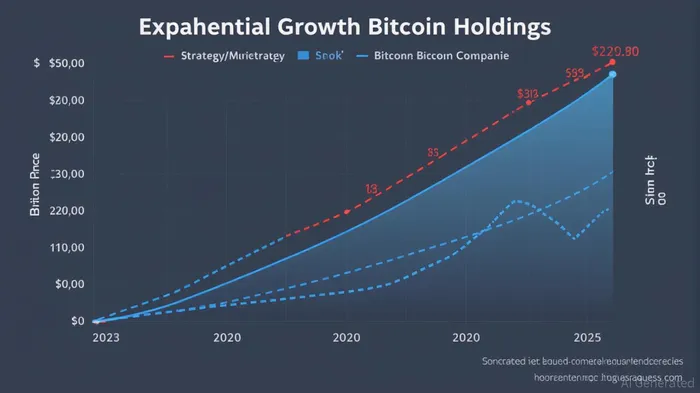
In 2025, BitcoinBTC-- has transcended its origins as a speculative asset to become a cornerstone of corporate treasury strategies. The most striking example is StrategyMSTR-- (formerly MicroStrategy), which has transformed its balance sheet into a $73 billion Bitcoin accumulation vehicle. This case study, alongside broader trends in corporate adoption, reveals how Bitcoin is reshaping long-term value creation through inflation hedging, portfolio diversification, and financial innovation.
The Strategy Model: Debt, Bitcoin, and Shareholder Value
Strategy's aggressive Bitcoin strategy, initiated in 2020, epitomizes the shift in corporate treasury management. By issuing over $2 billion in convertible bonds and preferred shares, the company funded the purchase of 528,185 BTC by mid-2025, accounting for 76% of all corporate Bitcoin holdings [1]. This debt-driven approach, while controversial, has delivered extraordinary returns. Between 2024 and 2025, Strategy's stock surged 313%, outpacing traditional equities and demonstrating the market's appetite for Bitcoin-linked value propositions [2].
The company's success hinges on its dual focus: Bitcoin as a hedge against fiat devaluation and as a capital appreciation engine. According to a report by CoinDesk, Strategy's Bitcoin per Share (BPS) metric—calculating BTC value per outstanding share—has become a key performance indicator for investors, signaling confidence in the asset's long-term store-of-value properties [3]. This model has been replicated by firms like Metaplanet (Japan) and Méliuz (Brazil), which reported 22% and 7.7% gains, respectively, from Bitcoin treasury reserves [4].
Broader Trends: Institutional Confidence and Regulatory Clarity
The surge in corporate Bitcoin adoption is not isolated to a single industry or geography. By 2025, 151 public companies hold Bitcoin, up from 64 in 2024, reflecting growing institutional confidence [5]. Thailand's RSXYZ, for instance, is acquiring 3,333 BTC annually through dollar-cost averaging, while U.S. firms leverage regulatory clarity from the Financial Accounting Standards Board (FASB) to adopt fair market value accounting for Bitcoin [6].
Regulatory progress has been pivotal. The proposed Bitcoin Act 2024 and FASB's updated accounting rules have reduced systemic risks, enabling companies to report Bitcoin gains and losses transparently [7]. As noted by Deloitte, 23% of surveyed CFOs now anticipate integrating cryptocurrency into business operations within two years, underscoring Bitcoin's role in modern corporate finance [8].
Financial Engineering and Risk Management
Bitcoin's volatility necessitates sophisticated risk management. Companies like Strategy employ hedging strategies, duration matching, and tiered liquidity approaches to mitigate downside risks [9]. For example, convertible debt instruments with 0% interest rates have allowed firms to raise capital without diluting equity, while derivatives markets enable exposure monetization without liquidating holdings [10].
However, challenges persist. Over 50% of Bitcoin treasury companies purchased BTC at prices above current market values, creating vulnerability to price declines [11]. Additionally, secure custody solutions—such as Multi-Party Computation (MPC) wallets—remain critical to safeguarding assets against hacks or mismanagement [12].
Investor Dynamics and Market Correlation
The correlation between Bitcoin's price and corporate stock performance is undeniable. Companies with over 5% of their treasury in Bitcoin often see stock prices move in tandem with BTC, amplifying trading volumes and attracting retail and institutional investors [13]. This dynamic was evident in 2025, when MetaPlanet's stock surged 4,800% following its Bitcoin pivot [14].
Conclusion: A New Era of Corporate Finance
Bitcoin's integration into corporate treasuries marks a paradigm shift in value creation. While risks like volatility and regulatory uncertainty remain, the strategic advantages—hedge against inflation, diversification, and capital appreciation—are compelling. As institutional adoption accelerates and regulatory frameworks mature, Bitcoin is poised to become a standard asset class for forward-thinking corporations.
For investors, the lesson from Strategy's $73 billion bet is clear: Bitcoin is no longer a fringe experiment but a strategic tool for long-term value creation. The next phase of corporate finance will likely see more companies leveraging Bitcoin's unique properties to navigate macroeconomic instability and deliver shareholder value.





Comentarios
Aún no hay comentarios