
Strategic Consolidation in Telecommunications: AT&T and EchoStar's $23 Billion Spectrum Deal Redefines Industry Dynamics
The telecommunications sector is undergoing a seismic shift as AT&TT-- and EchoStarSATS-- finalize a $23 billion agreement to acquire 50 MHz of nationwide low-band and mid-band spectrum licenses. This landmark transaction, announced in August 2025, represents a strategic consolidation of resources that addresses both companies’ long-term challenges while positioning them to dominate the next phase of 5G innovation [1].
AT&T’s Spectrum Power Play
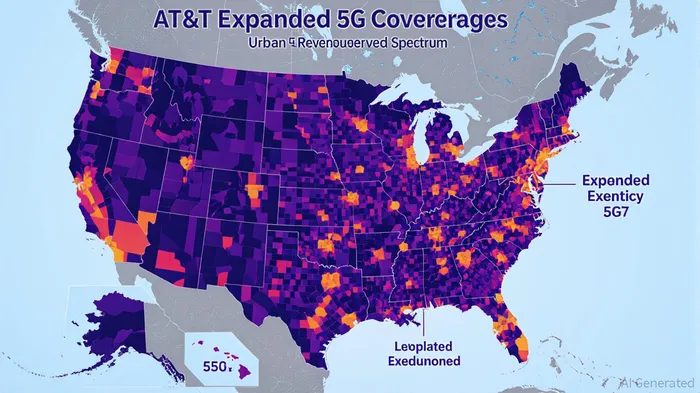
AT&T’s acquisition of 3.45 GHz and 600 MHz spectrum licenses is a calculated move to strengthen its 5G infrastructure. By securing these frequencies, AT&T gains access to mid-band spectrum for high-speed data delivery and low-band spectrum for expansive coverage. This dual-frequency strategy enables the company to enhance 5G reliability and speed across 400 U.S. markets, directly competing with rivals like VerizonVZ-- and T-MobileTMUS-- [1]. The immediate deployment of mid-band spectrum underscores AT&T’s urgency to close the gap in 5G performance, a critical factor in retaining enterprise clients and consumers demanding AI-driven and IoT-enabled services [2].
EchoStar’s Strategic Rebirth
For EchoStar, the sale is a lifeline. The $23 billion infusion will reduce its $25.4 billion debt burden by 30–40%, ensuring compliance with FCC spectrum utilization rules and freeing capital for innovation [2]. More importantly, the deal allows EchoStar to pivot to a hybrid mobile network operator (MNO) model. Boost Mobile, EchoStar’s MVNO subsidiary, will now operate on AT&T’s infrastructure while retaining its cloud-native 5G core and access to T-Mobile’s network. This hybrid approach minimizes EchoStar’s capital expenditures on network maintenance while preserving customer relationships and brand equity [3].
Regulatory and Market Implications
The FCC’s scrutiny of spectrum underutilization has long pressured EchoStar to justify its holdings. This deal resolves those concerns by transferring licenses to a carrier with the scale to deploy them efficiently [2]. Meanwhile, AT&T’s expanded spectrum portfolio aligns with its vision of integrating wireless and fiber networks to meet surging data demands. Analysts project this consolidation will generate $10–15 billion in annual cost synergies by 2027, driven by reduced spectrum leasing costs and operational efficiencies [1].
Long-Term Value Creation
Both companies emphasize a mid-2026 closing date, pending regulatory approvals. AT&T’s CEO has stated the deal will “future-proof” its network for AI and IoT applications, while EchoStar plans to reinvest proceeds into a $5 billion LEO satellite constellation for direct-to-device broadband [2]. This dual focus on terrestrial and satellite connectivity signals a broader industry trend toward hybrid infrastructure models.
For investors, the transaction highlights the importance of strategic consolidation in a sector where spectrum scarcity and regulatory hurdles are persistent challenges. AT&T’s aggressive spectrum acquisition and EchoStar’s pivot to a leaner MNO model demonstrate how companies can adapt to evolving market demands while creating shareholder value.
**Source:[1] AT&T to Acquire Spectrum Licenses from EchoStar [https://about.att.com/story/2025/echostar.html][2] EchoStar Announces Spectrum Sale and Hybrid Mobile Network Operator (MNO) Agreement [https://ir.echostar.com/news-releases/news-release-details/echostar-announces-spectrum-sale-and-hybrid-mobile-network][3] Analysis: AT&T's $23bn spectrum deal with EchoStar ... [https://www.capacitymedia.com/article-analysis-att-echostar]







Comentarios
Aún no hay comentarios