
The Strategic Case for XRP and RLUSD as Catalysts for Institutional Blockchain Adoption
Regulatory Clarity: A Foundation for Institutional Confidence
The U.S. Securities and Exchange Commission's (SEC) the SEC's August 2025 ruling that XRP sold on public exchanges is a utility token has resolved a decade of legal ambiguity. This decision has unlocked institutional engagement, enabling XRP to be treated as a non-security token in retail and institutional contexts. For example, SBI Holdings now holds a $10 billion XRP position under its Digital Asset Treasury model, while global firms bet $11 billion on XRP. Ripple's acquisition of Hidden Road for $1.25 billion further underscores its pivot toward institutional services, integrating XRP and RLUSD into prime brokerage and derivative markets.
RLUSD, a New York Department of Financial Services (NYDFS)-regulated stablecoin, complements this shift. Fully backed by cash and cash equivalents, RLUSD surpassed $1 billion in circulation, making it a trusted medium for large-scale settlements. Its regulatory compliance has positioned it as a bridge between traditional finance and blockchain, as seen in its role in Ripple's pilot with Mastercard, WebBank, and Gemini.
Strategic Partnerships and Real-World Use Cases
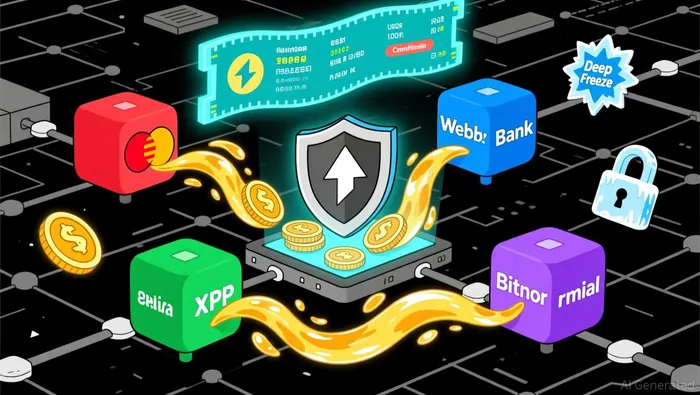
Institutional adoption of XRP and RLUSD is accelerating through high-profile collaborations. The Mastercard pilot leverages RLUSD on the XRP Ledger to settle credit card transactions. This marks the first time a regulated U.S. bank (WebBank) has processed fiat card settlements using a stablecoin on a public blockchain. By reducing intermediaries and improving liquidity timing, the initiative highlights the XRP Ledger's potential as a card-grade payment rail.
Similarly, Bitnomial has expanded margin collateral options to include XRP and RLUSD. This innovation allows traders to collateralize positions with stablecoins and XRP, enhancing capital efficiency while adhering to regulatory standards. Such use cases demonstrate how XRP and RLUSD are not just assets but tools for reimagining risk management and liquidity optimization.
Technical Infrastructure: Scalability and Compliance
The XRP Ledger's (XRPL) technical capabilities further solidify its appeal. Features like Clawback (enabling asset recovery) and Deep Freeze (preventing unauthorized transfers) attract regulated finance players, as noted in a Research Signals report. Additionally, the XRPL's EVM Sidechain and automated market makerMKR-- integrations position it as a hybrid infrastructure for both regulated and decentralized ecosystems.
RLUSD's role in this ecosystem is equally pivotal. With $88.8 million on the XRP Ledger, it enhances onchain liquidity and supports tokenized asset markets. This synergy between XRP and RLUSD creates a self-reinforcing cycle: XRP provides speed and scalability, while RLUSD ensures stability and compliance.
Strategic Implications for Investors
For investors, the strategic case for XRP and RLUSD rests on their dual role as both speculative assets and infrastructure components. XRP's $170.3 billion market cap in Q3 2025 reflects growing institutional demand, while RLUSD's $789 million market cap signals its emergence as a critical settlement tool. These metrics, combined with regulatory tailwinds and expanding use cases, suggest that XRP and RLUSD are not isolated trends but part of a broader institutional blockchain adoption wave.
Critics may argue that regulatory environments remain fluid, but Ripple's proactive alignment with compliance frameworks-such as NYDFS and SEC standards-mitigates this risk. Moreover, the XRP Ledger's proven track record in cross-border payments and real-time settlements provides a competitive edge over newer, less battle-tested protocols.
Conclusion
XRP and RLUSD are reshaping institutional finance by addressing pain points in liquidity, transparency, and efficiency. Their integration into credit card settlements, derivatives markets, and regulated stablecoin ecosystems underscores their strategic value. As institutional players increasingly prioritize blockchain-based solutions, XRP and RLUSD stand out as catalysts for a modernized financial infrastructure-one that balances innovation with compliance. For investors, this represents not just an opportunity to capitalize on digital assets but to participate in the evolution of global finance itself.






Comentarios
Aún no hay comentarios