
The Strategic Case for XRP ETFs in a Rotating Crypto Market
Institutional Adoption: A Catalyst for XRP ETF Growth
The launch of the Canary Capital XRP ETF (XRPC) in November 2025 marked a watershed moment for XRP. With a record $58.6 million in first-day trading volume and $245 million in inflows, XRPCXRP-- outperformed even BitcoinBTC-- and SolanaSOL-- ETFs, signaling robust institutional demand. This momentum is further amplified by Ripple's strategic initiatives, including the acquisition of Hidden Road Partners and the creation of Ripple Prime, which are streamlining institutional access to XRP.
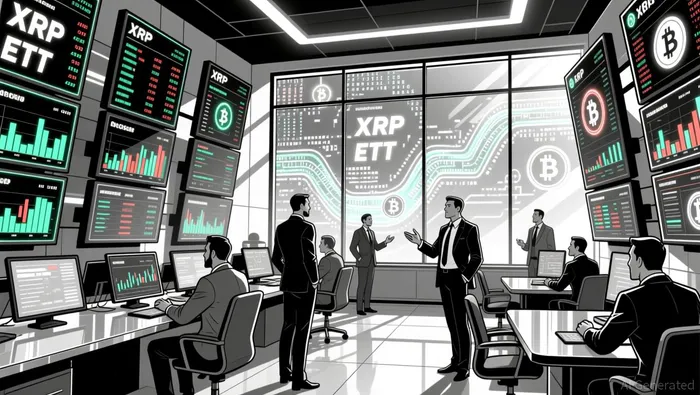
Grayscale's upcoming XRP and DogecoinDOGE-- ETFs, set to debut on November 24, 2025, underscore the growing legitimacy of XRP as an institutional asset. These products, coupled with Amplify ETFs' innovative XRP 3% Monthly Premium Income ETF (XRPM), which employs a covered call strategy to generate recurring income, are diversifying the tools available to institutional investors. The SEC's streamlined approval process has accelerated this trend, reducing regulatory friction and expanding market access.
Market Rotation Dynamics: XRP ETFs as a Diversification Tool
Institutional investors are increasingly rotating capital toward altcoins with tangible use cases, and XRP's unique attributes position it as a strategic asset. The XRP Ledger (XRPL) offers sub-second transaction finality and low-cost cross-border payments, making it a compelling alternative to Bitcoin's energy-intensive consensus model and Solana's scalability challenges. For example, the Bitwise XRP ETFXRP-- (ticker: XRP) provides exposure to a $125 billion market cap asset that is integral to global payment systems.
This rotation is not merely speculative. XRP's tokenization capabilities and non-inflationary reward model are attracting pension funds and sovereign wealth vehicles seeking to hedge against macroeconomic volatility. The XRP Tundra platform, which derives revenue from protocol usage, exemplifies how institutional liquidity in XRP can drive network throughput and staking rewards, creating a self-reinforcing cycle.
XRP vs. Bitcoin and Solana: Efficiency and Regulatory Clarity
While Bitcoin remains the cornerstone of institutional crypto portfolios, XRP ETFs offer distinct advantages. Unlike Bitcoin's proof-of-work model, the XRP Ledger's consensus mechanism is energy-efficient and scalable, aligning with ESG mandates. Compared to Solana, XRP's regulatory clarity-bolstered by SEC-approved ETFs-reduces compliance risks for institutions navigating fragmented global frameworks.
Moreover, XRP's role in treasury management is gaining traction. The XRP Ledger's ability to tokenize real-world assets (RWAs) enables institutions to hedge against fiat currency devaluation while leveraging blockchain's transparency. This contrasts with Bitcoin's limited utility beyond store-of-value and Solana's nascent RWA experiments.
Challenges and Risks
Critics, including VanEck's Matthew Sigel, question XRP's real-world utility, citing a lack of evidence on developer engagement and economic value capture. Additionally, XRP's price volatility-recently dropping to $2.30-poses risks for investors seeking stability. However, the influx of ETF-driven liquidity is expected to mitigate these concerns over time, as seen in the 51% surge in XRP derivatives volume ahead of ETF launches.
Conclusion: A Strategic Imperative for 2025 and Beyond
The strategic case for XRP ETFs rests on three pillars: institutional adoption, market rotation toward utility-driven assets, and regulatory tailwinds. As Grayscale and Bitwise expand their XRP offerings, institutions are gaining access to a diversified, high-utility asset that complements Bitcoin and Solana in a multi-chain portfolio. While risks persist, the growing alignment of XRP's technical strengths with institutional needs suggests that XRP ETFs will play a pivotal role in the next phase of crypto market evolution.







Comentarios
Aún no hay comentarios