
The Strategic Case for Short-Term Corporate Bonds in a Dovish Rate Outlook
The Reserve Bank of India’s (RBI) cautious neutrality in August 2025 has created a unique window for fixed-income investors. With the repo rate unchanged at 5.5% and CPI inflation at a decade-low 2.1% [1], the central bank is signaling a dovish bias while holding its powder dry amid global trade tensions. This environment has turbocharged demand for short-term corporate bonds, where yield spreads now offer compelling risk-adjusted returns. Let’s break down why this is a golden opportunity for income-hungry investors.
Yield Spreads: A Goldmine for Credit-Savvy Investors
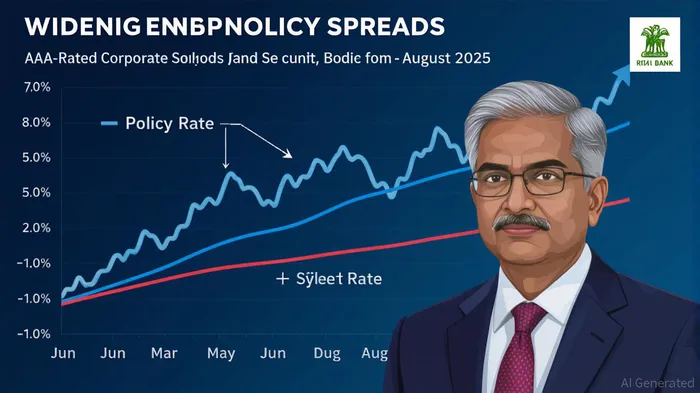
India’s corporate bond market is flashing green lights. AAA-rated bonds currently trade at spreads of 60–120 basis points over government securities, while AA-rated bonds widen to 100–180 bps [4]. These spreads reflect a market that’s pricing in both inflation moderation and the RBI’s reluctance to overstimulate. For context, the 50-basis-point repo rate cut in June 2025 alone pushed corporate bond yields higher, creating a 22-basis-point spread widening [2]. This isn’t just a numbers game—it’s a signal that investors are reallocating capital toward higher-yielding, short-duration credits as government bond yields stagnate.
The key here is duration management. With the RBI’s easing cycle front-loaded and a flattening yield curve, long-term bonds offer diminishing returns. Short-term corporate bonds, however, provide a sweet spot: they mitigate interest rate risk while capturing robust yields. For example, infrastructure bonds with stable cash flows now yield 7.5–8.5% [4], outpacing even the 6.4% offered by 5–7-year sovereign bonds [3].
Risk-Adjusted Returns: Balancing Credit Quality and Liquidity
The RBI’s dovish stance isn’t just about low rates—it’s about fostering a resilient ecosystem. SEBI’s reforms, including the launch of “Bond Central” and lower entry barriers, have deepened liquidity in the corporate bond market [3]. This is critical for managing credit risk. High-grade (AAA/AA) bonds, which dominate the short-term segment, have default rates near zero, making them a fortress in a low-inflation, low-interest-rate world.
Moreover, the RBI’s VRRR (Variable Rate Repo Auction) liquidity injections have kept bond prices buoyant [3]. This means investors can enter or exit positions without fear of illiquidity—a rare luxury in emerging markets. For those wary of geopolitical risks (e.g., U.S. tariffs), a laddered portfolio of 3–5-year corporate bonds offers both yield and flexibility to rebalance as policy evolves [2].
Strategic Entry Points: Where to Allocate Now
The data is clear: short-term corporate bonds are outperforming across metrics. Here’s how to capitalize:
1. Credit Tiering: Prioritize AAA/AA-rated bonds in sectors like infrastructure and technology, which offer yields of 7.5–8.5% with minimal default risk [4].
2. Duration Shortening: Avoid long-duration bonds as the yield curve flattens. Stick to 3–5-year maturities to lock in current spreads before the RBI’s easing cycle exhausts [2].
3. Active Rebalancing: Use the RBI’s VRRR auctions to adjust portfolios dynamically. For instance, if inflation surprises to the upside, pivot toward shorter-dated instruments to hedge rate hikes [3].
The Bottom Line
India’s fixed-income market is a masterclass in risk-adjusted returns. With the RBI’s dovish stance and corporate bond spreads at their widest in years, short-term credits are the standout performers. As one analyst put it, “This is the time to buy yield before the curve steepens” [4]. For investors who act now, the rewards could be substantial—provided they stay nimble and focus on high-quality, short-duration assets.
**Source:[1] RBI's Upcoming Monetary Policy: Expectations and ... [https://growthshuttle.com/rbis-upcoming-monetary-policy-expectations-and-implications-for-the-economy/][2] Corporate bonds gain favour as government securities' yields remain steady [https://www.business-standard.com/finance/news/corporate-bonds-gain-favour-as-g-sec-yields-remain-steady-125071601346_1.html][3] India's Bond Market: Navigating Policy Uncertainty with ... [https://www.ainvest.com/news/india-bond-market-navigating-policy-uncertainty-defensive-fixed-income-strategies-2507/][4] Corporate Bond Market Revival: Fixed- Income Strategies for Institutional Investors in India [https://www.equirus.com/blog/corporate-bond-market-revival-fixed-income-strategies-for-institutional-investors-in-india]







Comentarios
Aún no hay comentarios