
The Strategic Case for Large-Cap Cryptocurrencies in a Volatile Market
In an era marked by geopolitical tensions, inflationary pressures, and regulatory uncertainty, investors are increasingly seeking assets that balance growth potential with downside protection. Large-cap cryptocurrencies like BitcoinBTC-- (BTC) and EthereumETH-- (ETH) have emerged as compelling candidates in this search, particularly for their superior risk-adjusted returns and maturing market infrastructure. This article examines why these assets are gaining traction as strategic hedges in volatile markets, drawing on recent data and academic insights.
Risk-Adjusted Returns: A Quantitative Edge
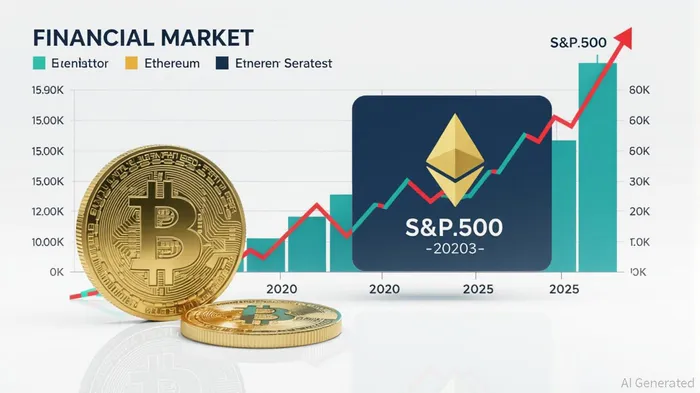
The Sharpe ratio—a metric that evaluates returns relative to volatility—has become a critical lens for assessing cryptocurrency performance. By mid-2025, Bitcoin’s Sharpe ratio reached 2.42, far outpacing the S&P 500’s 0.17 [1]. Ethereum, while less dominant, still posted a robust 0.97 in September 2024 [1]. These figures underscore the resilience of large-cap cryptos, which have consistently outperformed both small-cap counterparts and traditional equities during periods of market stress.
The disparity in risk-adjusted returns is amplified by structural advantages. Large-cap cryptocurrencies benefit from higher liquidity and tighter bid-ask spreads, which reduce slippage and enhance price stability [1]. For example, Bitcoin’s average 24-hour trading volume during 2023–2025 was $38.9 billion, dwarfing the fragmented liquidity of mid/small-cap tokens like SolanaSOL-- and DogecoinDOGE-- [1]. This liquidity buffer proved critical during the 2022 FTX crash, where large-cap assets like Bitcoin experienced a 16% drawdown, while smaller tokens saw collapses exceeding 80% in three days [1].
Market Maturity: Infrastructure and Institutional Adoption
The maturation of the cryptocurrency market has further solidified the case for large-cap assets. Institutional-grade infrastructure, including improved custody solutions and regulatory clarity, has reduced Bitcoin’s volatility from 46% in 2023–2024 to 37% by mid-2025 [1]. This evolution has attracted institutional capital, with 68% of investors planning to allocate to Bitcoin ETPs in 2025 [2]. Such adoption not only stabilizes prices but also enhances market depth, making large-cap cryptos less susceptible to manipulation.
Moreover, large-cap cryptocurrencies have demonstrated faster recovery rates after downturns. Bitcoin rebounded 70% in Q2 2025, while mid/small-cap tokens struggled with prolonged liquidity constraints [1]. This resilience is partly due to their role as “safe havens” in digital assets, akin to gold’s function in traditional markets.
Diversification and Portfolio Impact
Adding large-cap cryptocurrencies to traditional portfolios has proven effective in improving risk-adjusted returns. A 2025 study found that including 5% Bitcoin in a portfolio increased the Sharpe ratio from 0.17 to 0.30 [3]. However, this benefit diminishes during market turmoil when correlations between cryptos and equities rise, reducing their hedging effectiveness [3]. Investors must thus balance exposure with dynamic risk management strategies.
Conclusion
Large-cap cryptocurrencies are no longer speculative novelties but strategic assets in volatile markets. Their superior risk-adjusted returns, liquidity advantages, and maturing infrastructure position them as both growth drivers and hedges. While challenges like correlation risks persist, the data suggests that a measured allocation to large-cap cryptos can enhance portfolio resilience—a critical consideration as global markets navigate ongoing uncertainties.
**Source:[1] Why Large-Cap Cryptocurrencies Are Strategic Hedges in Volatile Markets [https://www.ainvest.com/news/large-cap-cryptocurrencies-strategic-hedges-volatile-markets-2508/][2] Evolving Digital Assets Sentiment Among Investors [https://www.ey.com/en_us/insights/financial-services/evolving-digital-assets-sentiment-among-investors][3] Cryptocurrency in Investment Portfolios Statistics 2025 [https://coinlaw.io/cryptocurrency-in-investment-portfolios-statistics/]






Comentarios
Aún no hay comentarios