
The Strategic Case for Investing in Solana-Based Stablecoins in 2026
Solana's Competitive Edge in the Stablecoin Ecosystem
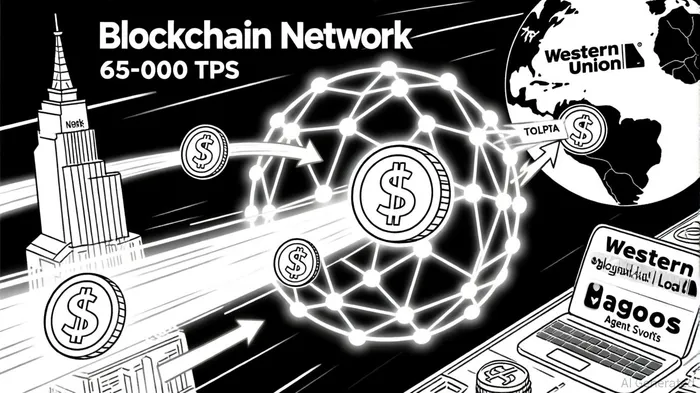
Solana's dominance in the stablecoin space is not accidental. Despite a 30% decline in overall network activity in 2025, its stablecoin market grew by 37%, outpacing broader trends, according to Analytics Insight. This resilience stems from Solana's architectural strengths: a blockchain capable of processing 65,000 transactions per second (TPS) at sub-cent costs, making it ideal for high-volume applications like cross-border payments and DeFi.
A key indicator of Solana's growing influence is the 40% surge in USDCUSDC-- usage on its network. Circle's recent minting of 750 million USDC on SolanaSOL-- further underscores the platform's appeal, as low fees and robust tooling attract developers and enterprises alike. For investors, this creates a flywheel effect: increased stablecoin adoption drives network activity, which in turn reinforces Solana's position as the go-to blockchain for institutional-grade stablecoin solutions.
Western Union's USDPT: A Catalyst for Mass Adoption
Western Union's USDPT stablecoin, set to launch in the first half of 2026, represents a pivotal moment for Solana-based stablecoins. Pegged 1:1 to the U.S. dollar and issued in partnership with Anchorage Digital Bank, USDPT will leverage Solana's infrastructure to enable real-time, low-cost cross-border transactions, according to a Cryptointelligence report. The company's Digital Asset Network-a global off-ramp for its 150 million customers-will further cement USDPT's utility by facilitating seamless conversions between digital assets and traditional fiat.
This strategic move is not just about technology. It's about market access. By integrating USDPT with its vast agent network spanning 200 countries, Western Union is bridging the gap between underbanked populations and digital finance. Analysts project that USDPT's real-world use cases-particularly in remittances-will drive significant volume on Solana, accelerating the blockchain's transition from a speculative asset to a foundational financial infrastructure.
The $750 Billion Opportunity: Why Now?
The timing of USDPT's launch aligns with a perfect storm of macroeconomic and regulatory factors. The passage of the GENIUS Act in July 2025 has provided much-needed clarity for stablecoin issuers, spurring entry from giants like JPMorgan and Zelle. Meanwhile, the broader stablecoin market is expected to grow at a compound annual rate of over 100% through 2026, fueled by demand for programmable money and decentralized finance.
For Solana-based stablecoins, the implications are profound. With USDPT's institutional backing and Solana's throughput advantages, the platform is poised to capture a disproportionate share of this growth. Consider that daily stablecoin transfer volumes on Solana surged by 50% in 2025 alone, a trend that USDPT is likely to amplify. Investors who position themselves early stand to benefit from both the appreciation of Solana's native token (SOL) and the fees generated by increased stablecoin activity.
Conclusion: A Strategic Inflection Point
The launch of USDPT is more than a product announcement-it's a validation of Solana's role in the future of finance. By combining Western Union's global reach with Solana's technical prowess, the partnership addresses one of the last barriers to mass adoption: interoperability between traditional and digital systems. For investors, this represents a rare convergence of innovation, demand, and regulatory tailwinds.
As the stablecoin market races toward $750 billion, Solana-based tokens are uniquely positioned to outperform. The question is no longer if this shift will happen, but how quickly investors can align their portfolios with it.






Comentarios
Aún no hay comentarios