
The Strategic Case for Investing in Crypto-Enabled Fintech Platforms in 2026
Bitcoin Adoption: Beyond Hype to Institutional Infrastructure
Bitcoin's adoption in 2025 has moved beyond speculative retail interest to institutional-grade infrastructure. EthereumETH--, often seen as Bitcoin's rival, has paradoxically become a critical enabler of this shift. Joseph Lubin of SharpLink Gaming, for instance, has staked nearly 100% of its ETH holdings while deploying $200 million of ETH onto the LineaLINEA-- Layer 2 platform to access higher yields. This strategy underscores a broader trend: institutions are no longer merely holding Bitcoin but are actively building ecosystems around it, leveraging Ethereum's smart contract capabilities to optimize risk-adjusted returns.
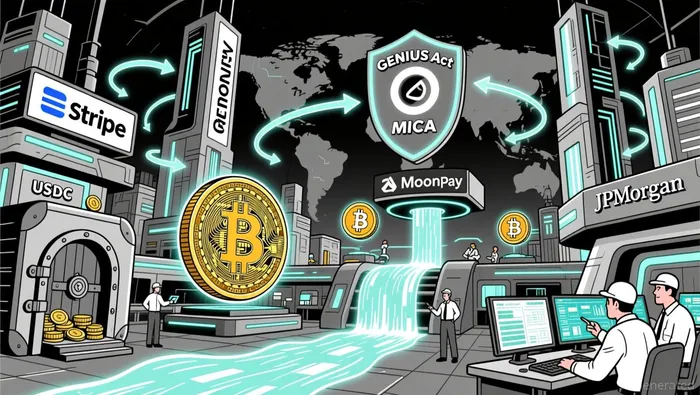
Regulatory clarity has accelerated this shift. The U.S. SEC's Project Crypto and GENIUS Act have provided a framework for institutional participation, reducing legal ambiguity and encouraging major players like JPMorganJPM-- and Alibaba to integrate crypto into their treasury operations. These developments signal that Bitcoin is no longer a speculative asset but a foundational component of institutional portfolios.
Stablecoin Infrastructure: The Backbone of Fintech Innovation
Parallel to Bitcoin's institutional adoption, stablecoin infrastructure has evolved into a cornerstone of modern fintech. MoonPay's recent integration with M0 to launch enterprise stablecoin services exemplifies this trend. By enabling companies to issue and manage fully reserved digital dollars across multiple blockchains, MoonPay has positioned itself as a critical infrastructure provider for the next generation of financial services.
McKinsey's analysis further reinforces this shift, noting that stablecoins are challenging traditional payment systems by offering faster, cheaper, and more transparent transactions. According to McKinsey's analysis, stablecoins are challenging traditional payment systems by offering faster, cheaper, and more transparent transactions. For example, Stripe and Visa now allow merchants to accept crypto payments that instantly settle in fiat, reducing reliance on legacy banking systems. Meanwhile, JPMorgan's JPM Coin and Société Générale's EURCV stablecoin highlight how traditional banks are adapting to the onchain finance revolution.
Regulatory frameworks are also catching up. The U.S. GENIUS Act and EU's MiCA regulations are establishing clear requirements for stablecoin reserves and stability, fostering institutional confidence. This alignment between innovation and regulation is critical for long-term adoption.
The Convergence: Bitcoin and Stablecoins in Fintech
The true strategic opportunity lies in the convergence of Bitcoin and stablecoin infrastructure. Cross-border payments, for instance, have become a battleground for fintech platforms. Stablecoins processed over $45 trillion in transaction volume in the last 12 months, surpassing Visa and Mastercard combined. PayPal's use of PYUSD to settle invoices and Xoom's cross-border remittances illustrate how stablecoins are replacing traditional systems like SWIFT.
Bitcoin's role in this ecosystem is equally transformative. While its price volatility persists, its value as a settlement layer for stablecoins is undeniable. For example, Cash App's integration of Solana-powered stablecoins-despite Jack Dorsey's Bitcoin maximalism-demonstrates the practicality of combining Bitcoin's security with stablecoins' usability. Similarly, in emerging markets like Argentina, stablecoins are being used to convert unstable local currencies into digital assets for payroll and remittances.
Navigating the Current Market Dynamics
Bitcoin's price in late 2025 has faced headwinds, dropping below $97,000 amid outflows from spot ETFs and a wave of liquidations. However, this volatility should not obscure the underlying infrastructure growth. On-chain metrics like the Bull Score Index and long-term holder behavior suggest that Bitcoin's fundamentals remain robust. Meanwhile, stablecoin adoption continues to accelerate, with corporate use cases and regulatory clarity providing a counterbalance to Bitcoin's price swings.
Strategic Investment Opportunities in 2026
For investors, the key is to focus on fintech platforms that are strategically positioned at the intersection of Bitcoin and stablecoin innovation. These include:
1. Infrastructure Providers: Companies like MoonPay and EigenCloud that enable enterprise-grade stablecoin issuance and management.
2. Cross-Border Payment Platforms: Firms leveraging stablecoins to disrupt traditional remittance systems, such as Xoom and PayPal.
3. Institutional Staking and Yield Platforms: Entities like SharpLink that optimize Bitcoin and ETH holdings through Layer 2 solutions.
The cross-border payments market alone is projected to grow significantly, with stablecoins potentially capturing 20% of the global market by 2030. This growth is driven by efficiency gains, regulatory alignment, and the increasing demand for real-time settlements.
Conclusion
The convergence of Bitcoin adoption and stablecoin infrastructure is not a passing trend but a structural shift in global finance. While Bitcoin's price volatility remains a challenge, the infrastructure layer-powered by stablecoins and institutional-grade tools-is laying the groundwork for a new era of fintech. For investors, 2026 offers a rare opportunity to position capital in platforms that are not only riding the crypto wave but actively reshaping it.





Comentarios
Aún no hay comentarios