
The Strategic Case for Investing in Africa’s Maturing Tech Ecosystem Amid 2025’s Fundraising Momentum
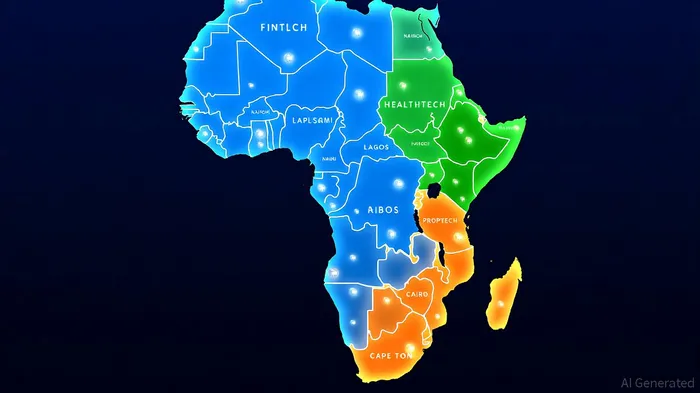
Africa’s tech ecosystem is no longer a speculative frontier—it is a maturing, high-growth market with a compelling investment thesis. In 2025, the continent’s startups have raised over $1.4 billion in the first half of the year alone, a 78% increase compared to H1 2024 [1]. This surge is driven by sector diversification, innovative financing mechanisms, and a rapidly evolving regulatory landscape. For investors, the question is no longer if to invest in Africa’s tech ecosystem, but how to strategically capitalize on its momentum.
Sector Diversification: Beyond Fintech865201-- to Agritech and Climate Tech
While fintech remains the dominant force—accounting for nearly half of Africa’s tech funding in 2025 [1]—the ecosystem is diversifying into adjacent sectors with high societal and economic impact. Healthtech, for instance, has seen a spike in investment, exemplified by hearX’s $100 million raise to scale its AI-powered hearing diagnostics [1]. Similarly, proptech is gaining traction, with Egypt’s Nawy securing $75 million—the largest deal in the category—to digitize real estate transactions [1].
Agritech and climate tech are also emerging as critical pillars. In Zimbabwe, agritech startups raised $50 million in 2024, leveraging AI and IoT to modernize agriculture and address food security [2]. Climate tech startups, such as Nigeria’s Earthbond and Kenya’s Remedial Health, are tackling renewable energy and supply chain sustainability, attracting $20 million in funding [2]. These sectors are not only solving local challenges but also positioning African startups as global innovators.
The “Big Four” economies—Kenya, Nigeria, South Africa, and Egypt—continue to dominate, capturing 83% of Q1 2025 funding [1]. Kenya’s fintech and agritech sectors raised $227 million, while Nigeria’s Lagos-based startups secured $176 million [1]. South Africa’s focus on AI and fintech attracted $344 million, and Egypt’s proptech and fintech deals totaled $339 million [1]. However, emerging markets like Togo (via Gozem’s $30 million Series B) and Rwanda are also gaining traction, signaling a broader geographic expansion.
Structured Financing: Venture Debt and Revenue-Based Models Gain Traction
As African startups navigate a global funding squeeze, structured financing mechanisms are becoming critical to sustaining growth. Venture debt now accounts for 37% of total VC deal value in Africa, with startups raising $755 million through this route in 2024 [3]. This non-dilutive capital allows companies to extend runways and achieve milestones without over-diluting equity. For example, MFS Africa’s $100 million debt facility highlights how predictable revenue and geographic diversification can secure favorable terms [3].
Revenue-based financing (RBF) is also gaining popularity, particularly for businesses with stable cash flows. Unlike traditional debt, RBF ties repayments to a percentage of revenue until a multiple of the investment is repaid, offering flexibility for scaling companies [3]. Private credit funds are further expanding access to tailored debt solutions, such as mezzanine finance and unitranche loans, particularly in agriculture and energy [3].
Government policies are amplifying these trends. Kenya’s Startup Bill and Nigeria’s Startup Act provide tax breaks, low-interest loans, and regulatory clarity, reducing barriers for early-stage startups [1]. Meanwhile, institutions like Afreximbank are leveraging AI and blockchain to enhance cross-border trade through its Africa Trade Gateway (ATG) ecosystem, addressing financing gaps for SMEs [4].
Strategic Investment Opportunities: A Win-Win for Investors and Markets
The convergence of sector diversification and structured financing creates a unique window for investors. Fintech remains a safe bet, with Kenya’s M-Pesa dominating mobile payments (98.9% market share) and Nigeria’s fintech sector attracting $176 million in H1 2025 [1]. However, the rise of agritech and climate tech offers exposure to high-impact, scalable solutions. For instance, Thrive Agric’s AI-driven farming analytics and Apollo Agriculture’s cost-reduction tools are transforming smallholder productivity [1].
Investors should also prioritize markets with supportive ecosystems. Egypt’s Kigali Innovation City and Nairobi’s Tatu City are creating hubs for tech talent and infrastructure [1]. Events like GITEX Africa and the Africa Tech Festival further connect startups with global capital, facilitating cross-border partnerships [4].
Risks and Mitigation
While the opportunities are clear, risks such as regulatory fragmentation and currency volatility persist. Founders must navigate high-interest rates (12–18% for venture debt) and acceleration clauses in debt agreements [3]. However, these risks are mitigated by Africa’s growing pool of local VCs and diaspora-backed funds, which provide culturally attuned capital and reduce reliance on foreign investors [1].
Conclusion
Africa’s tech ecosystem is maturing into a resilient, diversified, and capital-efficient market. For investors, the strategic case is clear: sector diversification into agritech, healthtech, and climate tech, combined with innovative financing tools like venture debt and RBF, offers a pathway to high-growth returns while addressing global challenges. As the continent’s startups scale from local solutions to global players, now is the time to act.
Source:
[1] Startup Funding in Africa Surpasses $1 Bn in the First Half of ... [https://www.futurize.studio/blog/startup-funding-in-africa-2025]
[2] Zimbabwe Startup Ecosystem in 2025: A Year of Resilience and Transformation [https://www.statsandmarketinsights.com/blog/76/zimbabwe-startup-ecosystem-in-2025-a-year-of-resilience-and-transformation]
[3] The Rise of Venture Debt in African Startups - The L.U.M.I. Brief [https://www.lumibrief.com/p/the-rise-of-venture-debt-in-african]
[4] Emerging trends & opportunities in Africa's trade finance landscape [https://fintechview360.com/emerging-trends-opportunities-in-africas-trade-finance-landscape-talk-with-afreximbank/]







Comentarios
Aún no hay comentarios