
The Strategic Case for Chainlink ETFs in a Post-Government Reopening Market
Institutional Adoption: From Oracles to Tokenized Finance
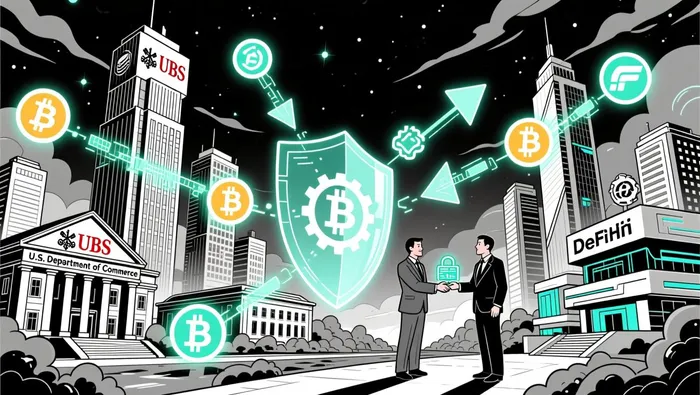
Chainlink's evolution from a decentralized oracleADA-- provider to a foundational infrastructure layer for institutional tokenized finance is central to its strategic value. The introduction of the Digital Transfer Agent (DTA) technical standard in Q3 2025, as reported by Cryptofront News, has enabled institutions like UBSUBS-- and Deutsche Börse to integrate onchain workflows while maintaining compliance with legacy systems. For example, UBS's pilot program demonstrated how ISO 20022 messages could trigger smart contract actions in tokenized funds, bridging traditional and blockchain-based finance, as detailed in Chainlink's Q3 2025 review.
The U.S. Department of Commerce partnership further solidified Chainlink's institutional credibility by publishing macroeconomic data such as GDP and the PCE Price Index onchain, as noted in the Chainlink Q3 review. This move not only enhances data integrity for DeFi protocols but also aligns with regulatory frameworks, making Chainlink a trusted intermediary for institutions. By Q3 2025, Chainlink had secured over $100 billion in total value secured (TVS) across 65+ blockchains, with 70% market share in the oracle sector, according to the Chainlink Q3 review.
Market Liquidity Expansion: Infrastructure and ETF Synergies
Chainlink's liquidity expansion is driven by its dual role in enabling tokenized assets and supporting cross-chain interoperability. The Cross-Chain Interoperability Protocol (CCIP), now operational on 65 networks, has facilitated seamless asset transfers, while the Chainlink Reserve-a strategic onchain reserve of 523,159 LINK tokens-has stabilized liquidity mechanisms, as described in the Chainlink Q3 review. These developments are critical for ETFs, which require robust infrastructure to manage large-scale tokenized fund redemptions and collateral management.
The potential approval of Chainlink-linked ETFs by Bitwise, Grayscale, and Tuttle Capital, as reported by Phemex, could further amplify liquidity. For instance, Bitwise's proposed U.S. spot Chainlink ETF aims to provide institutional investors with a regulated vehicle to access LINK's utility in tokenized finance. This aligns with the broader trend of BitcoinBTC-- ETFs, such as BlackRock's IBIT, which achieved $100 billion in AUM by Q4 2025, as highlighted in PowerDrill AI's Institutional Adoption 2025 report, demonstrating the scalability of crypto ETFs in institutional portfolios.
Risk and Reward: Balancing Utility and Volatility
While Chainlink's institutional adoption is robust, its price performance remains volatile. Despite a 2.25% 24-hour gain, as noted in CoinMarketCap's LINK price analysis, LINK is down 23.8% monthly, reflecting broader market uncertainty. However, its integration with Stellar's $5.4B real-world asset (RWA) volume, as noted in CoinMarketCap's LINK price analysis, and partnerships with Saudi Awwal Bank and Zand Bank, as detailed in the Chainlink Q3 review, suggest long-term utility. The key risk lies in Ethereum's recovery and DeFi's resurgence, both of which are prerequisites for sustained growth, as discussed in CryptoNewsLand's Chainlink coverage.
Strategic Implications for Investors
The post-government reopening environment has created a unique inflection point for Chainlink ETFs. Institutions seeking exposure to tokenized finance must weigh Chainlink's infrastructure dominance against market volatility. The DTA standard, CCIP expansion, and ETF applications collectively signal a transition from speculative crypto assets to utility-driven infrastructure. For investors, this represents an opportunity to capitalize on the convergence of institutional adoption and regulatory clarity.





Comentarios
Aún no hay comentarios