
The Strategic Case for BlockDAG in a Stagnant Crypto Market
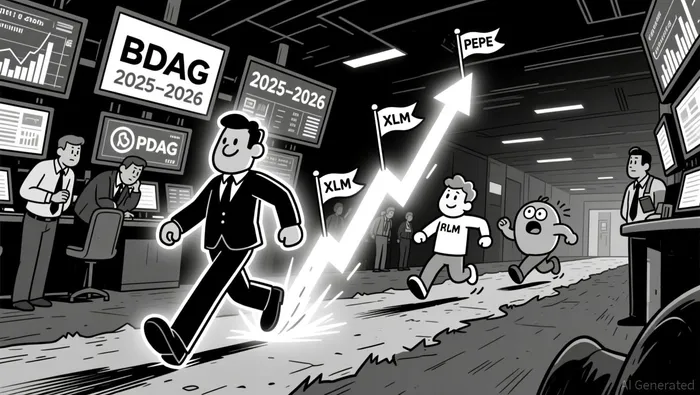
In a crypto market defined by stagnation and underperformance, investors are increasingly seeking projects that combine technical innovation with actionable ROI potential. BlockDAG (BDAG) emerges as a compelling outlier, leveraging its final-stage presale, community-driven adoption, and projected 1,566% return on investment to outperform legacy projects like StellarXLM-- (XLM) and PEPEPEPE--. This analysis examines why timing, scarcity, and ROI metrics position BlockDAG as a superior investment in 2025–2026.
Timing: The Final-Stage Presale Window
BlockDAG's presale is in its final phase, with the price locked at $0.003 per coin until its January 26, 2026, deadline. This creates a critical inflection point for investors: the presale price is set to jump to $0.05 at launch, a 1,566% projected ROI based on market maker estimates. Early participants in Batch 1 have already realized a 2,900% return by Q4 2025, underscoring the project's rapid value appreciation.
By contrast, stagnant projects like Stellar and PEPE lack such clear catalysts. Stellar (XLM) trades in a narrow range of $0.258–$0.394 for 2025, with a year-to-date price decline of 50.43% and a modest 0.24% share of the total crypto market. PEPE, while experiencing short-term volatility tied to macroeconomic events, remains highly speculative, with its price swinging 30% in response to Fed policy shifts in October 2025. These projects lack the structured, time-bound ROI trajectory that BlockDAG offers.
Scarcity: Limited Supply and Community-Driven Growth
BlockDAG's scarcity is engineered into its tokenomics. The total supply of 50 billion BDAG coins allocates only 20% (10 billion) to the presale, with 70% reserved for community incentives, miners, and ecosystem development. This ensures long-term value retention, as the majority of tokens are locked into utility rather than speculative trading. The project has already sold 21,000 mining devices and attracted 3.5 million users via the X1 app, creating a self-sustaining network effect.
Stellar and PEPE, however, face structural challenges. XLM's supply is not capped, and its adoption is hindered by regulatory uncertainty and competition from faster blockchains. PEPE, a memecoinMEME--, relies on retail sentiment and lacks a defined tokenomics model, making it vulnerable to sudden market shifts. BlockDAG's scarcity model, by contrast, aligns with institutional-grade fundamentals, offering a more predictable path to value capture.
ROI Potential: A Data-Driven Case
The projected ROI for BlockDAG is not speculative but grounded in tangible metrics. With $442 million raised in presale funds and 312,000 participants, the project has demonstrated robust demand. Analysts project a post-launch price range of $0.38–$0.43, translating to a 16.6x return for presale buyers. Even conservative estimates suggest a 1,566% ROI, far outpacing the modest gains or losses typical of stagnant projects.
Stellar's 2025 price predictions average $0.316, a 43% increase from its current $0.22 price. However, this pales in comparison to BlockDAG's potential. PEPE's volatility-driven by macroeconomic factors like inflation and VIX levels- offers no such clarity, with analysts projecting a 2025 range of $0.000007082–$0.00002405. These figures highlight the inherent risk of investing in projects without a defined utility or tokenomics framework.
Conclusion: A Strategic Imperative
BlockDAG's final-stage presale represents a rare convergence of timing, scarcity, and ROI potential in a stagnant market. With a clear launch date, a scarcity-driven token model, and community adoption metrics that rival top-tier projects, it offers a structured path to capital appreciation. In contrast, Stellar and PEPE remain trapped in cycles of volatility and uncertainty, lacking the technical and economic foundations to justify long-term investment.
For investors seeking to capitalize on the next phase of crypto innovation, BlockDAG's presale deadline on January 26, 2026, is not just a deadline-it's a decision point.






Comentarios
Aún no hay comentarios