
The Strategic Case for AI and Crypto Innovation in U.S. Geopolitical Competition
The global race for technological supremacy has intensified in 2023–2025, with artificial intelligence (AI) and blockchain emerging as pivotal battlegrounds in the U.S.-China tech rivalry. Venture capital (VC) has become the lifeblood of innovation in these sectors, fueling startups that are not only reshaping industries but also serving as strategic tools in the broader geopolitical contest. This article examines how U.S. VC-driven AI and crypto ecosystems are reinforcing American technological leadership, countering China's state-backed initiatives, and securing a dominant position in the digital future.
AI as the Cornerstone of U.S. Technological Supremacy
Artificial intelligence has dominated global VC funding in recent years, with the U.S. leading the charge. In 2024, global AI deal value surged by 52% to $131.5 billion, and AI and machine learning accounted for 35.7% of global deal value that year. By Q1 2025, a record $40 billion AI deal catalyzed a 28% quarter-over-quarter increase in VC-backed fundraising, pushing global AI investment to $80.1 billion. The U.S. has cemented its dominance, controlling 83% of total AI transaction value in the first half of 2025.
This leadership is underpinned by infrastructure and compute power. The U.S. commands 74% of the world's high-end AI supercomputing capacity and hosts 4,049 data centers by 2024, compared to China's 379. Venture capital has been instrumental in scaling these resources, enabling U.S. startups to train larger models and set global performance benchmarks. For instance, private AI investment in the U.S. reached $109.1 billion in 2024, dwarfing China's $9.3 billion.
Strategic measures, such as export controls on advanced AI chips, further solidify U.S. advantages. Chinese executives have openly acknowledged that restricted access to cutting-edge semiconductors is their most significant challenge. The U.S. government's CHIPS Act and private-sector investments in AI infrastructure are designed to maintain this edge, ensuring that American startups remain at the forefront of innovation.
Blockchain and Crypto: Rebuilding Foundations for Global Influence
While AI dominates headlines, blockchain and crypto are quietly reshaping the technological landscape. U.S. blockchain startups raised $4.8 billion in Q1 2025-the strongest quarter since late 2022-focusing on real-world applications like cybersecurity, tokenization, and decentralized finance (DeFi). This shift from speculative assets to foundational technologies aligns with investor demand for scalable solutions to enterprise and supply chain challenges.
China's blockchain strategy, in contrast, is state-led and permissioned. The Blockchain-based Service Network (BSN), a government-backed initiative, has expanded to 120 city nodes in China and 20 international locations by early 2025. While China filed 90% of global blockchain patents in 2023, its approach prioritizes control over decentralization, diverging from Western ideals. U.S. startups are countering this by fostering open-source collaboration and hybrid tokenomics models. For example, the Cryptocurrency Open Patent Alliance (COPA) promotes shared innovation, aligning with the U.S. International Cyberspace & Digital Policy Strategy to build an open, inclusive digital ecosystem.
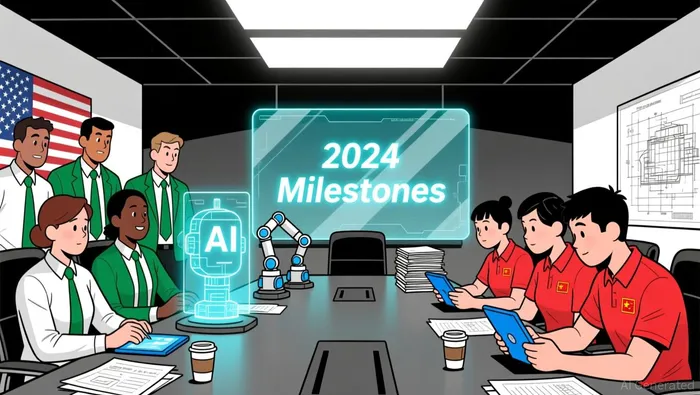
U.S. vs. China: A Tale of Two AI Ecosystems
The U.S. and China represent divergent models of AI development. The U.S. relies on a venture capital-driven ecosystem, with Silicon Valley as its innovation hub. By 2025, the U.S. accounted for 70% of global VC investment in AI, attracting $162 billion in funding. This ecosystem thrives on light regulation, a robust talent pool (40% of global AI researchers), and partnerships with cloud providers like NVIDIA.
China's state-backed approach, meanwhile, emphasizes centralized control and rapid commercialization. The country aims to become the global AI leader by 2030, with a target industry value exceeding $150 billion. While China leads in AI patent filings (60% of global applications), U.S. firms dominate in software and services (58% market share). This competition extends beyond funding: the U.S. is investing in clean energy to support data centers, while China leverages its control over rare earth elements to expand AI infrastructure.
Case Studies: U.S. Startups Leading the Charge
Several U.S. startups exemplify how venture capital is fueling strategic innovation. Aptos, a layer-1 blockchain, has positioned itself as a high-speed competitor in decentralized applications (dApps) and DeFi. LayerZero specializes in cross-chain interoperability, enabling seamless communication across ecosystems. Flare Networks enhances blockchain interoperability by providing smart contract capabilities to networks lacking native support. These companies are not just commercial ventures but geopolitical assets, countering China's state-led blockchain initiatives through open-source collaboration and decentralized governance.
In AI, startups like Scale AI and OpenAI have attracted record investments. Meta's $14.3 billion investment in Scale AI and OpenAI's $13 billion Series F round highlight how large tech firms are arming themselves with AI capabilities. These investments are critical for maintaining U.S. leadership in frontier technologies like large language models and automation.
Geopolitical Implications and the Path Forward
The U.S. strategy of leveraging VC to drive AI and blockchain innovation is not without risks. A Shiller P/E Ratio exceeding 40 in 2025 signals potential market overvaluation. However, investors remain focused on AI-native companies with clear revenue paths, prioritizing long-term strategic value over short-term speculation.
Geopolitically, the U.S. is exporting AI technology selectively to aligned partners, reinforcing ideological blocs. This contrasts with China's non-conditional outreach to the Global South, where it seeks to expand soft power through the Digital Silk Road. To counter this, the U.S. is developing an AI Capacity-Building Action Plan, offering alternative pathways for emerging markets to adopt democratic-aligned technologies.
Conclusion
Venture capital is the linchpin of U.S. technological leadership in AI and blockchain. By funding startups that prioritize innovation, infrastructure, and open ecosystems, the U.S. is not only maintaining its edge over China but also shaping the future of global digital governance. As the 2025–2030 period unfolds, sustained VC investment, strategic policy, and geopolitical alignment will be critical to ensuring that American innovation remains the cornerstone of a free and open digital world.





Comentarios
Aún no hay comentarios