
Strategic Capital Deployment in Texas's Decentralized Peaking Power Sector: A 2025 Investment Analysis
The Texas electricity market, a cornerstone of U.S. energy innovation, is undergoing a transformative shift in 2025 as decentralized peaking power development gains momentum. With over 26 million consumers served by more than 50 retail electric providers (REPs) and a generation mix dominated by natural gas (44%), wind (24%), and solar (10%), the state is redefining how energy is generated, stored, and distributed, according to the Texas Electricity Market 2025 guide. This evolution is driven by surging demand from data centers, cryptocurrency operations, and industrial electrification, which now account for 10% of the state's electricity consumption, as industry reporting has documented. For investors, the intersection of market-driven competition, regulatory adaptability, and technological innovation presents a compelling case for strategic capital deployment in decentralized peaking power infrastructure.
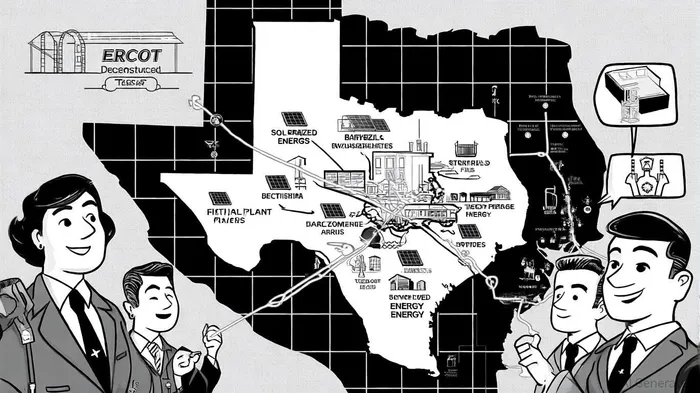
Market Dynamics and Capital Priorities
Texas's deregulated energy model, managed by the Electric Reliability Council of Texas (ERCOT), prioritizes price signals over subsidies, enabling renewable energy to outcompete traditional sources. In 2025, renewables accounted for 37% of the state's energy mix, with solar capacity alone set to expand by 26 GW this year alone, per the Texas Electricity Market 2025 guide. This shift has reoriented peak demand patterns from midday to evening hours, creating a critical need for flexible peaking resources.
Capital investments are increasingly targeting three areas:
1. Gas-Fired Power Plants: Over 100 new gas-fired projects are under development to meet surging demand, supported by $10 billion in public financing through the Texas Energy Fund (TEF). These plants aim to add 58,000 MW of capacity, though environmental concerns over 115 million metric tons of annual CO₂ emissions remain, according to the same state market guide.
2. Battery Storage and Virtual Power Plants (VPPs): Companies like Base Power, an Austin-based VPP provider, are securing significant funding. Base Power recently raised $1 billion in Series C financing to scale residential battery deployment and qualify for ERCOT's Aggregated Distributed Energy Resource (ADER) program, according to Newstarget. Such projects offer localized grid resilience and align with ERCOT's emphasis on demand response and storage, as industry reporting has noted.
3. Transmission Infrastructure: With renewable energy sources often located far from load centers, new transmission lines are critical. CenterPoint Energy's $2.2–2.7 billion investment in grid hardening and modernization for Houston underscores the urgency of addressing congestion and climate risks, a point reinforced by market research reports.
Regulatory and Legislative Catalysts
Texas's 2025 legislative session introduced key policies shaping capital flows. Senate Bill 6 (SB 6) mandates curtailment flexibility for large consumers (≥75 MW), ensuring grid reliability during peak stress events, a development covered in press reporting. Meanwhile, the Texas Energy Fund's In-ERCOT Generation Loan Program provides low-interest loans for projects adding ≥100 MW of dispatchable capacity, with disbursements slated for late 2025, as the state market guide outlines. These measures signal a regulatory pivot toward balancing decentralized innovation with centralized reliability.
However, challenges persist. The state's $194 billion capital investment needs in 2025-and a projected $1.4 trillion from 2025–2030-highlight the limitations of traditional financing models, according to Forbes. Rising interest rates and supply chain delays for gas plant turbines have prompted a shift toward private capital and public-private partnerships, an evolution tracked by industry commentators.
Strategic Opportunities and Risks
For investors, the decentralized peaking power sector offers both high-growth potential and structural risks:
- Opportunity 1: Scalable Storage Solutions. Battery storage, particularly when paired with solar, is ERCOT's preferred peaking resource. Base Power's $1B funding round exemplifies how VPPs can aggregate distributed batteries to provide grid services while reducing consumer costs, as reported by Newstarget.
- Opportunity 2: Modular Gas Plants. Developers are prioritizing smaller, flexible gas plants that can ramp quickly to meet evening peaks. These projects benefit from TEF loans and the state's $350 million Advanced Nuclear Energy Office, which may diversify the peaking resource mix, according to market analysis.
- Risk 1: Regulatory Uncertainty. While anti-renewable bills like SB 819 failed in 2025, future legislation could disrupt market dynamics. Investors must monitor permitting rules and interconnection fees, which now include a $100,000 minimum for large loads, a detail covered in press reports.
- Risk 2: Environmental Pushback. Gas plant expansions face scrutiny over emissions and Clean Air Act compliance. Projects must incorporate carbon capture or hybrid renewable-gas models to align with long-term decarbonization goals, as noted in the Texas Electricity Market 2025 guide.
Conclusion: A Resilient Investment Horizon
Texas's decentralized peaking power sector is a microcosm of the global energy transition, blending market forces, regulatory agility, and technological ingenuity. For capital allocators, the state's $177.32 billion global peaking power market (projected by 2032) and ERCOT's demand for 54 billion kWh from large flexible loads, as reported in market forecasts, represent a high-conviction opportunity. However, success hinges on strategic alignment with Texas's evolving regulatory framework and a commitment to sustainability. As the state's grid operator emphasizes, "A balanced mix of technologies-including solar, storage, and gas-is essential to meet demand without compromising reliability." For investors, the path forward lies in capitalizing on this balance.





Comentarios
Aún no hay comentarios