
Strategic Capital Allocation and Long-Term ROI in AI Infrastructure Scaling
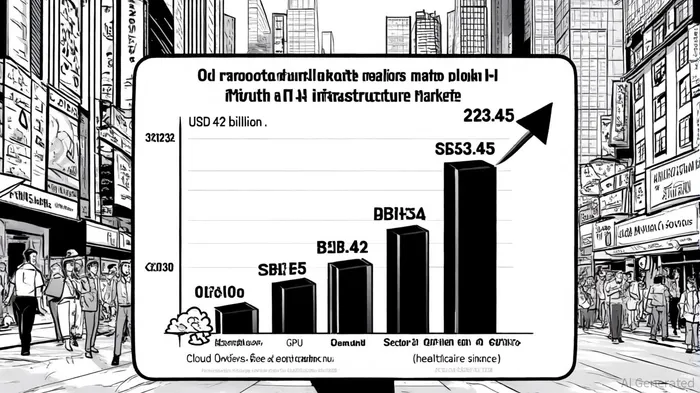
The AI infrastructure market is undergoing a seismic shift, driven by exponential demand for computational power and the urgent need for scalable solutions in enterprise sectors. According to a Grand View Research report, the global AI infrastructure market is projected to grow at a compound annual growth rate (CAGR) of 30.4% from 2023 to 2030, expanding from USD 35.42 billion to USD 223.45 billion. This surge is fueled by the proliferation of machine learning (ML) and deep learning applications, particularly in healthcare and finance, where AI is being deployed for drug discovery, fraud detection, and risk modeling. However, the path to long-term returns on investment (ROI) for AI-driven tech firms hinges on strategic capital allocation, infrastructure innovation, and alignment with sector-specific demands.
Capital Allocation: Hardware, Cloud, and Regional Dynamics
The lion's share of capital is flowing into hardware and server-based solutions, with embedded accelerators-particularly GPUs-forming the backbone of AI infrastructure. In the first half of 2024, global spending on AI infrastructure reached $47.4 billion, with servers accounting for 95% of this expenditure, according to an IDC report. This reflects a 105% year-over-year increase, underscoring the critical role of high-performance computing in training large AI models. Cloud and shared environments dominate server spending, representing 72% of the total, as hyperscalers like AWS, MicrosoftMSFT-- Azure, and GoogleGOOGL-- Cloud expand their AI-as-a-Service offerings; these dynamics are detailed in the IDC analysis.
Geographically, North America remains the dominant market, with the U.S. capturing 88.9% of the region's revenue in 2023, according to the Grand View Research report. However, the Asia-Pacific region is emerging as a high-growth frontier, driven by government initiatives in countries like South Korea, Japan, and China, as noted in a Precedence Research report. For instance, the U.S. alone is projected to grow its AI infrastructure market at a CAGR of 26.84% through 2034, while the PRC and APJ regions are closing the gap, according to a Yahoo Finance analysis. This regional diversification presents opportunities for investors to balance risk and reward by allocating capital to both mature and emerging markets.
ROI in Enterprise Sectors: Healthcare and Finance as Case Studies
The healthcare sector exemplifies the dual challenge of measuring AI's ROI: balancing tangible cost savings with intangible benefits like improved patient outcomes. AI-powered imaging tools have reduced radiologist reading time by 15% and boosted diagnostic accuracy by 10%, translating to annual savings of $1.2 million and additional revenue of $800,000 for one large health system, as reported by Grand View Research. Beyond financial metrics, healthcare organizations are increasingly adopting Quality-Adjusted Life Year (QALY) assessments and Patient-Reported Outcome Measures (PROMs) to quantify AI's impact on care quality, a trend the Grand View Research report also highlights.
However, ROI realization remains uneven. A McKinsey survey revealed that 75% of health system executives believe their organizations underinvest in AI and digital transformation, citing budget constraints and legacy system integration challenges; the Yahoo Finance analysis similarly flagged organizational barriers. Early adopters, such as Aidoc's aiOS™ platform, demonstrate that centralized AI governance and streamlined workflows can yield ROI over three to five years by reducing integration costs and enhancing operational efficiency, a pattern noted in the IDC work.
In finance, AI investments are similarly ROI-driven, with applications in clinical documentation optimization, revenue cycle management, and administrative automation. AI-powered solutions have reduced clinician burnout by minimizing documentation burdens, while payers leverage AI for claims processing and customer service, according to Healthcare Finance News. Yet, data privacy concerns and cultural resistance persist as barriers to scaling, a limitation also discussed by Precedence Research.
Emerging Trends and Strategic Priorities
The future of AI infrastructure is shaped by hybrid and multi-cloud strategies, which offer flexibility and cost optimization. A Nutanix survey found that 44% of Indian enterprises adopted hybrid cloud models in 2024, reflecting a global shift toward distributed architectures, as described in the Yahoo Finance analysis. Meanwhile, advancements in GPU-based accelerators-such as NVIDIA's Blackwell and AMD's AI chips-are redefining hardware capabilities, enabling 800 Gb/s network fabrics for large-scale model training, according to AI Infrastructure Market Statistics.
Governments are also playing a pivotal role. The European Union's EUR 1.5 billion Horizon Europe program and the U.S. CHIPS and Science Act are accelerating semiconductor innovation, directly influencing infrastructure dynamics, a point emphasized in the Yahoo Finance analysis. For investors, this underscores the importance of aligning capital with policy-driven opportunities.
Conclusion: Balancing Growth and Resilience
The AI infrastructure market's explosive growth presents a compelling case for strategic capital allocation. However, investors must navigate sector-specific challenges-such as healthcare's regulatory complexity and finance's data privacy demands-while prioritizing scalable, platform-based solutions. As AI tools mature and ROI metrics become more defined, enterprises that adopt agile, hybrid infrastructure models and leverage government-backed innovation will be best positioned to capture long-term value.







Comentarios
Aún no hay comentarios