
Strategic Capital Allocation in London's Prime Office Market: Navigating Recovery and ESG-Driven Demand
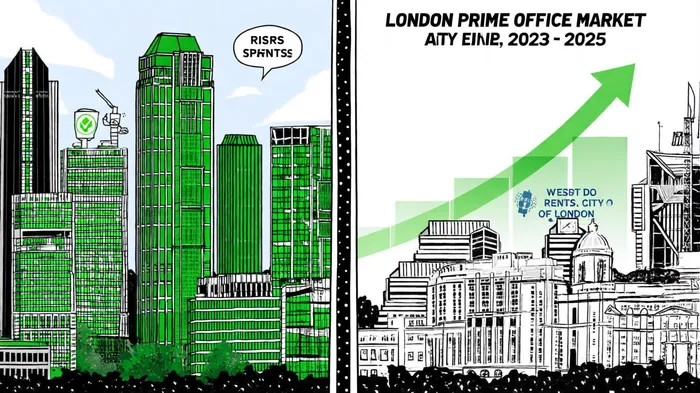
London's prime office market has entered a pivotal phase of recovery, marked by stark contrasts between asset quality, investor priorities, and occupier demands. As of early 2025, the market faces a 20-year high vacancy rate of 10.6%, driven by a surge in new supply—nearly 16.2 million sq ft of office space under construction[3]. Yet, this broad trend masks a critical segmentation: while lower-rated assets struggle with declining occupancy, premium 5-star buildings in the West End and City of London are experiencing robust demand, with vacancy rates in ultra-prime submarkets like Mayfair dropping to 2.15%[2]. This “flight to quality” underscores the importance of strategic capital allocation in a market where ESG compliance, technological integration, and sector-specific demand are reshaping investment paradigms.
Market Recovery Metrics: Vacancy Rates and Rental Growth
The post-pandemic shift to hybrid work models initially depressed demand for office space, but 2024–2025 has seen a reversal as businesses prioritize premium environments to attract talent. Prime rents in the West End reached £155–£160 per sq ft by late 2024, a 10% year-on-year increase, while the City of London recorded a record high of £122 per sq ft in November 2024[3]. This growth is concentrated in Grade A buildings, which now account for 64% of take-up in 2024, driven by their BREEAM “Excellent” or “Outstanding” sustainability ratings[3]. Meanwhile, lower-quality assets have lost over 10 million sq ft of occupancy since 2020, highlighting a market polarized by occupier preferences[3].
Capital Investment Trends and Global Investor Interest
Capital flows into London's prime office assets have shown resilience despite a subdued 2024. A 22% uptick in Q4 2024 saw £1.6 billion invested, with global investors—particularly American buyers—targeting trophy assets in the West End and City[3]. This trend is supported by stabilized yields: 4.1% in the West End and 5.25–5.5% in the City[3]. The influx of international capital reflects a broader shift in ownership profiles, as investors prioritize ESG-aligned properties with future-ready infrastructure[3].
Strategic Allocation: ESG Compliance and Technological Integration
The demand for ESG-compliant spaces is no longer a niche preference but a market imperative. By Q1 2025, 63% of transactions in Central London involved flexible office solutions, with 43% of institutional investors explicitly seeking sustainability credentials[2]. Premium buildings now feature energy-efficient systems, wellness facilities, and smart technologies to meet occupier expectations[2]. This is compounded by a supply crunch: only 5.91 million sq ft of Grade A office space is under construction post-2025, with over 60% already pre-let[2]. The scarcity of such assets has intensified competition, particularly in submarkets like St. James's, where vacancy rates remain near zero[2].
Sector-Specific Demand Drivers and Future Outlook
The tech and media sectors have emerged as key drivers of demand, accounting for 23% of take-up in Q1 2025[1]. These occupiers prioritize flexible, tech-integrated spaces to accommodate hybrid work models, a trend that now accounts for 63% of transactions[2]. Meanwhile, financial services firms in the City continue to anchor demand for premium assets, with prime rents rising 7.5% annually in 2024[3]. Looking ahead, the market's trajectory hinges on the interplay of limited supply and sector-specific growth. With global investors increasingly favoring ESG-compliant assets and occupiers demanding advanced infrastructure, prime office real estate in London is positioned to outperform broader commercial real estate markets.
For investors, the lesson is clear: capital allocated to premium, future-ready assets in high-demand submarkets will yield outsized returns in an era defined by sustainability, technology, and occupier-centric design.







Comentarios
Aún no hay comentarios