
Strategic Buy Opportunity Amid Regulatory Volatility and Strong Demand Drivers
The question of whether Nvidia's stock is oversold amid shifting U.S.-China export dynamics has taken center stage in financial markets. With technical indicators suggesting near-oversold conditions and regulatory developments in Beijing and Washington recalibrating the company's access to China's AI-driven datacenter market, investors are left weighing short-term volatility against long-term growth catalysts.
Technical Indicators Signal Potential Rebound
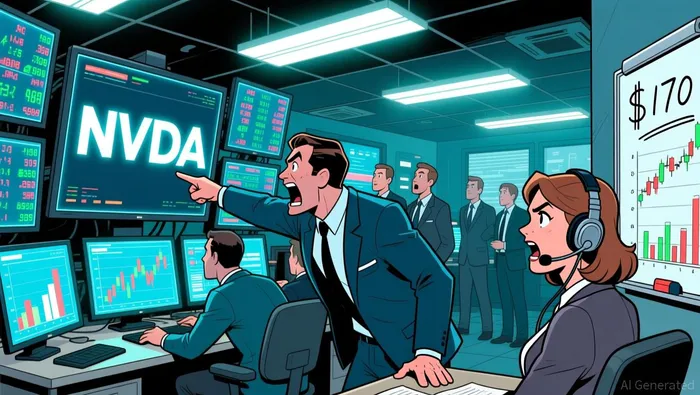
Nvidia's stock has recently broken below key moving averages, including the 15-day and 21-day exponential varieties, a bearish signal for short-term momentum. However, the Relative Strength Index (RSI) has dipped to 38 as of late December 2025, nearing traditional oversold territory (typically defined as below 30). This, combined with a critical support level at $170, suggests the stock may be poised for a rebound if buyers step in to defend that threshold according to technical analysis. Such technical conditions often attract contrarian investors, particularly when fundamentals remain intact.
Regulatory Volatility: A Double-Edged Sword
The U.S. government's late-December decision to lift the export ban on the H200 AI chip for China-albeit with a 25% revenue-sharing requirement-has introduced a layer of complexity according to market analysis. While this move excludes the more advanced Blackwell chips, it represents a partial thaw in restrictions that had previously barred the B30A, A800, and H800 models as reported by industry sources. For NvidiaNVDA--, this could translate into incremental revenue from a market that, despite regulatory hurdles, remains a critical long-term growth corridor.
Conversely, Chinese regulations mandating state-funded data centers to prioritize domestically sourced chips add a layer of uncertainty according to market observations. Yet analysts argue that these constraints may not significantly dent Nvidia's broader AI-driven demand. As one report notes, "The geopolitical risks are real, but they are increasingly seen as a fixed cost in a sector where AI infrastructure spending is accelerating globally" according to this analysis.
Demand Drivers Outweigh Near-Term Headwinds
Even under a worst-case scenario-zero China sales-analysts remain bullish on Nvidia's prospects. Wolfe Research, for instance, projects 2026 earnings of $8 per share, driven by robust AI adoption trends and the company's dominance in discrete GPU markets. Meanwhile, institutions like Bank of America and Citi highlight Nvidia's leadership in powering AI workloads, a sector expected to expand exponentially as enterprises and governments invest in next-generation computing according to market reports.
The recent 2.7% stock decline following concerns over DeepSeek's alleged use of restricted Blackwell chips underscores market jitters according to financial analysis. Yet Nvidia's denial of such claims, coupled with its technical strengths, suggests the selloff may have overcorrected. For strategic buyers, this volatility presents an opportunity to capitalize on a stock that remains fundamentally tied to the AI revolution.
Conclusion: Balancing Risk and Reward
Nvidia's current valuation reflects a delicate interplay of regulatory uncertainty and unrelenting demand for its AI infrastructure. While the RSI near 38 and broken moving averages signal short-term fragility, the stock's underlying momentum-backed by strong earnings projections and a partial easing of export restrictions-points to a potential inflection point. Investors with a medium-term horizon may find value in treating this as a strategic entry point, provided they hedge against geopolitical risks while leveraging the company's dominant position in a sector reshaping the global economy.





Comentarios
Aún no hay comentarios