
The Strategic Value of Brand Collaborations in Consumer Goods: A Deep Dive into Lenskart's Pop Mart Partnership
Strategic Rationale: Merging Utility with Playfulness
Lenskart's collaboration with Pop Mart is rooted in a clear strategic vision. The limited-edition "Lenskart × Sweet Bean Bitz Collection," launched in Singapore on December 4, 2025, combines Lenskart's design expertise with Pop Mart's intellectual property to create a product line that balances functionality with emotional appeal. The magnetically snappable charms, inspired by the "I Want a Hug" series, are compatible with Bitz-compatible frames, enabling customers to personalize their eyewear while engaging with a beloved cultural icon. This approach aligns with Lenskart's broader "House of Brands" strategy, which includes international acquisitions like Barcelona's Meller sunglasses brand, underscoring its ambition to diversify its portfolio and capture premium segments.
The partnership's focus on youth-centric design is particularly noteworthy. 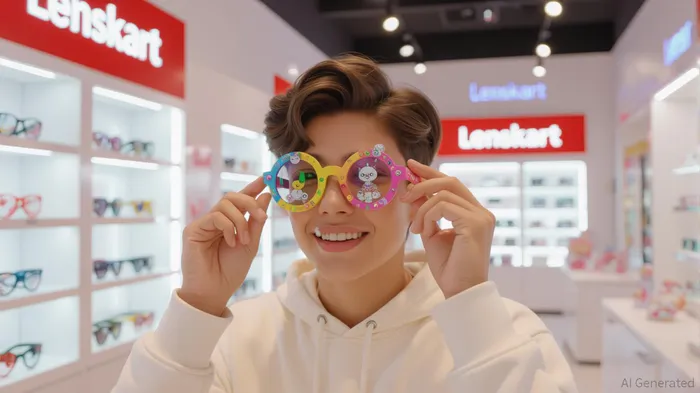 By leveraging Pop Mart's IP, Lenskart taps into a demographic that values self-expression and collectibility-traits traditionally associated with luxury retail rather than eyewear. This blurring of categories reflects a broader trend in consumer goods, where utility-driven products are repositioned as lifestyle accessories.
Market Reactions: A Tale of Two Valuations
The market's response to this collaboration has been mixed, reflecting both optimism and skepticism. Lenskart's IPO in late 2025, priced at ₹402 per share, was oversubscribed 28 times, yet the stock's early performance was volatile, plummeting to ₹356.10 before recovering to ₹404.55 on its first trading day. Analysts like Ambit Capital questioned the IPO's valuation, which implied a price-to-earnings multiple of over 230 times core earnings, warning of overvaluation. However, the company's post-IPO financials tell a different story. In FY2025, Lenskart reported operating revenue of ₹6,652.5 crore and a net profit of ₹297.3 crore-a stark turnaround from a net loss of ₹10 crore in FY2024. This growth, coupled with a 22.5% year-on-year revenue increase, suggests that the market may yet validate the company's strategic bets.
The Pop Mart collaboration appears to have contributed to this momentum. According to Lenskart's investor relations data, 63.7% of transactions fall in the ₹2,000–₹10,000 range, indicating a strong mid-ticket, value-conscious customer base. The integration of playful, collectible elements into eyewear could further elevate average order values, particularly among younger consumers. India Ratings' recent upgrade of Lenskart's credit rating also highlights the company's improving profitability and liquidity metrics.
Cross-Industry Valuation Opportunities
While direct sector-specific stock performance data for luxury retail and eyewear post-collaboration remains elusive, the partnership's implications for cross-industry valuation are evident. By aligning with Pop Mart, Lenskart has positioned itself as a bridge between mass-market eyewear and premium lifestyle branding. This dual identity could attract investors seeking exposure to both sectors, particularly as consumer preferences shift toward hybrid experiences.
The collaboration's emphasis on personalization and digital engagement further enhances its valuation potential. Lenskart's virtual try-ons and AI-driven recommendations, which already drive customer satisfaction, could be amplified through Pop Mart's IP-driven campaigns. Such innovations not only improve customer retention but also create data assets that are increasingly valuable in the digital age.
Conclusion: A Blueprint for Future Collaborations
Lenskart's partnership with Pop Mart exemplifies how strategic brand alliances can drive consumer equity and unlock cross-industry valuation opportunities. By merging the functional with the fantastical, the collaboration addresses a critical gap in the eyewear market: emotional resonance. While the stock's valuation remains a point of contention, the company's financial resilience and expanding global footprint suggest that its long-term prospects are robust. For investors, this case underscores the importance of evaluating brand collaborations not just as marketing exercises but as strategic tools for redefining market positioning and shareholder value.







Comentarios
Aún no hay comentarios