
U.S. Strategic Bitcoin Reserve: Implications of the DOJ's 57 BTC Sale on Institutional Adoption
The U.S. government's evolving approach to digital assets has reached a pivotal inflection point. With the establishment of the Strategic BitcoinBTC-- Reserve (SBR) under Executive Order (EO) 14233 and the controversial April 2025 sale of 57.55 BTCBTC-- by the Department of Justice (DOJ), the intersection of sovereign digital asset strategy and market signaling has never been more critical. This analysis unpacks the implications of these developments for institutional adoption, regulatory clarity, and the broader trajectory of Bitcoin as a strategic reserve asset.
The DOJ's 57 BTC Sale: A Flashpoint in Sovereign Digital Asset Management
In late April 2025, the DOJ's U.S. Marshals Service (USMS) liquidated 57.55 BTC-seized from Samourai Wallet developers-through Coinbase Prime, bypassing the multi-agency review process mandated by EO 14233. This executive order, signed by President Trump in March 2025, explicitly prohibits the sale of forfeited Bitcoin without Treasury authorization, directing such assets into the SBR to hedge against economic volatility and assert technological sovereignty. The DOJ's actions have sparked legal and political scrutiny, with critics arguing the sale undermines the strategic intent of the SBR and sets a dangerous precedent for government-held digital assets.
While the DOJ claims the sale was authorized via a court-approved Asset Liquidation Agreement with Samourai Wallet co-founders, blockchain analysis reveals the BTC was transferred to a custodial wallet without clear evidence of fiat conversion. This ambiguity highlights a critical gap in transparency and accountability-a recurring theme in the management of government-held crypto. For institutions, this incident underscores the risks of regulatory inconsistency and the need for robust governance frameworks to protect digital asset reserves.
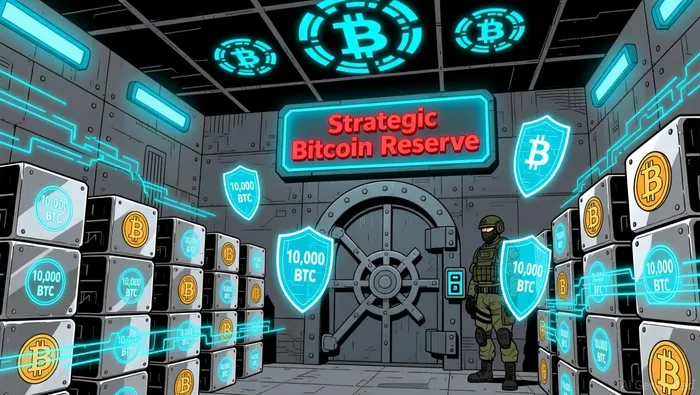
The Strategic Bitcoin Reserve: A New Era of Sovereign Digital Asset Strategy
EO 14233 represents a paradigm shift in U.S. digital asset policy. By institutionalizing the SBR and a separate U.S. Digital Asset Stockpile, the government is positioning Bitcoin as a strategic reserve asset alongside gold and foreign currencies. The SBR is capitalized with forfeited BTC and is intended to serve as a long-term store of value, leveraging Bitcoin's fixed supply and unbreached security features. This move aligns with broader efforts to reduce regulatory uncertainty for digital asset businesses, as outlined in EO 14178, which tasks the Treasury and DOJ with fostering innovation while combating criminal misuse.
The SBR's potential scale is staggering. With the DOJ already holding over 100,000 BTC from high-profile seizures (e.g., Bitfinex hack, Silk Road), the U.S. could amass a reserve rivaling the largest sovereign wealth funds. Such a position would not only diversify the U.S. balance sheet but also signal to global markets that Bitcoin is a legitimate, non-correlated asset class. For institutions, this signals a green light to treat Bitcoin as a strategic reserve, accelerating adoption in portfolios and hedging strategies.
Market Signaling and the Path to Institutional Adoption
The DOJ's enforcement shift-detailed in Deputy Attorney General Todd Blanche's April 2025 memo-further reinforces this narrative. By ceasing prosecutions of crypto exchanges and focusing on criminal actors (e.g., ransomware operators, drug traffickers), the DOJ is reducing regulatory overhang and fostering a pro-innovation environment. This aligns with the Trump administration's broader goal of positioning the U.S. as a global leader in digital asset innovation.
However, the 57 BTC sale has introduced noise into this narrative. Critics argue it erodes trust in the SBR's integrity, while proponents view it as a temporary misstep in an otherwise coherent strategy. For institutions, the key takeaway is the importance of clarity in sovereign asset management. A well-governed SBR would send a powerful signal: that Bitcoin is a strategic asset, not a speculative commodity. This could catalyze institutional inflows, mirroring the 2021 surge in ETF demand and the 2024 institutional buying spree.
The Road Ahead: Governance, Transparency, and Global Competition
The U.S. is not alone in exploring sovereign digital asset strategies. Nations like El Salvador, Nigeria, and the UAE have already integrated Bitcoin into their financial systems, while China's CBDC ambitions highlight the global race for digital asset dominance. For the U.S. to maintain its edge, the SBR must be managed with the same rigor as traditional reserves. This includes transparent reporting, multi-agency oversight, and alignment with international standards (e.g., IMF guidelines).
The DOJ's 57 BTC sale, while controversial, has exposed vulnerabilities in current governance frameworks. Moving forward, the Treasury and DOJ must prioritize accountability-perhaps through a public dashboard tracking SBR holdings and disposition decisions. Such transparency would not only restore trust but also provide institutions with the confidence to allocate capital to Bitcoin as a strategic reserve.
Conclusion: A Strategic Asset, Not a Speculative Commodity
The U.S. Strategic Bitcoin Reserve represents a tectonic shift in how governments-and by extension, institutions-view digital assets. While the DOJ's recent sale has raised valid concerns, the broader policy direction is clear: Bitcoin is being integrated into the sovereign financial architecture. For investors, this signals a new era of legitimacy and adoption. Institutions that align with this trajectory-by treating Bitcoin as a strategic reserve asset-will be well-positioned to capitalize on the next phase of the digital asset revolution.
The question is no longer if Bitcoin will be part of the global financial system, but how quickly institutions will embrace it. The U.S. government's actions, for better or worse, are accelerating that timeline.






Comentarios
Aún no hay comentarios