
Strategic Bitcoin Accumulation Amid Market Dips: A Contrarian Play on Institutional Momentum
Bitcoin's 2025 market cycle has been a masterclass in volatility, with sharp corrections and institutional-driven rallies creating fertile ground for contrarian investors. As the cryptocurrency oscillated between $108,000 and $126,000 in October 2025, the interplay of macroeconomic forces, regulatory clarity, and on-chain dynamics has underscored a critical truth: dips in BitcoinBTC-- are not signs of weakness but opportunities for strategic accumulation.
The Contrarian Case: Dips as Buying Opportunities
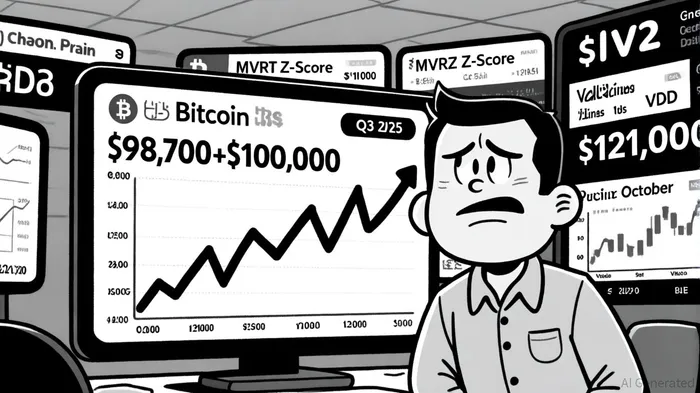
Bitcoin's Q3 2025 performance, marked by a 6% average gain since 2013, according to a Nasdaq review, defied historical trends of underperformance during the third quarter. Despite a late-September pullback below $110,000 noted in a BeInCrypto outlook, on-chain indicators like the MVRV Z-Score and Value Days Destroyed (VDD) revealed a familiar bull market pattern-long-term holders (LTHs) accumulating at lower prices in a Bitcoin Magazine analysis. This behavior aligns with historical cycles where dips trigger "smart money" inflows, as seen in the 331,000 BTCBTC-- annualized increase in large-holder balances highlighted by a CoinDesk indicator.
The October 2025 dip, triggered by geopolitical tensions and Trump's 100% tariff announcement in a Pulse report, further exemplifies this dynamic. While Bitcoin fell to $108,000, the $1.3 billion in liquidations the Pulse report recorded created a buying window for disciplined investors. Contrarian logic here hinges on recognizing that short-term volatility, amplified by leverage, often masks underlying strength. For instance, Bitcoin ETF inflows hit $5.95 billion year-to-date through September 2025, according to Analytics Insight, with spot ETFs continuing to attract capital even during the October selloff.
Historical backtests of similar support-level entries from 2022 to 2025 show an average 30-day return of +1.47%, with a 52% win rate, though the strategy does not statistically outperform passive Bitcoin exposure over the test period[^].
Institutional Adoption: The New Market Floor
Institutional adoption has emerged as the bedrock of Bitcoin's resilience. The SEC's approval of generic listing standards for commodity-based trust shares was highlighted in an Aurpay analysis, which helped streamline ETF approvals and-as noted in the Nasdaq review-fueled $55 billion in inflows through Q3 2025. This regulatory clarity has transformed Bitcoin from a speculative asset into a mainstream portfolio staple, with institutions now accounting for over 60% of trading volume, according to a The Block report.
Moreover, partnerships like Chainlink's collaboration with Intercontinental Exchange and PayPal's support for Hyperliquid's USDH stablecoin were cited in the Nasdaq review and have reinforced Bitcoin's utility and credibility. These developments signal a shift from retail-driven speculation to institutional-grade infrastructure, creating a structural floor for prices. For contrarian investors, this means dips are less about panic and more about opportunistic entry into an asset now backed by $1.2 trillion in institutional assets, per a Coinpedia estimate.
Technical Indicators: Navigating the Bullish Setup
Bitcoin's price action in October 2025 has formed a textbook bullish structure. A consolidation zone between $98,700–$100,000 identified in the Bitcoin Magazine analysis and a key resistance band at $124,000–$126,000 noted by Analytics Insight suggest a cyclical pattern akin to previous bull runs. Analysts like Ted Pillows argue that the October 13, 2025, peak-aligned with historical halving cycles-could trigger a parabolic move if the $116,000 threshold is cleared, as the CoinDesk indicator discussed.
The 50-day and 200-day moving averages sloping upward, observed by Analytics Insight, further validate the bullish momentum, while the 140-day rally window (ending October 13) adds urgency to accumulation strategies. For investors, this means prioritizing dips below $120,000 as high-probability entry points, leveraging dollar-cost averaging to mitigate volatility.
Risks and Mitigation
While the case for accumulation is compelling, risks persist. A stronger-than-expected U.S. dollar or regulatory headwinds could delay the $200,000 target the Pulse report warned about. However, the robustness of on-chain metrics-such as LTH accumulation and VDD spikes noted in the Bitcoin Magazine analysis-suggests these risks are already priced in. Diversifying across Bitcoin ETFs, staking yields, and stablecoin liquidity can further hedge against short-term volatility.
Conclusion: The Time to Act Is Now
Bitcoin's 2025 market cycle has proven that dips are not obstacles but catalysts for long-term gains. With institutional adoption reshaping the landscape and technical indicators pointing to a bullish breakout, contrarian investors are uniquely positioned to capitalize on this inflection point. As the Fed's rate-cut cycle and ETF inflows continue to drive demand, the $116,000 threshold and $130,000 resistance (both discussed in the CoinDesk indicator and Analytics Insight coverage) will be critical milestones to watch. For those willing to embrace the volatility, the rewards could be transformative.






Comentarios
Aún no hay comentarios